Bureau of Port Security (BoPS)
Context: The Union Government has approved the establishment of a statutory Bureau of Port Security to strengthen India’s maritime security architecture.
About Bureau of Port Security (BoPS)
- BoPS is a newly constituted statutory body, modelled on the Bureau of Civil Aviation Security, to regulate and coordinate port security in India.
- Nodal Ministry: The BoPS functions under the Ministry of Ports, Shipping and Waterways (MoPSW).
- Objective: To create a robust, risk-based, and future-ready port security framework ensuring compliance with international maritime security standards.
- Structure of BoPS
-
- The BoPS is established under Section 13 of the Merchant Shipping Act, 2025, giving it statutory authority.
- It will be headed by a Director General of IPS rank to ensure strong regulatory enforcement.
- During the initial one-year transition period, the Director General (DG) of Shipping will hold additional charge as DG for BoPS.
Role of Bureau of Port Security
- Regulatory Functions: Including mandatory security assessments, audits, and approval of port security plans.
- Custodian of Security Information: It will manage the collection, analysis, and exchange of security-related information, with special focus on cybersecurity and protection of port’s IT infrastructure.
- Security Training: It will oversee the training, certification, and regulation of Private Security Agencies.
- Central Industrial Security Force (CISF) is designated as a Recognised Security Organisation for port facilities.
Significance
- The creation of BoPS institutionalises port security governance, enhances protection of critical maritime infrastructure, and strengthens India’s overall maritime and trade security framework.
WHO South-East Asia Regional Office
Context: Prime Minister Narendra Modi and the WHO Director-General inaugurated the new WHO South-East Asia Regional Office complex in New Delhi during the second WHO Global Summit on Traditional Medicine
- A WHO technical report on training in Yoga and the book “From Roots to Global Reach: 11 Years of Transformation in Ayush” were also released.
About WHO South-East Asia Regional Office
- The WHO South-East Asia Regional Office in New Delhi serves as the regional headquarters coordinating public health initiatives across South-East Asian countries.
- Objective: To strengthen regional health cooperation and support equitable, evidence-based, and sustainable health systems.
- Significance
- The new complex also houses the WHO India Country Office, deepening India’s institutional partnership with the World Health Organisation.
- The facility enhances India’s role as a hub for regional and global health diplomacy, policy coordination, and capacity building.
Community-Based Disaster Risk Reduction
Context: The Union Government has approved a nationwide project to strengthen community-based disaster risk reduction through model Gram Panchayats.
About the National Project for Strengthening Community-Based Disaster Risk Reduction
- The National Project for Strengthening Community-Based Disaster Risk Reduction Initiatives aims to embed disaster resilience within Panchayati Raj Institutions at the grassroots level.
- Objective: To integrate disaster risk reduction into local governance through a bottom-up, community-driven approach.
- Nodal Bodies: Ministry of Panchayati Raj (MoPR) and National Disaster Management Authority (NDMA)
Budget Outlay: ₹507.37 crore.
- Key Components
-
- Development of cluster-based Model Gram Panchayats in 20 States to demonstrate long-term, hazard-specific disaster mitigation strategies.
- Institutional strengthening and policy integration of disaster risk reduction into Panchayat planning, including Gram Panchayat Development Plans (GPDPs).
- Capacity building and awareness generation for State Disaster Management Authorities (SDMAs), District Disaster Management Authorities (DDMAs), elected representatives, Panchayat functionaries, and community volunteers.
- Use of digital platforms such as eGramSwaraj and Gram Manchitra for disaster planning, expenditure tracking, and real-time information dissemination.
Significance
- The project addresses multi-hazard disaster risks by creating replicable and scalable models of disaster-resilient Gram Panchayats.
- It aligns with the Sendai Framework for Disaster Risk Reduction (2015–2030) by prioritising prevention, preparedness, and local-level resilience.
- It strengthens grassroots governance and community ownership, safeguarding rural lives, livelihoods, and infrastructure against disasters.
Bharat Taxi
Context: The Government has launched Bharat Taxi, India’s first cooperative, driver-owned ride-hailing service, starting operations in Delhi from January 1.
About Bharat Taxi
- Bharat Taxi is a cooperative-based mobility platform designed as an alternative to app-based cab aggregators, prioritising drivers and passengers.
- Objective: To provide affordable, transparent, and fair ride-hailing services while improving driver earnings and working conditions.
- Nodal Body: The service is managed by Sahakar Taxi Cooperative Limited, under the broader vision of the Ministry of Cooperation.
- Working Model: Bharat Taxi operates on a zero-commission, driver-owned cooperative model, where drivers collectively own, govern, and benefit from the platform.
- Driver-Centric Provisions: Drivers receive up to 80 per cent of the fare directly, improving income stability.
- Payments are managed through a monthly credit system, ensuring transparency and financial security.
Key Features
- Transparent and predictable fares, aimed at avoiding surge pricing and excessive peak-hour charges.
- Multi-modal options, including cars, auto-rickshaws, and two-wheelers through a single mobile application.
- Digital accessibility, with a multilingual app available on Android and iOS, enabling easy booking and real-time vehicle tracking.
- Safety-first design, featuring verified driver onboarding, integration with Delhi Police, and ride-sharing options with trusted contacts.
Significance
- Bharat Taxi strengthens cooperative entrepreneurship, ensures fair mobility services, and promotes inclusive, people-centric urban transport solutions.
India’s 1st Deep Brain Stimulation Workshop For Parkinsons
Context: Recently, the All India Institute of Medical Sciences (AIIMS), New Delhi, hosted India’s first advanced workshop on Deep Brain Stimulation (DBS).
- This landmark event focused on building national capacity to manage Parkinson’s disease and other movement disorders using cutting-edge device-assisted therapies.
About Deep-Brain Stimulation (DBS)
- Refers: A neurosurgical procedure where electrodes are implanted into specific brain regions to deliver targeted electrical impulses.
- Mechanism: Electrodes are connected to a pacemaker-like device (Implantable Pulse Generator) placed under the skin of the chest.
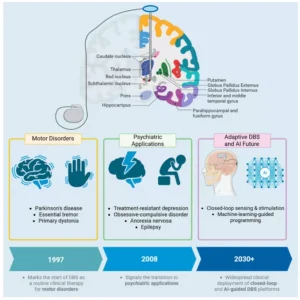 It works by modulating abnormal neural circuits and correcting neurochemical imbalances that cause motor and psychiatric symptoms.
- Applications: Primarily used for Parkinson’s, Essential Tremor, and Dystonia.
- It is also FDA-approved for Obsessive-Compulsive Disorder (OCD).
- 2025 Milestone: In February 2025, the FDA approved Adaptive DBS (aDBS). Unlike traditional systems, this closed-loop system automatically adjusts stimulation in real-time based on the patient’s own brain signals (e.g., Medtronic’s BrainSense technology).
- Key Advantages: Reversible, non-destructive, and highly flexible through wireless programming.
- Limitations: It remains an invasive procedure with surgical risks and high costs; it is a symptom-management tool rather than a cure.
About Parkinson’s Disease
First described as “Shaking Palsy” by James Parkinson in 1817, this is a chronic, progressive neurodegenerative disorder that primarily affects movement, due to the gradual loss of dopamine-producing neurons in a specific area of the brain called the substantia nigra.
- Pathology: It results from the degeneration of dopamine-producing neurons in the substantia nigra.
- Dopamine is the neurotransmitter vital for smooth, coordinated muscle movement.
- Causes: Factors include genetic mutations, aging, and environmental toxins (pesticides, heavy metals).
- Demographics: Men are more frequently affected than women.
- Symptom Management: Initially treated with drugs (Levodopa), but DBS becomes critical when medications lead to “motor fluctuations” or narrowed therapeutic windows.
 20 Dec 2025