Recently, findings from the Ministry of Statistics and Programme Implementation (MoSPI)’s Annual Survey of Unincorporated Sector Enterprises (ASUSE) 2025 highlight whether India’s unincorporated sector reflects structural transformation or persistent informality.
UPSC Online Courses
Key Findings of the Annual Survey of Unincorporated Sector Enterprises (ASUSE) 2025
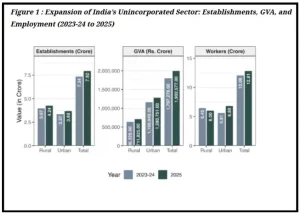
- Expanding Scale of the Informal Sector: The unincorporated non-agricultural sector now comprises 7.92 crore establishments, registering an ~8% increase since 2023–24, which reflects the continuous entry, survival, and proliferation of small economic units, even in the absence of structural transformation.
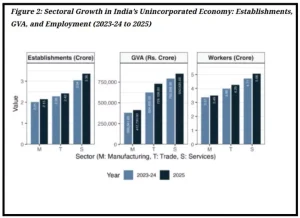
 Sectoral Composition Remains Largely Unchanged: The distribution of establishments continues to remain broadly similar, with ~27% in manufacturing, ~31% in trade, and ~42% in services, indicating persistence of the existing structure rather than a decisive shift towards manufacturing-led transformation.
- Largest Employment Generator: The sector supports 12.81 crore workers, marking a 6.18% growth in employment, reaffirming its role as the primary absorber of surplus labour, particularly for those excluded from the formal job market.
- Persistence of Informal and Vulnerable Employment: Employment remains heavily skewed towards self-employment (~62%), with only ~24% hired workers, indicating that job creation is largely informal, insecure, and driven by necessity rather than opportunity.
- Nature of Employment Growth Remains Distress-Driven: Although employment has increased, it continues to be dominated by self-employment and family labour, rather than regular wage-based jobs, showing that employment generation remains necessity-driven rather than reflecting formal labour market deepening.
- Output Growth Driven by Trade and Services: The sector recorded a 10.9% increase in Gross Value Added (GVA), with trade and services contributing nearly 80%, suggesting a shift towards low-value, demand-driven activities rather than productivity-enhancing manufacturing growth.
 Modest Productivity with Emerging Slowdown: Per-worker GVA grew by ~4.5%, declining from 5.6% earlier, highlighting a slowdown in productivity gains, which points to limited technological adoption, low capital intensity, and stagnant efficiency levels.
- Weak Wage Growth and Income Transmission: Despite rising output, wages increased by only ~3.88%, indicating that gains from economic growth are not adequately transmitted to workers, reflecting low bargaining power and surplus labour conditions.
- Marginal Rise but Persistent Gender Constraints: The share of women-owned enterprises increased modestly to 27%, but they remain concentrated in low-value, home-based activities, due to structural barriers such as limited access to credit, assets, mobility, and market linkages.
Nature of Growth- Expansion without Structural Transformation
- The growth of the unincorporated sector reflects an increase in scale rather than structural transformation, as the rise in establishments and employment is not accompanied by commensurate improvements in productivity, formalisation, or job quality.
- This indicates a pattern of survival-driven expansion, where enterprises continue to proliferate without transitioning into higher value-added or formal economic activities.
About Annual Survey of Unincorporated Sector Enterprises (ASUSE)
- Official Survey of Informal Sector: The ASUSE is a nationwide sample survey conducted by the National Statistical Office under the Ministry of Statistics and Programme Implementation.
- Covers Non-Agricultural Informal Economy: It captures data on unincorporated enterprises in manufacturing, trade, and services, excluding agriculture and corporate/registered firms.
- Measures Scale and Structure: Provides estimates on number of establishments, employment, and ownership patterns, helping assess the size and composition of the informal sector.
- Tracks Output and Productivity: Collects data on Gross Value Added (GVA), receipts, and productivity, enabling analysis of economic performance and efficiency.
- Assesses Employment Quality: Generates insights into nature of employment (self-employed vs hired workers), wages, and working conditions in the informal sector.
- Supports Policy Formulation: Acts as a key database for designing policies related to MSMEs, labour welfare, financial inclusion, and formalisation of the economy.
|
Understanding the Workforce
- Concept of Workforce: The workforce refers to the economically active population, including individuals who are employed or actively seeking employment.
- It reflects not just the availability of labour, but also the quality, nature, and conditions of employment in an economy.
- Composition of Workforce: In developing economies like India, the workforce is characterised by a dualistic structure, consisting of:
- A small, regulated formal sector, and
- A large, unregulated informal sector, which dominates employment.
- This duality is central to understanding issues of productivity, income inequality, and social security gaps.
UPSC Online Coaching
About Formal Workforce
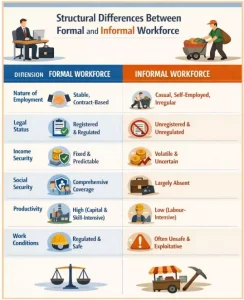
- Definition: The formal workforce comprises workers engaged in registered enterprises or institutions that operate under legal and regulatory frameworks, ensuring compliance with labour laws and taxation systems.
- Key Characteristics:
- Employment Security and Legal Protection: Workers typically have written contracts, defined roles, and protection against arbitrary dismissal.
- Regular and Predictable Income: Wages are fixed, timely, and often indexed, providing economic stability.
- Social Security Coverage: Access to provident fund, pensions, health insurance, gratuity, and paid leave, ensuring long-term welfare.
- Higher Productivity and Skill Levels: Formal employment is associated with better technology, training, and capital intensity, leading to higher efficiency.
- Institutional Integration: Workers are part of organised supply chains and financial systems, enabling upward mobility.
- Data and Trends:
- Limited Employment Share: The formal workforce accounts for only about 7–10% of total employment, highlighting its restricted labour absorption capacity.
- High Output Contribution: Despite its small size, the formal sector contributes a disproportionately large share to GDP, reflecting higher productivity and efficiency.
- Gradual Formalisation: Payroll data (EPFO enrolments) indicate incremental formal job creation, though the pace remains slow and uneven.
- Rising Contractualisation: Increasing reliance on contractual and gig employment is blurring the boundary between formal and informal work
About Informal Workforce
- Definition: The informal workforce includes workers engaged in unregistered, unregulated, and often small-scale economic activities, lacking formal recognition and institutional safeguards.
- Key Characteristics:
- Absence of Job Security: Employment is often casual, seasonal, or self-driven, with high vulnerability to job loss.
- Irregular and Low Earnings: Income is unstable and often below subsistence levels, with no wage protection mechanisms.
- Lack of Social Protection: Workers remain excluded from pensions, insurance, maternity benefits, and workplace safety norms.
- Dominance of Self-Employment: A large proportion are own-account workers or family labour, reflecting distress-driven employment.
- Low Productivity and Capital Constraints: Operations are characterised by limited access to credit, technology, and markets, leading to stagnant productivity.
- Data and Trends:
- Dominant Employment Share: The informal workforce constitutes around 80–90% of total employment, making it the primary source of livelihoods.
- Massive Enterprise Base: As per ASUSE 2025, the sector comprises 7.92 crore establishments, reflecting scale and fragmentation.
- Largest Employment Provider: The sector employs 12.81 crore workers, highlighting its role as a labour absorber.
- Self-Employment Dominance: Around 62% of workers are self-employed, indicating necessity-driven employment patterns.
- Low Productivity Levels: Per worker GVA is about ₹1.56 lakh (~4.5% growth), reflecting stagnant efficiency and limited technological progress.
- Weak Wage Growth: Wage growth remains subdued (~3.88%), indicating poor income transmission.
- Gendered Informality: Women-owned enterprises account for ~27%, but remain concentrated in low-value activities, reflecting structural constraints.
Demand-Driven vs Productivity-Led Growth:
- The growth trajectory of the informal sector appears increasingly consumption-driven, centred around local trade and services that respond to immediate demand conditions.
- This differs from a productivity-led growth path, which would require capital deepening, technological upgrading, and stronger integration with formal production systems.
|
Interlinkages Between Formal and Informal Workforce
The formal and informal sectors are deeply interconnected rather than isolated:
- Labour Buffer Function: Informal sector absorbs surplus labour not accommodated in formal employment.
- Cost Efficiency for Formal Sector: Firms often rely on informal workers through outsourcing, contract labour, and supply chains.
- Demand Linkages: Informal workers sustain local consumption demand, which in turn supports formal production.
- This creates a symbiotic but unequal relationship, where risks are transferred to informal workers.
Click to Know UPSC Offline Courses
Importance of the Informal Sector
- Backbone of Employment Generation: The informal sector serves as the primary source of employment in India, engaging nearly 85–90% of the workforce.
- According to ASUSE 2025, the unincorporated sector employs 12.81 crore workers, highlighting its role as the largest absorber of surplus labour, especially for low-skilled and migrant workers.
- Significant Contribution to the Economy: Despite low productivity, the informal sector makes a substantial contribution to output, employment, and local economic circulation, making it a critical pillar of economic activity.
- Clusters such as Moradabad brassware and Tiruppur garments demonstrate how informal enterprises support production, exports, and local industries.
- Safety Net for Vulnerable Populations: The sector functions as a livelihood safety net for migrants, women, and marginalised groups, who lack access to formal employment.
- During crises such as the COVID-19 pandemic, informal work acted as a fallback employment mechanism, absorbing returning migrant labour.
- Promotion of Micro-Entrepreneurship: The informal sector promotes self-employment and grassroots entrepreneurship due to its low entry barriers and minimal capital requirements.
- Activities such as kirana stores, street vending, and home-based enterprises enable livelihood diversification.
- Support to Local Demand and Economic Circulation: Informal enterprises sustain local demand and consumption cycles, particularly in rural and semi-urban areas.
- They provide last-mile delivery of goods and services, strengthening the grassroots economy.
- Shock Absorber During Economic Distress: The sector acts as an economic shock absorber, providing flexible employment opportunities during downturns.
- Workers often shift to informal activities such as gig work, delivery services, and petty trade during periods of economic stress.
- Flexibility–Constraint Duality of Informality: The informal sector provides low-entry livelihood opportunities, adaptability, and economic flexibility, especially during downturns and employment crises.
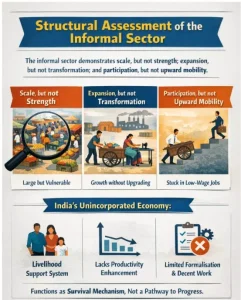 At the same time, this very informality results in limited growth potential, weak social protection, and exclusion from formal support systems, making it both an economic cushion and a structural constraint.
Challenges of the Informal Sector
- Persistent Informality and Structural Stagnation: A fundamental challenge is the continued dominance of informality, with over 90% of workers outside formal employment arrangements, reflecting limited structural transformation and the inability of the formal sector to generate adequate jobs.
- Low Productivity and the “Missing Middle” Trap: The sector suffers from low productivity levels (₹1.56 lakh per worker GVA, ASUSE 2025) due to limited access to capital, technology, and skills.
- The dominance of “dwarf enterprises” and absence of mid-sized firms (“missing middle”) prevents economies of scale and traps the sector in low-value, low-growth cycles.
- Poor Quality and Precarious Nature of Employment: Employment is largely informal, insecure, and irregular, with absence of written contracts, job security, and safe working conditions, leading to precarious livelihoods, especially among daily wage and construction workers.
- Lack of Social Security and Welfare Protection: A vast majority of workers lack access to pensions, insurance, healthcare, and paid leave, making them highly vulnerable to income and health shocks, as evident during the COVID-19 crisis.
- Income Insecurity and Weak Transmission of Growth Gains: Wages remain low and volatile, with ASUSE 2025 showing only ~3.88% wage growth, lower than output growth. This indicates weak bargaining power of labour, where economic gains are concentrated at the enterprise level rather than reaching workers.
- Limited Access to Credit, Markets and Scalability: Informal enterprises face barriers in accessing institutional finance due to lack of collateral and formal records, forcing reliance on informal credit. Additionally, fragmented ownership structures (proprietary units) restrict scalability, competitiveness, and long-term expansion.
- Gender-Based Constraints and Unequal Opportunities: Women face structural barriers such as limited access to assets, credit, and markets.
- Although ~27% enterprises are women-owned (ASUSE 2025), they remain concentrated in low-value, home-based activities, limiting economic mobility.
- High Vulnerability to Domestic and Global Shocks: The sector is highly sensitive to inflation, fuel price increases, and global disruptions.
- With trade and services contributing ~80% of GVA, rising energy and logistics costs directly erode margins. Additionally, global shocks (e.g., oil price spikes, remittance fluctuations) are transmitted quickly, making informal livelihoods highly fragile.
Global Actions & Initiatives for the Informal Sector
- International Labour Standards & Decent Work Agenda: The International Labour Organization (ILO) promotes the Decent Work Agenda, focusing on formalisation, social security, and labour rights. Instruments like Recommendation 204 (Transition from Informal to Formal Economy) guide countries in policy design.
- Universal Social Protection Frameworks: Global efforts led by the World Bank and International Labour Organization promote universal social protection systems, including cash transfers, health coverage, and pensions for informal workers.
- Sustainable Development Goals (SDGs): The United Nations under SDG 8 (Decent Work and Economic Growth) emphasises productive employment, formalisation, and protection of labour rights, especially for informal workers.
- Financial Inclusion Initiatives: Global programmes such as the Global Partnership for Financial Inclusion (GPFI) promote digital payments, microfinance, and access to credit for small and informal enterprises.
- Support for Micro, Small and Medium Enterprises (MSMEs): Institutions like the International Finance Corporation (IFC) and UNDP support capacity building, access to finance, and market integration of informal enterprises globally.
- Digitalisation and Formalisation Efforts: Countries are increasingly adopting digital ID systems, e-payments, and e-governance platforms to bring informal workers into the formal economy. For example, Brazil’s Cadastro Único and Kenya’s mobile money ecosystem (M-Pesa) have improved financial inclusion and welfare delivery.
- Gender-Focused Interventions: Global initiatives led by UN Women focus on empowering women in the informal sector through access to finance, skills, and social protection, recognising the feminisation of informal labour.
Click to Know UPSC OnlyIAS Coaching Centres
Initiatives Taken by India for the Informal Sector
- Digital Identity & Social Security Architecture: The e-Shram Portal has registered over 31.48 crore unorganised workers, creating a national database for targeted welfare delivery.
- The Universal Account Number (UAN) ensures portability of benefits, especially for migrant workers.
- The One-Stop-Solution (2024) integrates 14+ schemes, while the mobile app (2025) enables real-time access.
- Reflects a shift towards portable, technology-driven social protection.
- Financial Inclusion & Credit Support: PM Street Vendor’s AtmaNirbhar Nidhi (PM SVANidhi) provides a credit ladder (₹15k–₹50k) and UPI-linked credit cards, extended till 2030.
- PM Vishwakarma supports artisans through toolkits, training, and concessional loans (up to ₹3 lakh).
- MUDRA and JAM Trinity enable collateral-free credit and financial inclusion.
- Targets the “missing middle” and reduces reliance on informal credit markets.
- Formalisation & Market Integration: Udyam Registration simplifies MSME onboarding into formal systems.
- Goods and Services Tax (GST) incentivises formalisation through tax systems.
- Government e-Marketplace (GeM) provides market access and public procurement opportunities.
- Aims at integrating informal enterprises into formal value chains.
- Labour Reforms & Legal Protection: The Code on Social Security 2020 recognises gig and platform workers and enables social security coverage.
- Establishment of a Social Security Fund for informal workers.
- Introduction of a statutory floor wage under the Code on Wages.
- Moves towards universalising labour rights and protections.
- Social Security, Pension & Insurance Coverage: Pradhan Mantri Shram Yogi Maandhan (PM-SYM) ensures ₹3,000/month pension with government contribution.
- Pradhan Mantri Jeevan Jyoti Bima Yojana (PMJJBY) provides affordable life insurance.
- Strengthens long-term income security and risk protection.
- Livelihood Promotion, Skills & Women Empowerment: Mahatma Gandhi National Rural Employment Guarantee Act (MGNREGA) and National Urban Livelihoods Mission (NULM) provide employment and self-employment opportunities.
- Pradhan Mantri Kaushal Vikas Yojana (PMKVY) enhances skills and productivity.
- Lakhpati Didi and Drone Didi initiatives promote women-led entrepreneurship and tech-based livelihoods.
- Focuses on income enhancement, productivity, and inclusive growth.
- Digital Footprint and “Shadow Formalization”: Beyond traditional registration, the UPI and Digital India revolution have created a “shadow formalization.”
- By 2026, millions of unincorporated units have a verifiable digital transaction trail.
- This data-rich ecosystem is being leveraged through the Account Aggregator (AA) framework to move the sector toward cash-flow-based lending, reducing the historical reliance on physical collateral (like land or gold) which most informal workers lack.
|
Way Forward
- From Enumeration to Enterprise Strengthening: Policy must shift from merely counting enterprises to strengthening them by enhancing productivity, competitiveness, credit access, and market integration, moving beyond welfare to capability-building and enterprise development.
- Incentive-Driven and Choice-Based Formalisation: Formalisation should transition from “informality by compulsion” to “formality by choice” through incentive-compatible mechanisms such as simplified compliance, benefits via Udyam Registration, preferential procurement, and plug-and-play infrastructure.
- Universal, Portable and Sustainable Social Security: Strengthen comprehensive social protection systems using the e-Shram Portal, ensuring portability for migrant workers, while operationalising a Social Security Fund (under Code on Social Security 2020) through innovative financing such as a social security cess on digital platforms.
- Expanding Access to Affordable Credit: Improve institutional credit flow through schemes like Pradhan Mantri MUDRA Yojana, supported by credit guarantees, fintech solutions, and digital credit histories, to reduce reliance on informal lending channels.
- Productivity-Led Growth and Skilling: Break the low-productivity trap by promoting skill development, digitalisation, and technology adoption through initiatives like Pradhan Mantri Kaushal Vikas Yojana, along with cluster-based industrial ecosystems.
- Integration with Formal Value Chains and Markets: Enhance market access and scalability by linking informal enterprises with formal supply chains, leveraging platforms like Government e-Marketplace and promoting cluster-based development models.
- Ensuring Decent Work and Urban Employment Security: Improve quality of employment through fair wages, job security, and safe working conditions, alongside exploring an Urban Employment Guarantee Scheme (on the lines of Mahatma Gandhi National Rural Employment Guarantee Act) to provide a wage floor for urban informal workers.
- Gender-Inclusive and Shock-Resilient Framework: Promote women’s economic empowerment through targeted credit, skilling, and asset access, while building resilience to shocks (inflation, fuel costs, demand disruptions) via income stabilisation and diversification strategies.
Conclusion
India’s journey toward a $5 trillion economy and ‘Viksit Bharat’ cannot be completed on the back of survivalist labor. The transition from informality by compulsion to formality by choice requires shifting the policy lens from ‘protecting the poor’ to ‘productive empowerment of the worker’.


 4 Apr 2026





.png)






 Current Affairs




 GS Foundation
 Optional Course
 Combo Courses
 Degree Program