India released the Periodic Labour Force Survey (PLFS) Annual Report 2025, marking a shift to a calendar-year methodology with improved sampling and labour market estimation.
Key Highlights of the Survey
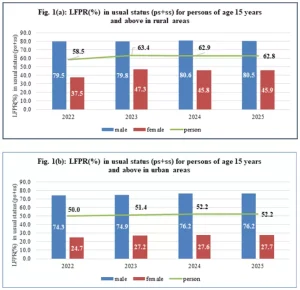
- Labour Force Participation Rate (LFPR): LFPR for persons aged 15+ remained stable at 59.3% in 2025, with male participation at 79.1% and female at 40.0%.
- Rural female participation sustained earlier gains, while urban participation levels remained largely unchanged.
- Worker Population Ratio (WPR): WPR stood at 57.4%, showing stability compared to 2024.
- Male WPR was 76.6%, while female WPR was 38.8%, reflecting persistent gender disparity.
- Unemployment Rate (UR): Overall UR declined to 3.1%, indicating improved labour absorption.
- Rural UR (2.4%) remained lower than urban UR (4.8%), with notable reduction in youth unemployment.
- Employment Structure: Share of self-employed declined from 58.2% (2023) to 56.2% (2025).
- Regular wage/salaried employment increased to 23.6%, indicating gradual formalization.
- Casual labour remained stable at around one-fifth of total employment.
- Sectoral Trends: Agriculture remained the largest employer but its share declined to 43%.
- Manufacturing and services sectors recorded increased employment share, indicating structural shift.
- Gender Dimensions: Female workforce participation improved moderately, but disparities persist in wages and working hours.
- Women reported domestic responsibilities as the major reason for not participating in the labour force.
- Education & Skills: Average years of schooling reached 10 years (15+ age group).
- Only 4.2% of persons (15–59 years) received formal vocational training, highlighting skill gaps.
Check Out UPSC CSE Books From PW Store
About Periodic Labour Force Survey (PLFS) Annual Report
- The National Statistics Office (NSO) conducts PLFS to generate high-frequency labour market data for employment and unemployment analysis.
- Published by : Ministry of Statistics and Programme Implementation (MoSPI).
- Period Covered: The 2025 report covers January–December 2025, marking a shift from the earlier July–June agricultural cycle.
- Methodology Changes: Revamped sampling design with increased sample size (~2.7 lakh households) and rotational panel system for higher accuracy.
- Key Indicators
- Labour Force Participation Rate (LFPR): Percentage of persons aged 15 years and above who are part of the labour force.
- Labour force includes:
- Persons working (employed)
- Persons seeking or available for work (unemployed)
- It indicates the extent of active participation of the population in economic activities.
- Worker Population Ratio (WPR): Percentage of persons aged 15 years and above who are employed in the population.
- It includes all individuals engaged in any economic activity (paid/unpaid, formal/informal).
- Reflects the actual employment level in the population.
- Unemployment Rate (UR): Percentage of persons aged 15 years and above who are unemployed among the labour force.
- Unemployed persons are those who are not working but seeking/available for work.
- It measures the severity of joblessness within the active labour force (not total population).
- Activity Status Measures
- Usual Status (PS+SS): Based on last 365 days (principal + subsidiary activities).
- Current Weekly Status (CWS): Based on the last 7 days, capturing short-term employment dynamics.
- Factors Influencing Labour Trends: Education levels, gender roles, sectoral shifts, and urban–rural differences significantly influence employment patterns.
Conclusion
PLFS 2025 reflects stable participation, declining unemployment, and gradual structural transformation, but highlights gender gaps and skill deficits as key policy challenges.
 30 Mar 2026