Induction Cooktops vs LPG: Working, Benefits, Limitations & India Demand Surge

25 Mar 2026

Induction Cooktops vs LPG: Working, Benefits, Limitations & India Demand Surge

The West Asia conflict has disrupted LPG supplies and raised cylinder prices in India, boosting the demand for induction cooktops as an alternative cooking solution.
About Induction Cooktop

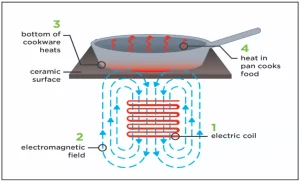
  • An induction cooktop is a modern cooking device that uses electromagnetic induction instead of conventional combustion to generate heat. 

Working Principle

  • It consists of a copper coil placed beneath a glass or ceramic surface. 
    • When alternating current passes through the coil, it produces a rapidly changing magnetic field.
  • Induction CooktopsAccording to Faraday’s Law of Electromagnetic Induction, this changing magnetic field induces electric currents in a nearby conductor. 
  • When a ferromagnetic utensil is placed on the cooktop, eddy currents are generated within the base of the utensil, causing it to heat up directly.
    • Eddy currents are circular loops of electric current induced within a conductor when it is exposed to a changing magnetic field.
  • The heat is produced due to the resistance offered by the metal to the flow of these currents, as explained by Joule’s Law of Heating.
    • Joule’s Law of Heating states that heat generated is proportional to the square of the current, the resistance, and the time for which current flows.

Enroll now for UPSC Online Course

Advantages

  • Efficiency: Induction cooktops convert about 85% to 90% of their electrical energy directly into cooking heat. In stark contrast, traditional LPG stoves hover around 40% to 50% efficiency. 
  •  Localised Heating: A gas flame loses a massive amount of its thermal energy to the ambient air around the pot, induction targets the heat exactly where it is needed.
    • This localised heating is responsible for induction cooking faster, safer and ultimately a highly resilient alternative to unpredictable fossil fuels.
  • Enhanced Safety: The cooktop surface remains relatively cool during operation, which significantly lowers the risk of burns and enhances user safety.
  • Environmental Sustainability: Induction cooking contributes to environmental sustainability by reducing dependence on fossil fuels, and when powered by renewable energy, it can substantially lower carbon emissions.
  • Precision and Control: Induction cooktops provide precise temperature control, allowing efficient energy use and improved cooking outcomes.

Limitations

  • Durability Issues: They are less durable than LPG stoves, harder to repair, dependent on electricity (which can be unreliable in India) and not compatible with all cooking styles.
  • Utensil Compatibility: Induction cooktops work efficiently only with ferromagnetic materials such as iron and certain types of steel. 
    • Non-magnetic materials like aluminium and copper are generally incompatible unless they have a magnetic base layer, often marketed as “induction base” cookware.
  • Dependence on Electricity: Induction cooktops are dependent on electricity supply, and their usage is constrained in regions with frequent power cuts and voltage fluctuations, which are common in parts of India.
  • High Initial Cost: The initial cost of induction cooktops and compatible cookware is relatively high, often 2–3 times more expensive than basic LPG stove setups, making them less accessible for low-income households.

Check Out UPSC CSE Books

Visit PW Store

online store 1

Induction Cooktop vis-i-vis Conventional Gas Stove (LPG)

Parameter Induction Cooktop Conventional Gas Stove (LPG)
Working Principle Uses electromagnetic induction (eddy currents) to heat utensil directly Uses combustion of LPG to produce flame and heat
Energy Efficiency High (~85–90%) Moderate (~40–50%)
Heating Method Direct heating of utensil Indirect heating via flame
Cooking Speed Faster (30–50% quicker) Relatively slower
Safety No open flame; lower risk of fire and burns Open flame; higher risk of fire and gas leakage
Surface Temperature Surface remains relatively cool Stove surface becomes hot
Environmental Impact Cleaner; depends on electricity source Uses fossil fuel; emits CO₂ and other gases
Dependence Requires electricity Requires LPG cylinder supply
Initial Cost Higher (device + compatible utensils) Lower initial setup cost
Operating Cost Lower in long term (efficient energy use) Higher due to rising LPG prices
Utensil Compatibility Only ferromagnetic cookware (iron, steel) Compatible with all types of utensils
Suitability Limited for traditional cooking (e.g., roasting) Suitable for all cooking styles
Maintenance Complex; repair can be costly Simple; easy and widely serviceable

Explore SRIJAN Prelims Crash Course

Need help preparing for UPSC or State PSCs?

Connect with our experts to get free counselling & start preparing

Aiming for UPSC?

Download Our App

      
Quick Revise Now !
AVAILABLE FOR DOWNLOAD SOON
UDAAN PRELIMS WALLAH
Comprehensive coverage with a concise format
Integration of PYQ within the booklet
Designed as per recent trends of Prelims questions
हिंदी में भी उपलब्ध
Quick Revise Now !
UDAAN PRELIMS WALLAH
Comprehensive coverage with a concise format
Integration of PYQ within the booklet
Designed as per recent trends of Prelims questions
हिंदी में भी उपलब्ध

<div class="new-fform">


    </div>

    Subscribe our Newsletter
    Sign up now for our exclusive newsletter and be the first to know about our latest Initiatives, Quality Content, and much more.
    *Promise! We won't spam you.
    Yes! I want to Subscribe.