India inducted its third nuclear-powered ballistic missile submarine (SSBN), INS Aridhaman significantly strengthening its sea-based nuclear deterrence capabilities.
- The other two India’s nuclear-powered ballistic missile submarines (SSBN) are INS Arihant and INS Arighaat, which were commissioned in 2016 and 2024, respectively.
- A fourth SSBN is currently under construction, and, like the Aridaman, will also be able to carry more K-4 missiles owing to its larger size.
UPSC Online Courses
About INS Aridhaman
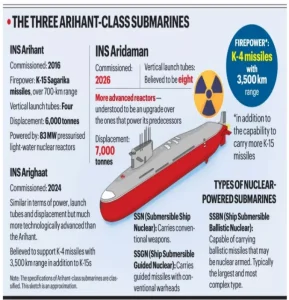
- Displacement and Launch Capability: INS Aridaman is a 7,000-tonne nuclear-powered submarine equipped with eight vertical launching system (VLS) tubes, which is nearly double that of its predecessor.
- Missile Capability: The submarine is capable of carrying:
- K-15 (Sagarika) with a range of over 700 km
- K-4, a longer-range SLBM with a strike capability of around 3,500 km
- Advanced Nuclear Propulsion: INS Aridaman is powered by advanced nuclear reactors, which are considered an upgrade over those used in earlier submarines. This allows it to:
- Remain submerged for extended durations (months together)
- Avoid frequent surfacing, thereby enhancing stealth and survivability
What is the Nuclear Triad?
- A nuclear triad refers to the ability to launch nuclear missiles from platforms in the air, land and at sea.
Components of Nuclear Triad
- Land-based Missiles (ICBMs)
- Nuclear weapons launched from land.
- Usually deployed in silos or mobile launchers.
- Air-based Delivery Systems
- Nuclear weapons delivered by aircraft such as strategic bombers.
- Provides flexibility and recall capability before strike.
- Sea-based Systems (Submarine-launched ballistic missiles – SLBMs)
- Launched from nuclear-powered submarines (SSBNs).
- Most survivable component due to stealth and mobility.
- India achieved nuclear triad capability with the induction of INS Arihant, completing all three legs:
- Land: Agni series missiles
- Air: Mirage 2000, Su-30 MKI
- Sea: INS Arihant (SSBN)
|
Significance
- Part of Elite Nuclear Triad Group : With the INS Aridaman’s induction, India has solidified its position within an elite group of nations possessing a fully operational nuclear triad. These include the US, Russia, China, and France.
- Strengthening of Nuclear Triad: The induction of INS Aridaman significantly enhances and strengthens India’s nuclear triad by reinforcing its sea-based deterrence component.
- Enhanced Operational Capability at Sea: With INS Aridaman’s induction, India will have three operational ballistic missile submarines at sea for the first time.
- Assurance of Second-Strike Capability: Although India’s nuclear doctrine stipulates a “no first use” policy, it is committed to using nuclear weapons solely for deterrence and retaliation — SSBNs guarantee India’s second-strike capability.
What is an SSBN ?
- SSBN stands for ‘Ship Submersible Ballistic Nuclear Submarines’.
- A Nuclear-Powered Ballistic Missile Submarine (SSBN) is a type of submarine that:
- Is powered by a nuclear reactor (enables long endurance without refueling)
- Carries ballistic missiles armed with nuclear warheads
- Serves as a key component of a country’s nuclear deterrence capability
UPSC Online Coaching
Key Features of SSBNs
- Nuclear Propulsion: SSBNs are powered by onboard nuclear reactors instead of conventional diesel engines, enabling them to remain submerged for extended periods, often months without surfacing, thereby ensuring high levels of endurance and operational stealth.
Nuclear-Powered Attack Submarine (SSN) Programme
- India is actively pursuing a Nuclear-Powered Attack Submarine (SSN) programme to strengthen its underwater combat capabilities. Unlike SSBNs, SSNs are designed for offensive roles, including hunting enemy submarines and protecting naval assets.
- The Indian Navy plans to indigenously build two SSNs, marking a step towards technological self-reliance.
- Additionally, India will lease one SSN from Russia, expected to be delivered by 2027–28, to bridge the capability gap until indigenous submarines become operational.
India’s Submarine Strength
- Authorised Strength: The Indian Navy is sanctioned to maintain 18 submarines.
- Refit Factor: Around 30% of submarines are under refit at any given time.
- Total Conventional Submarines: The Indian Navy operates 16 conventional submarines.
- Kalvari-class Submarines:
- 6 submarines of the Kalvari-class
- Built at Mazagon Dock Shipbuilders Limited in collaboration with Naval Group
- Shishumar-class Submarines:
- 4 submarines of the Shishumar-class
- Kilo-class (Sindhughosh) Submarines:
- 7 submarines of the Sindhughosh-class
Global Comparison
- United States:
- 14 Ohio-class SSBNs
- 53 fast-attack submarines
- China:
- 12 nuclear submarines
- Includes 6 nuclear-powered attack submarines (SSNs)
|
- Ballistic Missiles: They are equipped with Submarine-Launched Ballistic Missiles (SLBMs), which are capable of carrying nuclear warheads over long distances, providing a reliable and potent strategic strike capability.
- Stealth Capability: SSBNs operate quietly beneath the ocean surface, making them extremely difficult to detect, which enhances their survivability and ensures their effectiveness in a nuclear conflict scenario.
Click to Know UPSC Offline Courses
Advantages of SSBNs
- High Survivability: SSBNs ensure high survivability due to their ability to remain hidden underwater for prolonged periods, making them less vulnerable to enemy detection and attack.
- Strategic Stability: They contribute to strategic stability by maintaining a credible and assured nuclear deterrent, thereby discouraging adversaries from initiating conflict.
- Continuous Deterrence Patrols: SSBNs enable continuous deterrence patrols, ensuring a constant at-sea nuclear presence and readiness for retaliation if required.
- Enhanced National Security: Their stealth and difficulty in tracking significantly strengthen national security by ensuring a reliable second-strike capability.
Limitations
- High Cost of Development and Maintenance: SSBNs involve extremely high costs in terms of design, construction, and long-term maintenance due to their complex nuclear propulsion systems and advanced weaponry.
- For example, India’s Advanced Technology Vessel (ATV) Project has required substantial financial and technological investment over decades.
- Technological Complexity: The development of SSBNs requires advanced expertise in nuclear reactor miniaturization, missile integration, and stealth technology, which only a few countries possess
- Communication Constraints: Maintaining communication with submerged SSBNs is difficult as traditional radio waves cannot penetrate deep water, necessitating the use of very low frequency (VLF) or extremely low frequency (ELF) systems.
- For example, India uses dedicated VLF communication facilities to stay connected with its submarines.
- Vulnerability to Advanced ASW Technologies: Despite their stealth, SSBNs face increasing threats from evolving anti-submarine warfare (ASW) technologies such as sonar networks, underwater drones, and satellite tracking.


 4 Apr 2026





.png)






 Current Affairs




 GS Foundation
 Optional Course
 Combo Courses
 Degree Program