Magnetic Fields in Molecular Clouds: ARIES Study on Star Formation

21 Mar 2026

Magnetic Fields in Molecular Clouds: ARIES Study on Star Formation

Scientists have “seen” the skeleton of the magnetic field surrounding small molecular clouds L1604 and L121 for the first time.
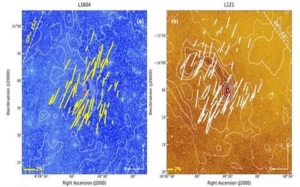

Magnetic Fields in Molecular Clouds

  • Study conducted by Aryabhatta Research Institute of Observational Sciences (ARIES), Department of Science and Technology (DST)  in collaboration with Assam University.
  • Methodology: R-band polarimetry using ARIES Imaging Polarimeter (AIMPOL) on the 104-cm ARIES telescope, Nainital.

Key Findings

  • Magnetic field strength: Both clouds are sub-critical, meaning magnetic energy dominates over turbulence and gravity at the envelope scale.
  • Dense cores: Despite overall magnetic protection, gravity may dominate in the dense cores, making them sites for star formation.
  • Differences between clouds:
    • L1604: Massive and dense, magnetic field less ordered.
    • L121: Less dense, magnetic field strong and orderly, less affected by gravitational collapse.
  • Magnetic fields act as an invisible hand, slowing star formation and preventing rapid gas depletion in the galaxy.

Significance of the Study

  • Star formation regulation: Shows that magnetism controls the pace of star birth in molecular clouds.
  • Galaxy evolution: Prevents all gas from collapsing into stars simultaneously, maintaining a stable star formation rate.
  • Observational breakthrough: First direct mapping of magnetic skeleton in small molecular clouds.
  • Future research: Helps understand the interplay of gravity, turbulence, and magnetic fields in star formation.

About Molecular Clouds

  • Molecular clouds are cold, dense regions of interstellar gas and dust where molecules, especially molecular hydrogen (H₂), form and survive.
  • They are often called “stellar nurseries” because they are the primary sites of star formation in galaxies.

Types of Molecular Clouds

  1. Bok Globules: These are Small, dense clouds, often sites of single star formation.
  2. Dark Clouds: They appear as dark patches in the sky; dense enough to block starlight.
  3. Giant Molecular Clouds (GMCs): These are Large clouds containing thousands of solar masses, often forming star clusters.

  • For Example:
    • Orion Molecular Cloud Complex – Nearby star-forming region.
    • Taurus Molecular Cloud – Rich in low-mass star formation.
    • L1604 and L121 – Small molecular clouds recently studied for magnetic fields.

Enroll now for UPSC Online Course

L1604 and L121: Molecular Clouds

Cloud Location Distance Mass & Density Magnetic Field Features
L1604 Galactic anticenter ~816 parsecs High density, massive Magnetic field weaker, less orderly; gravity dominates in dense cores
L121 Toward Galactic center 124 parsecs Less dense, less massive Stronger and more orderly magnetic field; resists gravitational collapse

Key Features

  • Temperature: Very cold, typically 10–30 K, allowing molecules to exist.
  • Density: High compared to other interstellar regions, typically 100–1,000,000 particles per cm³.
  • Composition: Mainly molecular hydrogen (H₂), with helium, CO, and traces of other molecules; dust grains make up 1% of the mass.
  • Size: Range from small Bok globules (1–5 light-years) to giant molecular clouds (GMCs, 10–100 light-years).
  • Mass: Can range from a few solar masses (small clouds) to millions of solar masses (GMCs).

Check Out UPSC CSE Books

Visit PW Store


online store 1

Importance of Molecular Clouds 

  • Birthplace of Stars: Molecular clouds act as stellar nurseries, where gravitational collapse of dense regions leads to star formation.
    • They are essential for the continuous creation of new stars in galaxies like the Milky Way.
  • Role in Planetary System Formation: The same collapsing cores that form stars also lead to the formation of protoplanetary disks, which eventually give rise to planets and solar systems.
  • Regulation of Star Formation: Molecular clouds regulate the rate of star formation through the interplay of gravity, thermal pressure, turbulence, and magnetic fields.
    • This prevents rapid depletion of galactic gas reserves.
  • Contribution to Galactic Evolution: They serve as reservoirs of gas and dust, influencing the structure and evolution of galaxies over time.
    • Star formation within these clouds determines the stellar population and lifecycle of galaxies.
  • Chemical Enrichment of the Universe: Molecular clouds contain complex molecules (e.g., CO, organic compounds) that contribute to the chemical evolution of the universe.
    • They are sites where prebiotic molecules may form.

Need help preparing for UPSC or State PSCs?

Connect with our experts to get free counselling & start preparing

Aiming for UPSC?

Download Our App

      
Quick Revise Now !
AVAILABLE FOR DOWNLOAD SOON
UDAAN PRELIMS WALLAH
Comprehensive coverage with a concise format
Integration of PYQ within the booklet
Designed as per recent trends of Prelims questions
हिंदी में भी उपलब्ध
Quick Revise Now !
UDAAN PRELIMS WALLAH
Comprehensive coverage with a concise format
Integration of PYQ within the booklet
Designed as per recent trends of Prelims questions
हिंदी में भी उपलब्ध

<div class="new-fform">


    </div>

    Subscribe our Newsletter
    Sign up now for our exclusive newsletter and be the first to know about our latest Initiatives, Quality Content, and much more.
    *Promise! We won't spam you.
    Yes! I want to Subscribe.