‘Op Netra 1.0’
Context: Indian Army conducted a high-altitude mega eye camp ‘Op Netra 1.0’ in Ladakh to deliver advanced ophthalmic care in remote regions.
UPSC Online Courses
About ‘Op Netra 1.0’
- Indian Army conducted ‘Op Netra 1.0’, an advanced surgical eye camp at Leh’s 153 General Hospital.
- It is supported by the Indian Air Force through airlifting advanced medical equipment.
- It represents a humanitarian outreach initiative delivering specialized healthcare in high-altitude and remote regions.
- Objective: To provide accessible, high-quality ophthalmic care to underserved populations in Ladakh.
- It sought to overcome geographical barriers and ensure inclusive healthcare delivery in extreme terrains.
- Beneficiaries included patients from remote Ladakh regions such as Hanle, Demchok, and Turtuk.
- Key Features
- Extensive Outreach: The camp screened around 950 patients across multiple remote districts.
- It ensured last-mile healthcare access in difficult high-altitude terrains.
- Advanced Surgical Care: Around 214 specialized procedures were performed, including complex cataract and retinal surgeries.
- Cutting-edge techniques like minimally invasive glaucoma surgery enhanced treatment outcomes.
- Indigenous Digital Innovation: Launch of the Op Netra App enabled QR-based patient identification and end-to-end digitization.
- It improved efficiency, safety, and coordination in high-volume medical operations.
- Significance
- Healthcare Inclusion: The initiative restored vision for several visually impaired patients, improving quality of life.
- Civil-Military Synergy: The operation showcased strong coordination between defence forces and civil administration in frontier regions like Ladakh.
- Strengthening Military Medical Capacity: Builds on a broader initiative delivering thousands of eye surgeries nationwide.
World Press Freedom Index 2026
Context: India has slipped to 157th place in the Press Freedom Index 2026, reflecting rising concerns over media freedom, safety, and institutional pressures.
About the World Press Freedom Index 2026
- India’s Rank: India ranked 157th out of 180 countries in 2026, slipping from 151 in 2025.
- Global Trend: Press freedom has declined globally, with over 50% countries now in “difficult” or “very serious” categories.
- Top Countries: Led by Norway, Netherlands, Estonia, Denmark, Sweden.
- Bottom Countries: lowest ranked include Eritrea, North Korea, China, Iran.
- Neighbour Comparison: India ranks below Nepal (87), Sri Lanka (134), Bangladesh (152), Pakistan (153); only above China (178).
- Key Concerns in India:
- Legal & Institutional Issues: Use of sedition, defamation, and anti-terror laws to curb press freedom.
- Economic Pressure: Heavy reliance on government advertising revenue, enabling indirect control over media.
- Safety Concerns: India remains among most dangerous countries for journalists, with 2–3 killings annually.
- Declining Diversity: Limited representation of women and marginalized groups in media leadership and discourse.
About the World Press Freedom Index
- It is an annual global ranking that assesses the level of press freedom in countries worldwide.
- Publisher: Released by Reporters Without Borders (RSF).
- Coverage: Evaluates 180 countries and territories each year.
- Indicators Used: Based on political, legal, economic, social, and safety conditions for journalists.
- Purpose: Measures how freely journalists can report news without censorship, pressure, or violence.
Whitley Awards 2026
Context: Indian conservationists Barkha Subba and Parveen Shaikh have won the 2026 Whitley Awards for efforts to protect the Himalayan Salamander and Indian Skimmer habitat.
About the Whitley Awards 2026
- It is a global conservation award, presented annually by Whitley Fund for Nature to recognise grassroots conservation leaders.
- Green Oscars: Widely known as the “Green Oscars” for excellence in wildlife conservation.
- Funding Support: Each winner receives about £50,000 funding for conservation projects.
- Focus Areas: Supports community-led, science-based conservation in biodiversity-rich regions of Asia, Africa, and Latin America.
- Barkha Subba: Protects the Himalayan Salamander through habitat restoration, invasive species removal, and disease monitoring in Darjeeling wetlands.
- Leads a community-based conservation model, focusing on safeguarding ~30 breeding sites and promoting sustainable land use.
- Parveen Shaikh: Leads the “Guardians of the Skimmer” initiative to protect nesting sites of the Indian Skimmer on the Chambal River.
- Achieved measurable success as nest survival increased (from 14% to 27%) and population rose from 400 to ~1,000 (2017–2025).
Himalayan Salamander

- The Himalayan Salamander (Tylototriton himalayanus) is a rare and threatened amphibian facing habitat loss, pollution, and climate change.
- Distribution: Found across India (Darjeeling & Northeast), Nepal, Bhutan, extending into Southeast Asia and Southwest China.
- Habitat: Inhabits cold mountainous ecosystems, forests, wetlands, tea gardens, rice fields, and pond margins.
- Unique Features: Lizard-like body with bony ridges, dorsal warts, flattened tail, and brown-to-creamy coloration.
- Conservation Status: Protected under Schedule I (Wildlife Protection Act, 1972) and listed as Vulnerable (IUCN).
Indian Skimmer
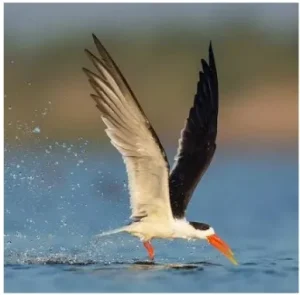
- The Indian Skimmer (Rynchops albicolli) is a rare riverine bird species known for its unique feeding method of flying low and skimming water.
- Habitat: Found along large, slow-flowing rivers with sandbars like Ganga, Chambal, Yamuna and tributaries.
- Distinct Features: Bright orange bill, black upperparts, white underparts; nests colonially on sandbars.
- Ecological Role: Acts as a flagship and indicator species of healthy river ecosystems and sediment dynamics.
- Conservation Status: Listed as Endangered (IUCN).
UPSC Online Coaching
BEA Global Forum (2026–27)
Context: Dr Bhaskar Jyoti Sonowal of Assam is elected as the President of the BRICS Entrepreneurs Alliance Global Forum for 2026–27, marking India’s rising leadership in BRICS+ platforms.
Background
- India BRICS Business Summit: The election of Dr Bhaskar Jyoti Sonowal follows the India BRICS Business Summit held in Hyderabad on 18–19 April 2026.
- Key Outcome of the India BRICS Business Summit: Adoption of the Hyderabad Declaration, outlining a roadmap for MSME growth and enhanced global collaboration.
About BRICS Entrepreneurs Alliance (BEA)
- It is a business platform under BRICS+ that connects entrepreneurs, industry leaders and policymakers across member countries.
- BRICS+ is an informal term used to describe the expanded version of BRICS.
- Establishment: The BRICS Entrepreneurs Alliance was formally established in September 2025 during the II BRICS Forum on Traditional Values (Brazil).
- Organisational Structure of BEA:
- General Council: Representatives from all national chapters.
- Global President: Selected annually (aligned with BRICS chairmanship).
- Secretary General: Responsible for long-term coordination.
- National Chapters: Country-level units of entrepreneurs and business leaders.
- Functions:
- International Community Building: Platform for collaboration and trust-building among BRICS+ entrepreneurs.
- Partner Credibility: Maintains a verified registry to ensure reliable business partnerships.
- Business Support: Provides regulatory guidance, market insights and networking support.
- Capacity Building: Conducts training, workshops and knowledge-sharing for global competitiveness.
- Institutional Collaboration: The BRICS Entrepreneurs Alliance entered into a cooperation agreement with Volunteers of Peace to support global humanitarian initiatives.
- Volunteers of Peace is an international volunteer platform that helps connect volunteers and humanitarian projects, providing them with support and opportunities for collaboration
About BRICS
- Origin: The Term “BRIC” was coined by Jim O’Neill in 2001.
- First Summit: Held in Russia in 2009.
- Evolution: Initially included Brazil, Russia, India, and China; expanded to BRICS after South Africa joined in 2010.
- Expansion (2024–25): Inclusion of Egypt, Ethiopia, Iran, Saudi Arabia, United Arab Emirates and Indonesia.
- Objective: Promote economic cooperation, reform global governance, and enhance voice of Global South.
- Key Institution: New Development Bank (NDB) funds infrastructure and sustainable development projects.
- Significance: BRICS comprises about 45 to 46 per cent of the world’s population and about 35 to 37 per cent of global GDP in purchasing power parity (PPP) terms.
- It accounts for roughly one fourth of global trade; expanded BRICS+ brings together major energy producers such as Saudi Arabia, Russia and Iran.
INS Mahendragiri
Context: Recently, the Indian Navy took delivery of INS Mahendragiri (Yard 12654).
About INS Mahendragiri
- Indian Naval Ship (INS) Mahendragiri is a stealth multi-role guided missile frigate, developed under Project 17A (P-17A).
- It is the sixth Nilgiri-class frigate and the fourth built by Mazagon Dock Shipbuilders Limited.
- Yard 12654 is the unique shipyard hull number assigned by Mazagon Dock Shipbuilders Limited to identify and track the vessel during design and construction.
- Named After: It is named after the Mahendragiri, a prominent mountain peak in the Eastern Ghats located in Odisha.
- Construction: Built using integrated modular construction, enabling faster build time and efficient delivery within timelines.
- Propulsion: Configured with a CODOG (Combined Diesel or Gas) system using a gas turbine for high-speed operations and a diesel engine for economical cruising, driving a Controllable Pitch Propeller (CPP).
- Weapons and Sensors: Equipped with a comprehensive combat suite for Anti-Surface Warfare (ASuW), Anti-Air Warfare (AAW) and Anti-Submarine Warfare (ASW).
- Automation: Features an Integrated Platform Management System (IPMS) for centralised control and monitoring of machinery and onboard systems.
- Indigenisation: Around 75 per cent indigenous content across design, equipment, and systems, with participation of over 200 MSMEs and employment generation of about 4,000 direct and 10,000 indirect jobs.
- Significance: Strengthens India’s blue-water naval capability, enhances maritime security in the Indian Ocean Region (IOR), and reflects growing indigenous defence manufacturing strength.
About Project 17A
- Project 17A is an Indian Navy program to build advanced stealth-guided missile frigates (Nilgiri-class) to tackle modern maritime threats.
- Follow-on: It is an improved version of Project 17 (Shivalik-class) with better stealth and combat capabilities.
- Number of Ships: 7 frigates are planned under the project.
- Shipyards: Construction divided between
- Mazagon Dock Shipbuilders Limited
- Garden Reach Shipbuilders & Engineers
- Design: Designed by the Warship Design Bureau with focus on low radar cross-section and reduced signatures
- Project 17A Ships: INS Nilgiri (lead ship), INS Himgiri, INS Udaygiri, INS Dunagiri, INS Taragiri, INS Mahendragiri, and INS Vindhyagiri under the Nilgiri-class frigate.
Operation WHITE STRIKE
Context: The Narcotics Control Bureau (NCB) seized 349 kg of high-grade cocaine worth ₹1,745 crore in the Mumbai region under Operation WHITE STRIKE.
- It is one of the largest cocaine seizures in India, exceeding the country’s annual average (200–300 kg).
Significance of the Operation
- Disruption of Transnational Drug Syndicate: Reveals global supply chains involving import routes and local distribution networks.
- “Bottom-to-Top” Policing Approach
- Smaller seizure led to uncovering a larger cartel network.
- Intelligence-led Policing: Based on 6 months of surveillance and intelligence gathering.
- Strategic Location: Mumbai region acts as a major entry and distribution point due to ports and logistics corridors.
Click to Know UPSC Coaching Centres in India
About Narcotics Control Bureau (NCB)
- The Narcotics Control Bureau is India’s apex agency for combating drug trafficking and illicit drug use.
- Established: 17 March 1986 under Section 4(3) of the NDPS Act, 1985.
- Headquarters: New Delhi.
- Key Functions
-
- Coordination: Acts as the nodal agency coordinating central and state enforcement bodies.
- Intelligence & Enforcement: Collects intelligence and conducts operations against narcotics networks nationwide.
- International Cooperation: Works with global agencies such as INTERPOL and United Nations Office on Drugs and Crime to combat transnational drug trafficking.
 2 May 2026