Women and Men in India 2025: Selected Indicators and Data Report

1 May 2026

Women and Men in India 2025: Selected Indicators and Data Report

The Ministry of Statistics and Programme Implementation (MoSPI) released the 27th edition of its publication, Women and Men in India 2025: Selected Indicators and Data report.
  • The publication was released at the National Deliberative Summit on “Data for Development” in Bhubaneswar, Odisha.

Best Online Coaching for UPSC

About Women and Men in India 2025: Selected Indicators and Data

  • It presents a broad overview of gender-related trends across population, education, health, employment and decision-making in India.
  • It also gives a synoptic view of several indicators by rural-urban classification and state-wise distribution, offering insights into evolving gender disparities and development trends across the country.
    • It compiles gender-disaggregated data drawn from multiple ministries, departments and organisations.

Key Highlights of Report

Women and Men in India 2025

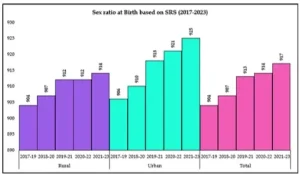
  • Improvement in Sex Ratio at Birth: The sex ratio at birth improved at the all-India level from 904 in 2017-19 to 917 in 2021-23, indicating progress in female survival at birth.
  • Decline in Infant Mortality Rate: It notes a sustained decline in infant mortality rates for both girls and boys between 2008 and 2023.
  • Achievement of Gender Parity in School Education: In education, gender parity has been achieved across all levels of school education from primary to higher secondary. 
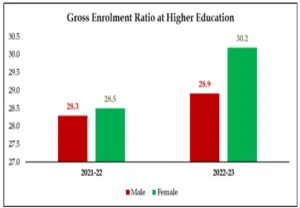
  • Rising Gross Enrolment Ratio (GER) in Higher Education: It also noted an improvement in Gross Enrolment Ratio in higher education, rising from 28.5 to 30.2 for females and from 28.3 to 28.9 for males between 2021-22 and 2022-23.
  • Women and Men in India 2025Increase in Labour Force Participation Rate (LFPR): On labour force participation, the report pointed to gains for both men and women aged 15 and above, with rural women recording the sharpest rise.
    • Increase in Labour Force Participation Rate (LFPR): Female labour force participation in rural areas increased from 37.5 per cent to 45.9 per cent between 2022 and 2025, it said.
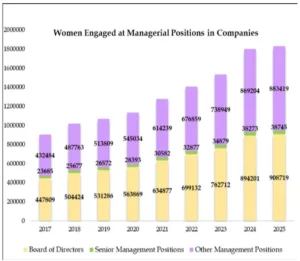
  • Rise in Women in Managerial Positions: The publication also highlighted a rise in women in managerial roles, noting a 102.54 per cent increase between 2017 and 2025, compared with a 73.80 per cent increase among men.
  • Women and Men in India 2025Strengthening Gender Data and Policy Framework: The report includes metadata for 50 key indicators to improve understanding of concepts, definitions and methodologies underlying the data, and is intended to support policymakers and researchers in designing gender-responsive policies.
  • Unpaid Care Work: Women continue to spend disproportionately more time on unpaid domestic activities compared to men.
  • Digital Fraud Risks: Women often lack the necessary digital literacy to report or prevent cybercrimes effectively.
  • Marital Age Shift: The mean age at marriage for women has shown a steady increase from 2021 onwards.
    • The mean age at marriage reached 24.3 in 2023, allowing for longer educational and professional development.

Policy Interventions Driving Gender Outcomes in Health, Education and Employment

Initiatives for Improving Women’s Health Outcomes

  • Beti Bachao Beti Padhao: A flagship initiative aimed at addressing the declining child sex ratio by promoting the value of the girl child, preventing gender-biased sex selection, and ensuring her survival, protection, and education.
  • Janani Suraksha Yojana: A demand-side intervention that provides cash incentives to pregnant women to encourage institutional deliveries, thereby reducing maternal and infant mortality, especially among poor and vulnerable sections.
  • Pradhan Mantri Matru Vandana Yojana: A maternity benefit scheme that offers partial wage compensation to pregnant and lactating women, enabling them to take adequate rest, improve nutrition, and ensure better health outcomes for both mother and child.
  • POSHAN Abhiyaan: A comprehensive nutrition mission that seeks to reduce stunting, undernutrition, anemia, and low birth weight through convergence of various schemes and real-time monitoring using technology.
  • Ayushman Bharat: A flagship health assurance programme providing financial protection for secondary and tertiary care hospitalization, improving women’s access to quality healthcare without financial hardship.

Initiatives for Improving Women’s Education

  • Samagra Shiksha Abhiyan: An integrated scheme covering school education from pre-primary to higher secondary, focusing on inclusive education, gender equity, infrastructure development, and learning outcomes.
  • Kasturba Gandhi Balika Vidyalaya: Establishes residential schools for girls belonging to disadvantaged communities in educationally backward areas, ensuring access to schooling where dropout rates are high.
  • National Scheme of Incentive to Girls for Secondary Education: Provides financial incentives to encourage girls, especially from marginalized groups, to continue education beyond the elementary level and reduce early dropouts and child marriage.
  • PM eVIDYA: A digital education initiative that leverages online platforms, TV channels, and mobile applications to ensure continuity of education, particularly benefiting girls in remote and underserved regions.

UPSC Coaching Classes

Initiatives for Increasing Female Labour Force Participation (FLFP)

  • Mahatma Gandhi National Rural Employment Guarantee Act (MGNREGA): Provides guaranteed wage employment in rural areas with a strong emphasis on women’s participation, ensuring income security and financial inclusion.
  • Deendayal Antyodaya Yojana – National Rural Livelihoods Mission (DAY-NRLM): Promotes women-led self-help groups (SHGs), enhancing access to credit, skill development, and sustainable livelihood opportunities.
  • Pradhan Mantri Mudra Yojana: Facilitates collateral-free loans to micro and small enterprises, enabling women entrepreneurs to start or expand their businesses.
  • Stand Up India Scheme: Encourages entrepreneurship among women by providing bank loans for setting up greenfield enterprises in manufacturing, services, or trading sectors.
  • Skill India Mission: Focuses on enhancing employability through skill training, vocational education, and industry-relevant courses, thereby improving women’s participation in the workforce.
  • Pradhan Mantri Ujjwala Yojana: Provides LPG connections to women from poor households, reducing drudgery and time spent on fuel collection, which can be redirected towards education or income-generating activities.

Challenges

  • Persisting Adverse Sex Ratio at Birth (SRB): Although the SRB has improved, it still remains below the natural baseline, reflecting deep-rooted societal preference for male children and the continued misuse of prenatal diagnostic technologies.
    • For Example: Certain northern states continue to show skewed ratios despite legal safeguards.
  • Regional and Rural-Urban Disparities: Progress in gender indicators is uneven, with significant variation across states and between rural and urban areas, highlighting unequal access to health, education, and employment opportunities.
    • For Example: Southern and western states outperform many northern and eastern states on key gender metrics.
  • Low Quality and Informal Nature of Female Employment: The rise in female labour force participation is often concentrated in informal, low-paid, and insecure jobs, limiting true economic empowerment.
    • A large proportion of rural women are engaged in unpaid family work or casual labour.
  • Underrepresentation in Leadership and Decision-Making Roles: Despite an increase in managerial participation, women remain significantly underrepresented in senior leadership roles across public and private sectors.
    • Limited presence of women in top corporate positions and higher bureaucracy.
  • Weak Education-to-Employment Transition for Women: Improvements in educational attainment are not adequately translating into workforce participation due to social norms, safety concerns, and lack of enabling work environments
    • Many educated women exit the workforce after marriage or childbirth.
  • Persistent Gender Wage Gap: Women continue to face wage discrimination and earn less than men for similar work, reflecting structural inequalities and occupational segregation.Pay gaps exist even in formal sectors like IT and services.
  • Inadequate Measurement of Women’s Work and Contributions: Despite improvements, data systems still inadequately capture unpaid care work and informal contributions made by women, leading to undervaluation in policy design. Household and caregiving roles remain largely invisible in GDP calculations.

Way Forward

  • Strengthening Enforcement of Gender Justice Laws: Effective implementation of laws against sex selection and gender discrimination, along with awareness campaigns to change societal attitudes.
  • Focused Interventions for Lagging Regions: Use disaggregated data to design targeted, region-specific policies addressing local gender gaps.
  • Promoting Quality and Formal Employment Opportunities: Encourage women’s participation in skilled, formal sectors through skilling initiatives, digital inclusion, and industrial policies.
  • Enhancing Women’s Representation in Leadership: Ensure greater participation of women in governance, corporate boards, and decision-making bodies through policy and institutional reforms.
  • Facilitating Work-Life Balance and Care Infrastructure: Expand childcare facilities, parental leave, and flexible working arrangements to retain women in the workforce.
  • Ensuring Equal Pay and Reducing Occupational Segregation: Strengthen enforcement of equal wage laws and promote women’s entry into non-traditional sectors.
  • Strengthening Gender Data Systems: Improve data collection on unpaid work, time-use, and informal sector contributions to enable more gender-responsive policymaking.

Click to Explore UPSC Offline Coaching

Conclusion

The 2025 report shows that India is making good progress in women’s education and leadership, with more women in managerial roles. However, challenges like a 14.4% literacy gap and low health check-up rates still exist. True gender equality will happen only when these improvements benefit every woman in daily life.

Check Out UPSC CSE Books

Visit PW Store

online store 1

Explore UPSC Foundation Course

Need help preparing for UPSC or State PSCs?

Connect with our experts to get free counselling & start preparing

Aiming for UPSC?

Download Our App

      
Quick Revise Now !
AVAILABLE FOR DOWNLOAD SOON
UDAAN PRELIMS WALLAH
Comprehensive coverage with a concise format
Integration of PYQ within the booklet
Designed as per recent trends of Prelims questions
हिंदी में भी उपलब्ध
Quick Revise Now !
UDAAN PRELIMS WALLAH
Comprehensive coverage with a concise format
Integration of PYQ within the booklet
Designed as per recent trends of Prelims questions
हिंदी में भी उपलब्ध

<div class="new-fform">


    </div>

    Subscribe our Newsletter
    Sign up now for our exclusive newsletter and be the first to know about our latest Initiatives, Quality Content, and much more.
    *Promise! We won't spam you.
    Yes! I want to Subscribe.