India’s water crisis is increasingly being viewed not merely as a problem of scarcity, but as a challenge of governance, institutional coordination, and sustainable management.
- India supports nearly one-fifth of the world’s population but has access to only about 4% of global freshwater resources.
- Water is primarily a State subject under Entry 17 of the State List.
Best Online Coaching for UPSC
About Water Governance
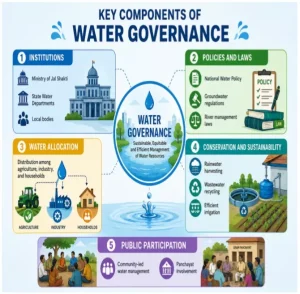
- Water governance refers to the system of laws, institutions, policies, and processes through which water resources are managed, allocated, regulated, and distributed among different users in a sustainable and equitable manner.
- It includes:
- Decision-making related to water use
- Coordination among governments and stakeholders
- Management of rivers, groundwater, irrigation, and drinking water
- Regulation of water quality and conservation
- Public participation and accountability
Why is Water Governance Important?
- Prevent Water Scarcity: Good water governance promotes efficient water storage, conservation, and equitable distribution to reduce water shortages.
- For example, rainwater harvesting and groundwater recharge help drought-prone regions manage water stress effectively.
- Reduce Conflicts Over Water: Proper governance creates transparent rules for water sharing among States, farmers, industries, and households, reducing disputes.
- For instance, river water tribunals help resolve interstate river conflicts like the Cauvery dispute.
- Improve Irrigation Efficiency: Scientific water management encourages micro-irrigation and efficient farming practices, reducing wastage in agriculture.
- Programmes like PMKSY promote “Per Drop More Crop” to improve water productivity.
- Ensure Clean Drinking Water: Strong water governance improves access to safe drinking water through better infrastructure, monitoring, and pollution control.
- Protect Ecosystems: Sustainable water management protects rivers, wetlands, forests, and biodiversity from overexploitation and pollution. Initiatives like Namami Gange aim to restore ecological balance in river systems.
- Build Climate Resilience: Effective governance helps communities prepare for floods, droughts, and irregular rainfall caused by climate change. Watershed development and water conservation programmes strengthen long-term resilience.
Challenges in Water Governance
- Institutional Fragmentation: Multiple agencies at the Centre, State, and local levels perform overlapping functions, leading to poor coordination and inefficiency in water management. Weak Centre–State cooperation further complicates integrated policy implementation.
- Groundwater Regulation Failure: Groundwater is often treated as private property linked to land ownership, encouraging excessive extraction.
- Weak regulation and poor enforcement have caused declining water tables in many regions.
- Lack of River Basin Planning: Water governance is largely based on administrative boundaries rather than natural river basins. The absence of an ecological and integrated basin-level approach affects sustainable water management.
- Poor Infrastructure: Hydrological assessments indicate that while total water availability is high, only about 1,100 billion cubic metres are considered usable, due to limitations in storage infrastructure, uneven rainfall distribution and ecological constraints.
- Declining Per Capita Water Availability: In the early years after independence, water availability exceeded 5,000 cubic metres per person annually.
- In 2026 it fell to around 1,400 cubic metres.
- Financial Constraints: Insufficient funding and poor maintenance of water infrastructure reduce efficiency and service delivery. Low cost recovery in irrigation and urban water systems weakens long-term sustainability.
- Urban Water Stress: Rapid urbanisation has increased pressure on water supply networks and sewage systems. Leakages, illegal connections, and non-revenue water create major inefficiencies in cities.
- According to the NITI Aayog Composite Water Management Index, around 600 million people face high to extreme water stress.
- Climate Change: Climate change is increasing the frequency of floods, droughts, glacial melt, and irregular rainfall patterns. These extreme events make water availability and management more uncertain.
Why India Faces a Water Crisis Despite Adequate Rainfall?
- Uneven Rainfall Distribution: India receives most of its rainfall during the monsoon season, leading to high temporal and spatial variability. As a result, some regions face floods while others suffer from droughts and water scarcity.
- Inadequate Storage Infrastructure: India lacks sufficient reservoirs, rainwater harvesting systems, and water storage facilities to capture and utilise rainfall efficiently. Poor groundwater recharge mechanisms further reduce usable water availability.
- Excessive Groundwater Extraction: Rapid expansion of tube-well irrigation and free or subsidised electricity have encouraged overextraction of groundwater. Consequently, water tables are declining sharply in states such as Punjab, Haryana, and Rajasthan.
- Inefficient Agricultural Practices: Cultivation of water-intensive crops like paddy and sugarcane in water-scarce regions increases stress on freshwater resources. Traditional flood irrigation methods also result in large-scale water wastage.
- Pollution and Degradation: Industrial effluents, untreated sewage, and agricultural runoff are polluting rivers, lakes, and groundwater sources. This reduces the availability of clean and usable freshwater.
- Weak Institutional Coordination: Water governance in India is fragmented among the Centre, States, and local bodies, leading to poor coordination and overlapping responsibilities. The absence of integrated river basin management further weakens sustainable planning.
UPSC Online Preparation
Government Initiatives regarding Water Governance
| Scheme |
Ministry |
Objective |
Key Features |
Significance |
| Jal Jeevan Mission |
Ministry of Jal Shakti |
Provide safe tap water to rural households |
Functional Household Tap Connections (FHTCs), village-level water planning |
Improves rural drinking water access and public health |
| Atal Bhujal Yojana (ATAL JAL) |
Ministry of Jal Shakti |
Promote sustainable groundwater management |
Community participation, groundwater budgeting, aquifer management |
Addresses groundwater depletion in water-stressed regions |
| Pradhan Mantri Krishi Sinchayee Yojana (PMKSY) |
Ministry of Agriculture & Farmers Welfare |
Improve irrigation efficiency |
“Per Drop More Crop”, drip and sprinkler irrigation |
Reduces water wastage in agriculture |
| Namami Gange Programme |
Ministry of Jal Shakti |
Rejuvenate the Ganga River |
Sewage treatment, pollution control, riverfront development |
Restores river ecology and water quality |
| AMRUT Mission |
Ministry of Housing and Urban Affairs |
Improve urban water infrastructure |
Water supply networks, sewage systems, wastewater reuse |
Strengthens urban water management |
Concept of Circular Water Economy
- A circular water economy is a sustainable approach to water management that focuses on the reuse, recycling, conservation, and efficient allocation of water resources.
- Unlike the traditional “use and dispose” model, it aims to maximise water efficiency by treating wastewater as a resource and promoting long-term sustainability.
Key Components of Circular Water Economy
- Wastewater Recycling: A circular water economy encourages the treatment and reuse of wastewater for various non-potable purposes, reducing pressure on freshwater resources.
- Treated wastewater can be used in industries, agriculture, and urban landscaping such as parks and gardens.
- Efficient Irrigation: Modern irrigation methods such as drip and sprinkler systems help deliver water directly to crops with minimal wastage.
- Precision farming techniques further improve agricultural water productivity and conserve freshwater resources.
- Demand-Side Management: Demand-side measures focus on reducing unnecessary water consumption through crop diversification, efficient water use practices, and rational water pricing reforms. These measures promote sustainable and responsible use of water resources.
- Technological Innovation: Advanced technologies such as IoT-based water monitoring systems, smart metering, and GIS mapping improve water management efficiency.
- These technologies help in real-time monitoring, leak detection, groundwater assessment, and better planning.
Best Practices & Global Lessons in Water Governance
| Country |
Best Practice |
Key Features |
Lessons for India |
| Israel |
Drip Irrigation & Wastewater Reuse |
Extensive use of micro-irrigation, recycling of treated wastewater for agriculture |
Promote water-efficient farming and large-scale wastewater reuse in agriculture |
| Singapore |
NEWater Recycling Model |
Advanced wastewater treatment and integrated urban water management |
Strengthen urban water recycling and reduce dependence on freshwater imports |
| Australia |
Murray–Darling River Basin Management |
Basin-level planning, ecological conservation, inter-state coordination |
Adopt integrated river basin governance and sustainable water allocation policies |
Way Forward
- Integrated Water Resource Management: India should adopt Integrated Water Resource Management (IWRM) through river basin-level planning and coordinated decision-making across agriculture, industry, urban development, and environment sectors.
- This approach can improve efficient water allocation, reduce inter-sectoral conflicts, and promote long-term water sustainability.
- Strengthen Local Governance: Greater powers and financial resources should be provided to Panchayats and Urban Local Bodies (ULBs) for decentralized water management and local planning. Increased community participation can improve accountability, encourage conservation practices, and ensure better implementation of water-related schemes.
- Promote Water Use Efficiency: India must encourage crop diversification, shift away from water-intensive crops in unsuitable regions, and promote smart irrigation technologies such as drip and sprinkler systems.
- Along with this, rational water pricing can reduce wastage and encourage efficient consumption across sectors.
- Improve Data Governance: A strong water governance system requires real-time monitoring, scientific aquifer mapping, and reliable hydrological databases for evidence-based policymaking. Developing open-access data systems can improve transparency, strengthen research, and support better water management decisions.
- Expand Wastewater Reuse: Cities should adopt mandatory wastewater recycling targets to increase the reuse of treated wastewater in industries, agriculture, and urban landscaping. Expanding wastewater reuse can reduce pressure on freshwater resources and support the transition toward a circular water economy.
- Climate-Resilient Water Systems: India should strengthen rainwater harvesting, watershed development, and other nature-based solutions to improve groundwater recharge and climate resilience.
- Such measures can help manage extreme rainfall events, droughts, floods, and long-term climate-related water stress.
Click to Know UPSC OnlyIAS Coaching Centres
Conclusion
- India’s water challenge is fundamentally a governance challenge rather than merely a hydrological deficit.
- Sustainable water security will depend on stronger institutions, scientific planning, participatory governance, and efficient resource utilisation.
- A shift from fragmented management to an integrated and circular water economy is essential for achieving ecological sustainability, agricultural resilience, and inclusive economic growth.
 14 May 2026