Recent allegations of a paper leak in the National Eligibility cum Entrance Test (NEET) triggered nationwide protests and renewed concerns over the integrity of public examinations.
- The Ministry of Education under the National Education Policy (NEP) 2020 entrusted the NTA with:
- Conducting common aptitude tests
- Testing higher-order conceptual understanding
- Reducing coaching dependence
- Holding multiple examinations annually
- Creating a single national testing gateway
Best Online Coaching for UPSC
About Ethical Governance in Public Examinations
- Ethical governance in public examinations refers to the conduct of examinations in a manner that upholds fairness, transparency, accountability, integrity, and public trust.
- It ensures that selection processes remain merit-based and free from corruption, malpractice, and institutional bias.
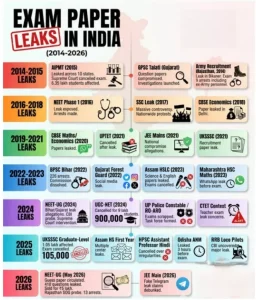
Ethical Dimensions of the NEET Controversy
- Integrity and Fairness: Public examinations are based on the principle of equal opportunity and merit-based selection.
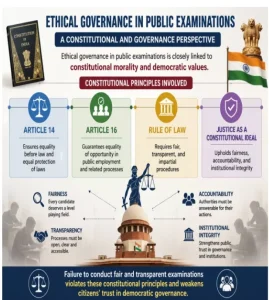 A paper leak compromises the fairness of the examination process by providing undue advantage to a few candidates, thereby destroying the level playing field.
- Ethical Concerns:
- Violation of honesty and fairness
- Undermining of meritocracy
- Erosion of procedural justice
- Loss of credibility of the examination system
- Accountability and Institutional Responsibility: Institutions conducting public examinations have a fiduciary responsibility to maintain confidentiality, transparency, and fairness throughout the process. Repeated leaks indicate serious institutional and administrative failures.
- Ethical Issues:
- Failure of institutional vigilance
- Administrative negligence and inefficiency
- Possible collusion and corruption
- Weak accountability mechanisms
- Lack of transparency in investigation and redressal
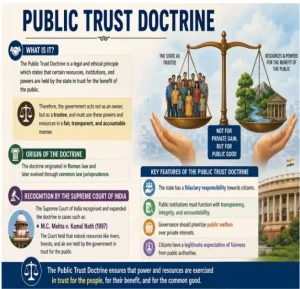 Governance Concern: When public institutions repeatedly fail to conduct fair examinations, citizens begin losing faith in the state’s ability to uphold justice and equality.
- Emotional and Psychological Impact on Students: The controversy has severe emotional, psychological, and financial consequences for aspirants and their families. Honest candidates often suffer despite no fault of their own.
- Impact on Stakeholders:
- Anxiety, stress, and mental distress among students
- Loss of motivation and confidence
- Financial burden on families due to prolonged preparation
- Feeling of injustice and helplessness among sincere aspirants
- Crisis of Probity in Governance: The NEET controversy reflects a larger crisis of probity in governance. Public examinations derive legitimacy not merely from legality, but from ethical conduct, institutional integrity, and public trust.
- Probity in Governance Includes:
- Transparency in processes
- Accountability of authorities
- Ethical conduct in administration
- Institutional integrity
- Protection of public trust
- Administrative Evil and Institutional Failure: The controversy also highlights the concept of “Administrative Evil,” where unethical outcomes arise not only from corruption but also from systemic failures and institutional apathy.
- Forms of Administrative Evil:
- Negligence and lack of vigilance
- Institutional indifference
- Normalisation of unethical practices
- Failure to act despite warning signs
- Administrative complacency
- To Preserve Social Stability and Trust in Merit-Based Mobility: Public examinations are often viewed as pathways for social mobility, especially for economically weaker sections.
- Ethical governance ensures that opportunities remain accessible through honest effort rather than unethical means.
Consequences of Exam Leak
- Normalisation of Corruption: Frequent examination leaks may create a social perception that success depends more on manipulation, influence, and unethical shortcuts than on merit and hard work.
- Weakening of Meritocracy: Honest and deserving students may lose opportunities despite years of sincere effort, thereby undermining the principle of merit-based selection.
- Social Distrust: Repeated institutional failures lead citizens to question the credibility of public institutions, governance processes, and administrative systems.
- Decline in Ethical Standards: When unethical behaviour yields rewards with limited consequences, moral disengagement gradually becomes socially accepted, leading to erosion of ethical values in society.
- Public Trust Doctrine and Examination Systems: Public examinations function on a fiduciary relationship of trust between citizens and institutions. Students invest years of hard work with the expectation that the examination process will remain fair, transparent, and impartial.
Philosophical Perspectives
- Immanuel Kant : Human Beings as Ends: Kant argued that human beings should never be treated merely as means to an end, but always as ends in themselves.
- Relevance to the NEET Controversy: Examination leaks reduce students’ years of hard work, aspirations, and dignity into collateral damage for corrupt interests and administrative failures. Honest aspirants become victims of a system that prioritises institutional convenience over individual justice.
- Mahatma Gandhi : Means and Ends: Gandhi believed that ethical means are as important as ethical ends. According to him, just outcomes cannot emerge from unethical processes.
- Relevance to the NEET Controversy: A fair and credible examination system cannot be built upon compromised procedures, corruption, and administrative negligence. Ethical governance is essential to preserve the legitimacy and moral credibility of public examinations.
UPSC Online Courses
Structural Challenges of NTA
- Weak Institutional Status: Unlike the Union Public Service Commission and the University Grants Commission, the National Testing Agency lacks statutory status and operates as an administrative society under the Ministry of Education.
- This results in limited autonomy, weak regulatory powers, and inadequate institutional accountability.
About the National Testing Agency (NTA)
- The National Testing Agency was approved by the Union Cabinet in 2017 and registered in 2018 as a society under the Societies Registration Act, 1860.
Mandate
- Conduct national-level entrance examinations
- Ensure transparent, efficient, and standardised testing
- Reduce burden of multiple entrance examinations
Major Exams Conducted
- NEET-UG
- JEE Main
- CUET
- UGC-NET
|
- Severe Staffing Shortages: Despite managing examinations for over 1.25 crore candidates annually, the NTA functions with limited permanent manpower and excessive dependence on outsourced staff.
- This creates problems such as administrative overload, weak institutional memory, and shortage of technical expertise.
- Overdependence on Outsourcing: The NTA heavily depends on private computer centres, third-party logistics firms, and outsourced software vendors for conducting examinations.
- Such dependence increases the risks of cybersecurity vulnerabilities, paper leaks, data breaches, and reduced accountability.
- Lack of Permanent Infrastructure: Despite possessing significant financial reserves from examination fees, the NTA has not developed secure permanent testing infrastructure.
- As a result, it remains dependent on rented institutions, leading to uneven testing standards and weak control over examination centres.
- Weak Cybersecurity Preparedness: The increasing shift towards Computer Based Testing (CBT) has exposed gaps in the NTA’s cybersecurity preparedness and digital governance capacity. Incidents of technical glitches, remote-access hacks, and data security concerns have undermined confidence in online examinations.
- Fragmented Organisational Structure: Different examination divisions within the National Testing Agency function in isolated silos with limited coordination and knowledge sharing. This weakens institutional learning, standardisation, and efficient crisis management across examinations.
- Limited Research and Innovation Capacity: The NTA largely functions as an administrative body rather than a research-driven testing institution. It lacks sufficient focus on psychometric research, adaptive testing, AI-led evaluation, and assessment innovation required for the modern examination system.
- Equity and Digital Divide Concerns: The transition towards large-scale CBT examinations may disproportionately affect rural, economically weaker, and digitally excluded students. Unequal access to digital infrastructure and computer familiarity can create barriers to fair and inclusive examinations.
Government Measures to Prevent Paper Leaks
- To address the growing menace of examination malpractices, the government enacted the Public Examinations (Prevention of Unfair Means) Act, 2024 to strengthen the security and integrity of public examinations.
- Stringent Punishment: The Act provides for imprisonment ranging from 3 to 10 years along with fines up to ₹1 crore for individuals or organised groups involved in paper leaks and examination fraud.
- Liability of Service Providers: The law also holds exam centres, service providers, and agencies accountable for malpractice, with provisions for penalties, blacklisting, and debarment in cases of involvement.
- Cognizable and Non-Bailable Offences: Offences related to paper leaks have been classified as cognizable and non-bailable, enabling stricter enforcement and faster investigation by authorities.
Way Forward
- Implementation of Key Recommendations of the K. Radhakrishnan Committee (2024): The High-Level Committee chaired by K. Radhakrishnan submitted 101 recommendations for restructuring the NTA.
- Major Recommendations:
- Introduce multi-stage examinations
- Adopt hybrid paper delivery systems
- Digitally transmit question papers
- Print papers inside exam centres shortly before examination
- Use AI/ML and blockchain technologies
- Promote adaptive testing systems
- Learn from global testing agencies
- Grant Statutory Status to NTA: Transform the NTA into a statutory body through an Act of Parliament to ensure:
- Greater autonomy
- Stronger accountability
- Institutional stability
- Encourage Research-Driven Testing: The National Testing Agency should be transformed into a research-oriented institution on the lines of the Educational Testing Service (ETS), with greater focus on adaptive testing, AI-led evaluation systems, psychometric research, and continuous assessment innovation to improve fairness, reliability, and efficiency in public examinations.
- Introduce Multi-Stage Examinations: The National Testing Agency should adopt a two-stage examination model similar to JEE, comprising a Computer Based Screening Test followed by an advanced examination for shortlisted candidates.
- Such a system would reduce logistical pressure, improve examination security, and minimise the risk of large-scale paper leaks.
- Develop Permanent Testing Infrastructure: The National Testing Agency should establish over 1,000 secure government-controlled testing centres by utilising existing infrastructure such as Kendriya Vidyalayas, Jawahar Navodaya Vidyalayas, and Government ITIs.
- This would reduce excessive dependence on private vendors and strengthen the security, reliability, and standardisation of public examinations.
- Institutional Accountability: Ensure time-bound investigations, strict punishment for negligence, and clear accountability of officials involved in examination management.
- Enhancing Transparency: Develop transparent examination procedures, independent audits, and effective grievance redressal mechanisms to rebuild public confidence.
- Better Inter-Agency Coordination: Improve coordination among examination bodies, police, and cybersecurity agencies for real-time monitoring and rapid response.
Click to Know UPSC Coaching Centres in India
What is the Ethical Contradiction?
- The state often imposes strict surveillance on students in the name of fairness, yet fails to ensure accountability within institutions themselves.
- This creates an ethical contradiction where suspicion is directed at aspirants, while systemic vulnerabilities remain inadequately addressed.
- For Example: In the name of ensuring fairness and preventing malpractice, students appearing in public examinations are subjected to stringent surveillance mechanisms such as:
- Biometric verification
- CCTV monitoring
- Strict dress codes
- Intensive frisking and security checks
|
 19 May 2026