2K22 Tunguska Air Defence System
Context: India has approved the purchase of 2K22 Tunguska from Russia to strengthen its multi-layered air defence against drones, aircraft, and low-flying threats.
About the 2K22 Tunguska Air Defence System
- The 2K22 Tunguska is a Soviet-origin, self-propelled, short-range air defence system designed to protect ground forces from low-flying aerial threats.
- NATO Designation: It is known by NATO as SA-19 “Grison”.
- Hybrid Weapon: It combines surface-to-air missiles and twin 30 mm autocannons on a single platform for layered engagement.
- Target Capability: The system can neutralise helicopters, drones, low-flying aircraft, and cruise missiles, making it effective against modern threats.
- Missile Range: Its missile system (9M311 series) can engage targets at 8–10 km range and up to 3,500 m altitude with high precision.
- Firepower: The twin autocannons fire at 3,900–5,000 rounds per minute, enabling rapid close-range defence.
- Radar & Technology: It features 360° acquisition radar, tracking radar, and digital fire control systems for accurate targeting.
- Electronic Warfare Capability: The system can function even under radar jamming using optical tracking systems.
- Mobility: Mounted on a tracked armoured chassis, it can move alongside mechanised forces across varied terrains.
- Strategic Role: It is a key component of a multi-layered air defence network, especially effective against drones and precision-guided weapons.
Zoji La Pass
Context: A deadly avalanche at Zoji La caused several fatalities and serious injuries.
About Zoji La Pass
- Zoji La is a high-altitude mountain pass (~3,580 m) in the Western Himalayas, linking the Kashmir Valley with Ladakh.
- Location: It lies between Ganderbal (J&K) and Kargil (Ladakh), connecting Sonmarg to Dras–Suru valleys and further to Leh.
- Strategic Importance: It is a crucial link on National Highway-1, connecting Srinagar to Leh and ensuring military and civilian access to Ladakh.
- Military Significance: Serves as a key supply route for Indian forces deployed near Siachen Glacier and the Line of Actual Control (LAC).
- Weather Conditions: The pass remains closed during winter due to heavy snowfall, affecting connectivity.
- Infrastructure Development: The Zoji La Tunnel project aims to provide all-weather connectivity between Kashmir and Ladakh.
Enroll now for UPSC Online Course
Shigellosis
Context: An outbreak of shigellosis has been reported in Kerala, including deaths and multiple infections, raising public health concerns.
About Shigellosis
- Shigellosis is a highly contagious bacterial infection caused by Shigella, leading to acute diarrhoea, especially in children under five.
- Transmission: It spreads through the faecal-oral route, including contaminated food and water.
- Symptoms: Common symptoms include diarrhoea (often bloody), stomach cramps, fever, vomiting, and a persistent urge to pass stool.
- Risk Factors: High risk among young children, immunocompromised individuals, travellers, and people in crowded or poor sanitation conditions.
- Treatment: Most cases are self-limiting, requiring hydration and rest, while severe cases may need antibiotics and medical care.
- Global Burden: Causes around 188 million cases annually worldwide, with significant mortality among children under five.
- AMR Concern: Rising antimicrobial resistance (AMR) makes infections harder to treat, highlighting the need for better sanitation and new treatments.
Surface Water and Ocean Topography (SWOT) Satellite
Context: NASA has developed a new ocean floor map using satellite-based gravity data from Surface Water and Ocean Topography satellite.
About the Surface Water and Ocean Topography (SWOT) Satellite
- SWOT is a joint Earth observation mission by NASA (National Aeronautics and Space Administration) and CNES (Centre National d’Études Spatiales) of France.
- It was launched in December 2022 to map global surface water.
- Objective: It aims to measure the height and distribution of water across oceans, rivers, and lakes to understand Earth’s water cycle.
- Technology: The satellite uses the advanced Ka-band Radar Interferometer (KaRIn) to detect centimetre-level variations in water surface height.
- Coverage: SWOT can scan nearly 90% of Earth’s surface every 21 days, providing high-resolution, wide-swath data.
- Ocean Applications: It helps study ocean currents, eddies, sea level rise, and indirectly maps seafloor features using gravity-induced surface variations.
- Inland Water Monitoring: The mission enables detailed observation of lakes, reservoirs, and rivers, including smaller water bodies not captured earlier.
- Significance: SWOT enhances understanding of climate change, hydrology, and ocean-atmosphere interactions.
Check Out UPSC CSE Books From PW Store
Helium Shortage & Tech Supply Chains
Context: A global helium shortage triggered by the Middle East conflict is beginning to disrupt technology supply chains, particularly semiconductor production.
Importance of Helium in Tech Industry
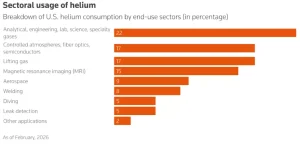
- Helium is a critical input in chip manufacturing, used for cooling, leak detection, and precision processes.
- Supply Constraints: Helium supply is geographically concentrated, with Qatar contributing a major share of global production.
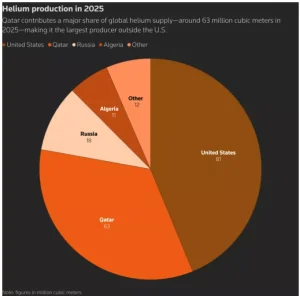 Producers: Helium production is highly concentrated in a few countries, as it is mainly extracted as a byproduct of natural gas processing.
-
- The USA and Qatar are the largest producers of helium.
- Market Impact: Prices of helium have surged significantly due to supply disruptions and logistical challenges.
- Impact on Semiconductor Industry: Chipmakers are facing production slowdowns and may need to prioritise critical manufacturing.
- Supply Chain Effects: The shortage is expected to create ripple effects across industries such as electronics, automobiles, and smartphones.
- Alternatives: Companies are exploring alternative helium sources, including increased reliance on the United States.
About Helium
- Helium is a colourless, odourless, inert noble gas with atomic number 2.
- Position in Periodic Table: It belongs to the noble gases group (Group 18) and is chemically non-reactive due to a complete outer electron shell.
- Occurrence: Helium is the second most abundant element in the universe but is rare on Earth and mainly obtained from natural gas deposits.
- Physical Properties: It has an extremely low boiling point (-269°C), making it useful for ultra-cold applications.
- Key Uses: Helium is widely used in cryogenics, semiconductor manufacturing, MRI machines, leak detection, and space.


 30 Mar 2026





.png)






 Current Affairs




 GS Foundation
 Optional Course
 Combo Courses
 Degree Program