In a recent ruling, the Supreme Court of India upheld a decision of the Andhra Pradesh High Court, affirming that Scheduled Caste (SC) status is restricted to Hindus, Sikhs, and Buddhists, and is lost upon conversion to religions like Christianity or Islam.
- The case arose when a Christian pastor sought protection under the Scheduled Castes and Scheduled Tribes (Prevention of Atrocities) Act, 1989, thereby bringing into sharp focus the legal, constitutional, and sociological tensions surrounding caste, religion, and affirmative action.
Key Highlights of the Supreme Court Judgment
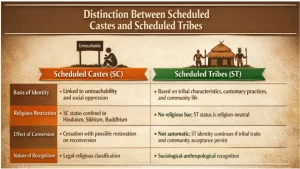
- Absolute Religious Restriction under Clause 3: The Supreme Court held that Clause 3 of the Constitution (Scheduled Castes) Order, 1950 creates a categorical and legally binding restriction on the recognition of Scheduled Caste status for persons who profess religions other than Hinduism, Sikhism, or Buddhism.
- This interpretation reaffirms the religion‑linked design of the SC framework as originally envisaged in 1950, and subsequently maintained through amendments in 1956 and 1990 to include Sikhs and Buddhists.
- By reading Clause 3 strictly, the Court underscored that the Constitution envisages SC safeguards primarily for those communities whose historical experience of untouchability and social exclusion has been recognised within specific religious contexts.
- Loss of SC Status upon Conversion: Under the present legal scheme, the Court clarified that conversion to Christianity or Islam leads to the cessation of Scheduled Caste status, thereby affecting access to constitutionally guaranteed reservation benefits and statutory protections specifically tied to SC identity.
- The Court’s analysis deliberately avoided absolutist language, recognising that this conclusion flows from the existing provisions of the SC Order and not from an immutable theological premise.
- Importantly, the ruling acknowledged that SC status as a legal category is distinct from ancestral or social origins — and that rights flowing from that legal category are conditioned on continued adherence to the specified religions.
- Ineligibility for Protection under the Prevention of Atrocities (PoA) Act: The Court made it clear that a person who is not legally recognised as a Scheduled Caste cannot ordinarily invoke protections under the Scheduled Castes and Scheduled Tribes (Prevention of Atrocities) Act, 1989.
- Although the Act exists to protect victims of caste‑based violence and discrimination, the judgment draws a line between social oppression and legal membership of the SC category.
- This has practical consequences; individuals who continue to face caste‑based abuse after conversion may find themselves outside the statutory ambit of the PoA Act unless they can establish reconversion and community acceptance under established jurisprudence.
- Doctrine of “Professing a Religion”: The Supreme Court emphasised that the term “profess” must be understood to imply an open, outward, and public expression of faith coupled with corresponding practices and conduct, rather than a mere private inclination or ancestral association.
- This interpretation aligns with earlier pronouncements in cases like Soosai v. Union of India (1985), where the Court examined the practical effects of caste discrimination among converts and found that evidence must be robust to justify legal extension of SC status.
- Principle of Mutual Exclusivity: The Court underlined that under the current constitutional and statutory framework, a person cannot simultaneously claim Scheduled Caste status while professing a religion outside the notified list of Hinduism, Sikhism, or Buddhism.
- However, the judgment did not dismiss the possibility of conditional restoration; rather, it situated this possibility in earlier jurisprudence where reconversion — if bona fide and socially validated — can result in restoration of status, as reflected in precedents such as C.M. Arumugam v. S. Rajagopal (1976) and Kailash Sonkar v. Maya Devi (1984).
- These precedents demonstrate that caste identity, while legally regulated, is deeply embedded in social acceptance and community recognition.
Historical Evolution of Scheduled Caste Status
- Origin in the Experience of Untouchability: The constitutional recognition of Scheduled Castes originated as a remedial response to the deeply entrenched social evil of untouchability and caste‑based exclusion that was embedded in pre‑independence Indian society.
- The framers of the Constitution understood that formal legal equality alone could not undo centuries of social marginalisation, and therefore crafted a set of affirmative action measures designed to facilitate substantive equality and genuine social participation for those historically oppressed groups.
- Constitution (Scheduled Castes) Order of 1950: In order to operationalise constitutional mandates, the President issued the Constitution (Scheduled Castes) Order, 1950, which established a legal method for identifying Scheduled Castes across states and union territories.
- The 1950 Order initially restricted SC status to persons professing Hinduism, based on the dominant understanding at the time that caste‑based untouchability was a feature of the Hindu social order from which others might derive.
- Extension to Sikhs and Buddhists: Over the next four decades, the SC framework was selectively expanded to include Sikhs (1956) and Buddhists (1990) after sociological and constitutional deliberations indicated that caste‑based social stigma often continued among converts to these faiths.
- These expansions did not render the SC Order religion‑neutral; rather, they represented a calibrated acknowledgement of the persistence of caste markers and social stratification across these specific religious communities.
- Continuing Exclusion of Dalit Christians and Dalit Muslims: Despite longstanding campaigns by civil society groups, activists, and affected communities, Dalit Christians and Dalit Muslims have continued to be excluded from SC status.
- Reports such as those of the Ranganath Misra Commission (2007) and ongoing examination by Justice K. G. Balakrishnan Commission (2022) highlights that caste‑based discrimination often persists socially after conversion, even if not doctrinally sanctioned within the religion.
- This continuing exclusion has fuelled sustained policy debates about whether the legal framework remains adequate in addressing substantive lived disadvantage.
About Scheduled Castes (SC)
- Historical and Sociological Basis: Scheduled Castes consist of groups that have historically endured untouchability, social exclusion, occupational segregation, and denial of civil rights, which are not merely historical artifacts but continue to influence patterns of marginalisation in education, employment, access to public goods, and participation in social institutions.
- The SC framework was therefore designed with a transformative intent, aiming to dismantle structural barriers rather than merely affirm formal legal rights.
- Protective Constitutional Classification: SC status is not simply an identity label; it is a constitutional classification that triggers a suite of affirmative action measures, including reservations in education and public employment, political representation, welfare schemes, and protection under special laws such as the SC/ST (PoA) Act.
- This classification reflects an understanding that systemic disadvantage cannot be addressed through general equality provisions alone.
- Objective of Substantive Equality: The underlying objective of SC classification is to achieve substantive equality, which means empowering historically marginalised groups to overcome social, economic, and educational disadvantages so that they can engage meaningfully in all spheres of public life.
- This transformative aspiration aligns with the broader constitutional vision articulated in the Preamble, as well as in Articles 14 (Right to Equality), 15 (Prohibition of Discrimination), 16 (Equality of Opportunity), and 46 (Promotion of Economically and Educationally Backward Classes).
- Linkage with Untouchability and Religious Context: The SC framework remains linked to untouchability and caste oppression as documented in colonial and post‑colonial sociological literature.
- Since those practices often manifested within communities that traditionally identified with Hinduism, Sikhism, and Buddhism, the SC Order reflects a historical lens that tied affirmative action measures to certain religious contexts.
- Constituent Assembly Vision: In Constituent Assembly debates, leaders such as Dr. B.R. Ambedkar emphasised that the protections for Depressed Classes (later termed Scheduled Castes) were aimed at remedying entrenched injustices within the social order.
- The initial exclusion of Dalit converts to religions such as Christianity or Islam was not envisioned as discrimination per se, but as a pragmatic application of extant social patterns and doctrinal understandings of caste at that historical moment.
Enroll now for UPSC Online Course
Constitutional and Legal Framework Governing SC Status
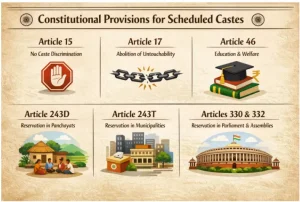
- Article 341 and Parliamentary Primacy: Article 341 empowers the President to specify Scheduled Castes.
- Under Article 341(2), once the President notifies a list, only Parliament can insert or omit groups from that list, making SC identity ultimately subject to legislative determination rather than judicial redesign.
- This places the matter predominantly in the realm of democratic policymaking and legislative choice, subject to constitutional safeguards.
- Interlinkage with Core Constitutional Provisions: The legal framework sits within a broader set of constitutional provisions that aim to balance equality, anti‑discrimination, and freedom of religion.
- Article 14 guarantees equality before law and equal protection
- Article 15(4) and 15(5) permit special provisions for SCs
- Article 16(4) provides for reservation in public employment
- Article 17 abolishes untouchability
 Article 25 guarantees freedom of conscience and religion
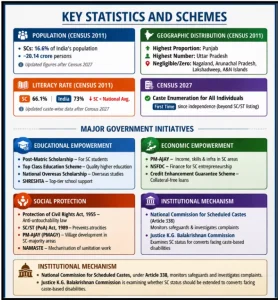
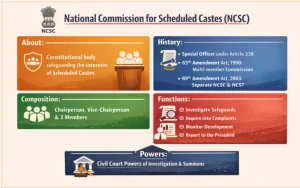
- Article 338 establishes the National Commission for Scheduled Castes to monitor safeguards and investigate grievances.
- Tension between Freedom of Religion and SC Safeguards: While the Constitution protects freedom of conscience under Article 25, the legal consequence that conversion may lead to loss of affirmative action benefits raises a normative question about indirect burdens on religious freedom.
- The law does not prohibit conversion, but the collateral consequence of losing SC status may create social and structural disincentives that require careful constitutional balancing.
- Federal and Governance Dimensions: Although many caste‑related issues are experienced at the state and local levels, the authority to recognise Scheduled Castes is centralised under Article 341, creating a tension between local sociological realities and constitutionally prescribed national criteria.
- States can recommend changes, but ultimate authority rests with Parliament, accentuating the governance challenge.
Important Judicial Precedents
- Soosai v. Union of India (1985): In Soosai, the Supreme Court upheld the validity of Clause 3 and the religion‑linked framework, finding that the petitioners did not place before the Court sufficient material to demonstrate that caste disabilities among Christian converts were constitutionally comparable to those faced by notified SCs.
- C.M. Arumugam v. S. Rajagopal (1976): The Court observed that reconversion to the original religion, followed by social acceptance by the caste community, can in certain circumstances allow revival of caste identity and associated benefits, acknowledging the social nature of caste beyond legal categories.
- Kailash Sonkar v. Maya Devi (1984): Reaffirmed that genuine and socially validated reconversion can result in restoration of caste status, thereby introducing nuance into the otherwise rigid application of the SC Order and highlighting that caste identity operates at the intersection of legal recognition and social acceptance.
- These precedents indicate that although conversion to a non‑notified religion leads to loss of SC status under statutory law, the judiciary has recognised doctrinally that caste identity is socially constituted and can, in limited circumstances, be reinstated through reconversion and proof of community acceptance.
Judicial Doctrines and Interpretations
- Doctrine of “Professing a Religion”: The Court’s interpretation confirms that SC status depends on publicly professed religion, measured by outward conduct and affiliation, rather than subjective or ancestral lineage, aligning with the statutory language of Clause 3.
- Cessation of Status on Conversion: Under the present scheme, conversion outside the notified religions results in the cessation of SC status as a legal category, affecting eligibility for affirmative action benefits.
- Reconversion and Conditional Revival: Judicial doctrine, as reflected in C.M. Arumugam and Kailash Sonkar, suggests that conditional revival is possible where reconversion is bona fide and accompanied by community acceptance, demonstrating how the legal framework intersects with social reality.
- Principle of Mutual Exclusivity: The present legal interpretation treats the combination of SC status and adherence to a non‑notified religion as mutually incompatible, while recognising that case‑specific evidence may justify restoration under certain conditions.
|
About Doctrine of Re‑conversion
- Proof of Original Caste Identity: A claimant seeking restoration after reconversion must establish original membership in a notified Scheduled Caste with credible documentary evidence, ensuring that claims are grounded in verified status.
- Bona Fide Re‑conversion: Reconversion must be sincere and not instrumental or opportunistic in nature; courts require evidence showing that the individual has genuinely reverted to the original faith.
- Community Acceptance as Social Validation: Since caste is socially constituted, acceptance by the original caste community is an important factor in judicial assessment, reflecting the communal dimension of caste identity.
- Burden of Proof on the Claimant: The claimant bears the entire burden of proof, which includes demonstrating original status, genuineness of reconversion, and acceptance by the caste community, thereby safeguarding the reservation system from exploitation.
Commissions and Policy Debate
- Ranganath Misra Commission (2007): The National Commission for Religious and Linguistic Minorities chaired by Justice Ranganath Misra recommended delinking SC status from religion to include Dalit Christians and Dalit Muslims, arguing that caste‑based discrimination transcends formal religious boundaries and that exclusion on religious grounds undermines substantive equality.
- Justice K.G. Balakrishnan Commission (2022): In recognition of continuing policy debates, the Union Government established a commission headed by former Chief Justice K.G. Balakrishnan in 2022 to examine whether SC status should extend to Dalit converts.
- The commission’s work — including hearings, data collection, and extension of tenure — demonstrates that the issue remains active, contested, and subject to empirical evaluation rather than settled legal doctrine.
- Need for Data on Converted Communities: Policy and judicial discussions are hampered by a lack of reliable data on Dalit Christians and Dalit Muslims.
- Debates around the 2025 Census and caste enumeration underscored the absence of comprehensive socio‑economic data on converted communities, which has significant implications for evidence‑based policy.
Check Out UPSC CSE Books From PW Store
Arguments in Favour of Retaining the Present Restriction (Status Quo)
- Untouchability as the Foundational Criterion of SC Status: The Scheduled Caste framework was constitutionally designed as a specific remedial measure against the practice of untouchability, which historically evolved within the Hindu social order and its socio-religious extensions.
- Since religions like Christianity and Islam are doctrinally egalitarian and do not formally recognize caste hierarchies, it is argued that the core disability justifying SC status is presumed to cease upon conversion, thereby justifying the continuation of the religion-based restriction.
- Protection of Finite Reservation Resources and Intra-Group Equity: Reservations function within fixed quotas and limited institutional capacities, making their distribution inherently competitive.
- Extending SC status to additional groups such as Dalit Christians and Muslims could significantly increase the beneficiary base, thereby diluting benefits for existing SC communities, especially the most marginalized sub-castes.
- This raises concerns about intra-group equity, where historically disadvantaged sections may be further pushed to the margins.
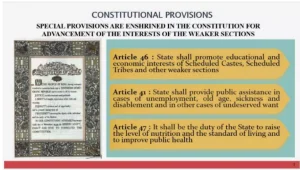 Preservation of the Targeted Nature of Affirmative Action: The SC category is a narrowly tailored constitutional instrument aimed at addressing a specific form of structural exclusion (untouchability).
- Expanding it to include all forms of caste-based disadvantage across religions risks blurring the distinction between SCs and other backward classes, thereby diluting the precision, effectiveness, and policy focus of affirmative action.
- Constitutional Validity under Reasonable Classification (Article 14): The religion-based restriction is defended as a valid classification under Article 14, as it is based on an intelligible differentia—historical experience of untouchability—and bears a rational nexus with the objective of providing targeted remedies.
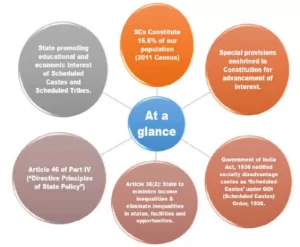 Therefore, the exclusion of other religious groups is viewed not as arbitrary, but as constitutionally grounded differentiation.
- Parliamentary Primacy and Institutional Competence (Article 341): The identification and modification of Scheduled Castes fall within the exclusive legislative domain of Parliament, as envisaged under Article 341.
- As highlighted in E.V. Chinnaiah v. State of Andhra Pradesh (2004), any expansion of SC status must be based on comprehensive empirical data and democratic deliberation, rather than judicial reinterpretation, thereby preserving the principle of institutional separation of powers.
- Risk of Institutionalizing Caste within Egalitarian Religions: Extending SC status to Christians and Muslims may amount to a state acknowledgment that caste divisions exist within these religions, potentially legitimizing and reinforcing such hierarchies.
- This could undermine the egalitarian ethos of these faiths and inadvertently contribute to the perpetuation of caste identities where they are doctrinally rejected.
- Administrative Complexity and Potential for Misuse: Broadening the SC category may create significant administrative challenges, including difficulties in verifying caste origins after conversion, tracking reconversion claims, and preventing fraudulent or opportunistic inclusion.
- This could lead to policy distortions, increased litigation, and erosion of public trust in the reservation system.
Arguments in Favour of Extending SC Status (Reformist View)
- Persistence of Caste-Based Discrimination Beyond Religion: Empirical studies and sociological evidence demonstrate that caste identities and associated discrimination often persist even after conversion to Christianity or Islam.
- Practices such as endogamy, social segregation, and occupational stratification continue, indicating that conversion does not eliminate caste stigma, thereby challenging the assumption underlying the current legal framework.
- Substantive Equality over Formal Religious Classification: The constitutional commitment under Articles 14, 15, and 16 is to substantive equality, which requires addressing actual lived disadvantage rather than formal identity markers.
- Excluding Dalit converts solely on the basis of religion results in unequal treatment of similarly placed individuals, thereby undermining the principle of compensatory justice.
- Arbitrariness in Selective Inclusion of Religions: The extension of SC status to Sikhs (1956) and Buddhists (1990) was based on the recognition that caste-based stigma persists despite conversion.
- However, continuing to exclude Christians and Muslims, despite similar sociological realities, appears selective and inconsistent, raising concerns about arbitrary classification under Article 14.
- Indirect Constraint on Freedom of Religion (Article 25): The current framework creates a situation where individuals must choose between exercising their freedom of conscience and retaining access to affirmative action benefits, effectively imposing a material and social penalty on conversion.
- This undermines the spirit of religious freedom in a secular constitutional order.
- Inconsistency with the Spirit of Article 17 (Abolition of Untouchability): If caste-based discrimination continues irrespective of religion, denying SC status to converts limits the scope of Article 17, which seeks to abolish untouchability in all its manifestations.
- This creates a contradiction between constitutional ideals and legal implementation.
- Denial of Legal Protection and Access to Justice: Dalit converts who continue to face caste-based atrocities are excluded from protections under laws such as the SC/ST (Prevention of Atrocities) Act, resulting in a serious gap in legal safeguards and leaving vulnerable groups without adequate mechanisms to seek justice.
- Need for Reform Based on Empirical Evidence and Constitutional Morality: Recommendations of bodies like the Ranganath Misra Commission and the ongoing work of Justice K. G. Balakrishnan Commission highlights the need to revisit the religion-based restriction.
- A more inclusive approach would align with constitutional morality, transformative justice, and evolving social realities, ensuring that affirmative action is grounded in actual disadvantage rather than doctrinal assumptions.
Enroll now for UPSC Online Classes
Way Forward
- Evidence-Based Recalibration: Parliament, as the constitutionally designated authority under Article 341, should undertake a comprehensive and time-bound review of the Constitution (Scheduled Castes) Order, 1950, assessing whether the religion-based restriction continues to align with the constitutional objective of substantive equality.
- This review must be grounded in rigorous empirical evidence, sociological research, and contemporary data, rather than historical assumptions alone, ensuring that the SC framework evolves in response to changing social realities while preserving its core intent.
- Nationwide Empirical and Socio-Legal Studies: There is a pressing need to commission large-scale, disaggregated socio-economic and ethnographic studies to examine:
- The extent and nature of caste-based discrimination among converted communities
- Comparative levels of educational, occupational, and social deprivation
- Persistence of untouchability-like practices across religions
- Such evidence—possibly through coordinated efforts involving bodies like the NITI Aayog and expert commissions—would enable data-driven policymaking, reducing reliance on assumptions and strengthening constitutional legitimacy.
- Distinguishing Reservation from Legal Protection (Decoupled Approach): A nuanced approach should differentiate between:
- Reservation (quota-based benefits)
- Protection from discrimination and atrocities (rights-based safeguards)
- Even if reservation expansion remains contentious, the State must ensure that all individuals facing caste-based discrimination—irrespective of religion—are covered under robust, religion-neutral anti-discrimination and atrocity laws.
- This would address the current protection gap, particularly in access to justice.
- Safeguarding Existing Beneficiaries through Sub-Categorisation: Any potential expansion of SC status must be accompanied by intra-category safeguards, such as:
- Sub-categorisation within SC quotas
- Targeted prioritisation for most marginalized sub-castes
- This would prevent elite capture or displacement within the SC category, ensuring that reforms do not inadvertently worsen inequalities among historically disadvantaged groups.
- Gradual and Phased Reform with Pilot Mechanisms: Instead of abrupt structural changes, reforms could be introduced in a phased and calibrated manner, including:
- Pilot-based inclusion in select regions or sectors
- Conditional or criteria-based eligibility linked to measurable indicators of deprivation
- Such an approach would allow policy experimentation, impact assessment, and course correction, minimizing unintended consequences.
- Harmonising Constitutional Values through a Balanced Framework: A sustainable solution must reconcile competing constitutional principles:
- Article 14 – Equality and non-arbitrariness
- Article 17 – Abolition of untouchability in all forms
- Article 25 – Freedom of religion and conscience
- Article 341 – Legislative authority over SC identification
- This requires a balanced jurisprudential and policy framework that ensures affirmative action remains targeted yet inclusive, principled yet pragmatic, without undermining any core constitutional value.
- Strengthening Anti-Discrimination Architecture Beyond Reservations: India’s current legal framework remains fragmented in addressing caste discrimination outside the SC category. There is a need to:
- Enact comprehensive anti-discrimination legislation (covering housing, employment, education)
- Strengthen institutional mechanisms like the National Commission for Scheduled Castes
- Improve awareness, reporting, and enforcement mechanisms
- This would ensure that social justice is not solely dependent on reservation policy, but embedded in a broader rights-based framework.
Conclusion
The ruling reaffirms the religion-linked SC framework but exposes a gap between legal categories and lived caste realities. A balanced, evidence-based reform—led by Parliament—must reconcile equality, religious freedom, and social justice to ensure affirmative action reaches all genuinely disadvantaged groups.


 25 Mar 2026


.png)




 Current Affairs




 GS Foundation
 Optional Course
 Combo Courses
 Degree Program