Books

The Difference Between Tropical and Temperate Cyclones explains origin, energy, structure, movement, and impact. Tropical cyclones form over warm oceans with strong winds, while temperate cyclones form in mid-latitudes with widespread weather changes.
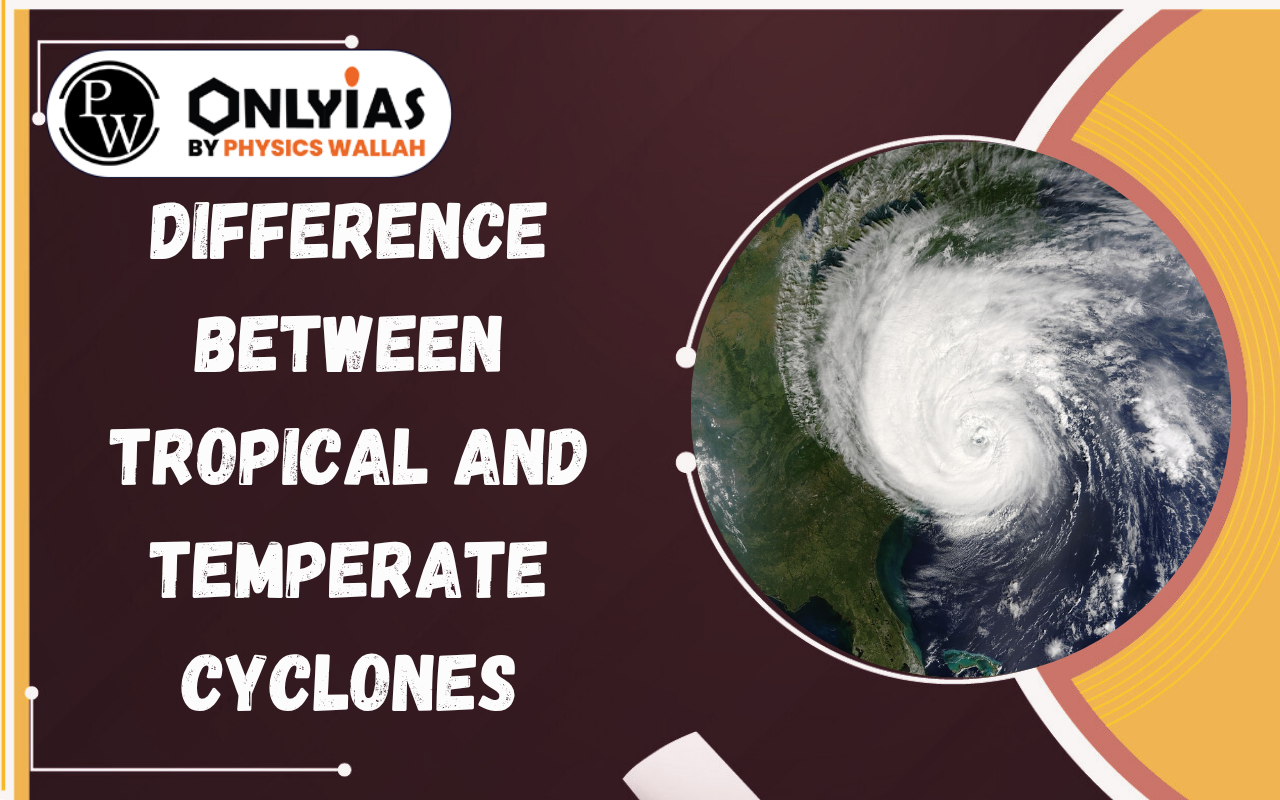
Cyclones are important weather systems that influence rainfall, wind patterns, and climate conditions across the world. In geography, they are broadly divided based on their origin and structure. The Difference Between Tropical and Temperate Cyclones helps students understand how these systems behave in different regions and why their impacts vary.
Here, we’ll explain the Difference Between Tropical and Temperate Cyclones. It covers origin, energy source, movement, rainfall, lifespan, and overall impact.
Cyclones are low-pressure systems where air moves inward and rotates around a central point. These systems play a key role in types of cyclones in geography and help explain global atmospheric circulation.
There are two main categories under cyclone types in world geography:
Understanding the Difference Between Tropical and Temperate Cyclones is important for exams and real-world weather understanding.
Tropical cyclones form over warm ocean waters in tropical regions. They are known for strong winds, heavy rainfall, and intense storms.
The characteristics of tropical cyclone include:
These features are also important under tropical cyclone characteristics UPSC preparation topics.
Temperate cyclones form in mid-latitude regions. They are also known as extratropical cyclones.
The features of temperate cyclone include:
These are also studied under temperate cyclone features UPSC.
The Difference Between Tropical and Temperate Cyclones can be clearly understood through different aspects. Below is the tropical and temperate cyclone differences table:
| Difference Between Tropical and Temperate Cyclones | ||
| Aspect | Tropical Cyclone | Temperate Cyclone |
| Region of Origin | Forms between the Tropic of Cancer and the Tropic of Capricorn over warm oceans | Forms in mid-latitudes between 35° and 65° |
| Nature of Origin | Thermal origin due to heat and moisture | Dynamic origin due to the interaction of warm and cold air masses |
| Energy Source | Gains energy from latent heat during condensation | Gains energy from temperature differences between air masses |
| Movement Pattern | Moves from east to west due to trade winds | Moves from west to east due to westerlies |
| Structure | Circular shape with a well-defined eye | Irregular shape with warm and cold fronts |
| Rainfall Pattern | Heavy rainfall in a short duration | Moderate rainfall over a large area for a longer time |
| Lifespan | Short lifespan, usually a few days to one week | Longer lifespan, can last up to two weeks |
| Impact | Intense and destructive, especially in coastal regions | Widespread impact but less intense at a single location |
Click to Know UPSC Coaching Centres in India
The tropical cyclone formation conditions include:
These conditions are necessary for strong cyclone development.
The temperate cyclone formation process includes:
This process is slower but more structured.
Check Out UPSC CSE Books
Visit PW Store
In exams, tropical vs extratropical cyclone UPSC is an important topic. Questions often focus on:
Students should clearly understand the Difference Between Tropical and Temperate Cyclones for conceptual clarity.
The Difference Between Tropical and Temperate Cyclones helps in understanding how weather systems behave across different regions. Tropical cyclones are intense and short-lived. Temperate cyclones are widespread and longer-lasting.
Both systems play a role in maintaining atmospheric balance. However, their formation, structure, and impact are very different. A clear understanding of the Difference Between Tropical and Temperate Cyclones is important for geography studies, competitive exams, and general awareness.
UPSC Offline Centres List
City
UPSC Offline Centres
Pantna
UPSC Coaching in Patna
Delhi
UPSC Coaching in Delhi
Lucknow
UPSC Coaching in Lucknow
Indore
UPSC Coaching in Indore
Jaipur
UPSC Coaching in Jaipur
Chandigarh
UPSC Coaching in Chandigarh
Bengaluru
UPSC Coaching in Bengaluru
Muzaffarpur
UPSC Coaching in Muzaffarpur
Prayagraj
UPSC Coaching in Prayagraj
Explore UPSC Test Series

In tropical cyclone vs temperate cyclone geography, tropical cyclones form over warm oceans in low latitudes, while temperate cyclones form in mid-latitudes due to air mass interaction.
The difference between tropical and extratropical cyclone lies in origin and energy source. Tropical cyclones depend on heat and moisture, while extratropical cyclones depend on temperature contrast.
The characteristics of tropical cyclone include strong winds, heavy rainfall, a clear eye, circular structure, and formation over warm ocean waters.
The structure of tropical and temperate cyclones is different. Tropical cyclones have a symmetric eye, while temperate cyclones have fronts and an irregular structure.
In tropical cyclone vs western disturbances and tropical cyclone vs mid latitude cyclone differences, tropical systems are intense and short-lived, while western disturbances and mid-latitude cyclones are widespread and longer-lasting.



Explore SRIJAN Prelims Crash Course


Connect with our experts to get free counselling & start preparing
Books
Udaan (Prelims Wallah)
Prahaar (Mains Wallah)
Q&A Bank (Prelims & Mains)
Budget & Economic Survey
NCERT Wallah
Marks Booster
हिंदी माध्यम विशेष शृंखला
 Current Affairs
Monthly Current Wallah
Subject Wise Current Affairs
Editorial Analysis
Editorial PDFs
News of The Day
Download Our App



Download Our App
<div class="new-fform">
</div>

 GS Foundation
 Optional Course
 Combo Courses
 Degree Program