The successful launch of the NASA Artemis II mission marks a major milestone in humanity’s return to the Moon, while simultaneously intensifying the geopolitical competition between the United States and China in the emerging lunar space race.
About Artemis II Mission
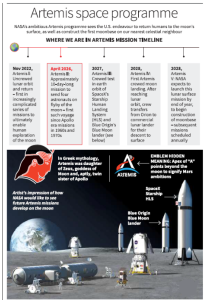
- Nature of the Mission: The Artemis II mission is a crewed lunar flyby mission that will carry astronauts on a free-return trajectory around the Moon without landing, marking the first human deep-space mission beyond low-Earth orbit since 1972.
- Technological Components: It employs the Space Launch System (SLS) rocket and the Orion crew capsule, representing the core technological architecture of NASA’s human spaceflight programme.
- Objective of the Mission: The mission is designed to test critical systems such as life-support, navigation, communication, and re-entry, thereby ensuring readiness for future lunar landing missions.
UPSC Online Preparation
| Apollo vs Artemis Missions: Major Differences |
| Aspect |
Apollo Programme |
Artemis Programme |
| Core Objective |
Human Moon landing (one-time achievement) |
Sustained lunar presence & Mars preparation |
| Approach |
Speed-driven |
Phased, test-driven |
| Mission Type |
Direct landing missions |
Step-by-step (e.g., Artemis II is a test, no landing) |
| Time Context |
Cold War competition |
Long-term exploration programme |
| Technology |
Saturn V (legacy systems) |
Space Launch System + Orion spacecraft (modern systems) |
| Safety Standards |
Limited by urgency |
Highly stringent, extensive testing |
| End Goal |
Reach Moon |
Stay on Moon & go beyond |
Mission Architecture and Operational Strategy
- Free-Return Trajectory as Fail-Safe Design: The mission adopts a free-return trajectory, ensuring that the spacecraft can naturally return to Earth even in case of major system failure, thereby embedding safety into mission design.
- High-Earth Orbit ‘Safe Zone’ Testing: Before committing to lunar travel, the spacecraft operates in a high Earth orbit safe zone, allowing engineers to verify systems and abort the mission if necessary, reflecting a layered risk mitigation strategy.
- Docking and Manoeuvring Capabilities: The mission includes testing of manual piloting and proximity operations, which are crucial for future missions involving docking with lunar landers or space stations, highlighting the shift towards modular mission architecture.
From Apollo to Artemis: Shift in Space Paradigm
- Apollo Model- Speed and Symbolism: The Apollo programme was driven by Cold War competition, with a singular objective of achieving a symbolic lunar landing, prioritising speed and political prestige.
- Artemis Model- Sustainability and Expansion: In contrast, Artemis is designed for long-term human presence, focusing on building infrastructure such as lunar bases, refuelling stations, and communication systems, thereby enabling sustained exploration.
- Debunking the ‘Lost Technology’ Myth: The absence of immediate landing does not imply technological regression, as Apollo-era systems were discontinued, and Artemis involves developing more advanced, complex, and sustainable technologies.
Significance of Artemis II Mission
- Validation of Deep-Space Human Capability: Artemis II plays a critical role in demonstrating that humans can safely travel beyond Earth’s protective magnetosphere, survive deep-space conditions, and return safely, thereby restoring capabilities last demonstrated during the Apollo era.
- Safety-First and Incremental Testing Approach: The mission reflects a risk-averse, step-by-step validation strategy, where each component is rigorously tested under real conditions, recognising that modern space missions prioritise safety and reliability over speed.
- Testing Human Survival Systems: It enables real-time assessment of life-support systems, radiation exposure, and physiological responses of astronauts, which are essential for long-duration missions in deep space.
- Re-entry and Heat Shield Validation: The mission is particularly significant in testing high-speed atmospheric re-entry, especially after anomalies observed in Artemis I, thereby ensuring that critical systems such as the heat shield function reliably under extreme conditions.
- Foundation for Future Lunar Missions: By validating key systems, Artemis II lays the groundwork for Artemis III and IV, which aim to achieve human landing and sustained presence on the Moon.
Emergence of a New Lunar Race
- Bipolar Space Competition: The current phase of lunar exploration is marked by a strategic rivalry between the United States and China, creating a bipolar structure in space geopolitics.
- Competing Programmes: While the U.S. is advancing through the Artemis Programme, China is developing the International Lunar Research Station (ILRS), both aiming for long-term lunar presence.
Click to Explore UPSC Offline Coaching
Strategic Importance of Lunar Resources
- Water Ice as a Critical Resource: The presence of water ice in permanently shadowed craters near the lunar south pole is central to the renewed interest in the Moon, as it can support life, fuel production, and habitation.
- First-Mover Advantage: Early establishment of infrastructure could allow countries to control access to key resources, thereby shaping future space missions and governance norms.
Geopolitical and Institutional Dimensions
- Multilateral vs State-Led Models: The Artemis programme follows a multilateral and commercial approach, whereas China adopts a centralised, state-driven model, reflecting contrasting governance styles.
- Geopoliticisation of Space: Space exploration is increasingly influenced by national prestige, strategic interests, and power projection, rather than purely scientific objectives.
India’s Role and Opportunities
- Normative Alignment through Artemis Accords: India’s participation in the Artemis Accords (2023) reflects its commitment to peaceful, transparent, and cooperative space exploration.
- Strategic Participation Opportunities: India can contribute through scientific payloads, joint missions, and collaboration in lunar infrastructure, while advancing its own programme such as Gaganyaan.
Operational and Strategic Challenges
- Cost and Technological Constraints: The Artemis programme faces challenges related to high financial costs, technological complexity, and delays, which may affect its execution timeline.
- China’s Competitive Edge: China’s consistent and state-driven approach, along with its ambitious timeline for a 2030 lunar landing, poses a serious competitive challenge.
- Concerns over Global Commons: The competitive race for lunar resources raises concerns regarding the equitable and peaceful use of outer space, potentially undermining its status as a global commons.
Conclusion
The Artemis II mission represents not only a technological milestone but also a strategic assertion of U.S. presence in the evolving space race.
- However, the intensifying competition highlights the need to ensure that outer space remains a domain of cooperation and shared benefit, rather than becoming an extension of terrestrial geopolitical rivalries.


 3 Apr 2026





.png)






 Current Affairs




 GS Foundation
 Optional Course
 Combo Courses
 Degree Program