Prime Minister Narendra Modi’s February 7–8 visit to Malaysia marked a strategic reset, moving the partnership beyond symbolism toward digital, industrial, financial, and security convergence.
Evolution of the ‘Act East’ Policy
- From ‘Look’ to ‘Act’: India’s policy toward East Asia began in 1991 with the “Look East” policy, which focused on the region alongside the West.
- In 2014, Prime Minister Modi converted this into the “Act East Policy,” shifting the focus from mere observation to active engagement.
- Three Pillars: The current policy is built on three specific areas of action- Connectivity, Commerce, and Culture.
- Strategic Geography: Malaysia sits at the Strait of Malacca, a critical “choke point” where 40% of global trade passes.
- This location is vital for China’s energy supplies, making Malaysia a key partner for India’s regional interests.
The Diplomatic ‘Reboot’
- Past Strains: Relations were previously tense because Malaysia had sided with Pakistan on the Kashmir issue and offered to mediate between India and Pakistan, a red line for India.
- The presence of Zakir Naik, wanted in India under the UAPA, also added strain.
- The 2026 Reset: PM Modi’s recent visit is described as a “reboot”.
- Both nations agreed to move past old grievances and focus on a future-oriented partnership.
Key Outcomes of the India–Malaysia Meeting
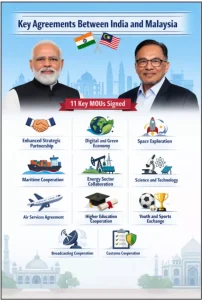
- Semiconductor Partnership: India brings strength in chip design and fabrication expertise, while Malaysia specialises in packaging and testing, making the partnership a complementary end-to-end semiconductor ecosystem.
- Strategic Collaboration: The visit led to the formalisation of the Malaysia–India Digital Council.
- An exchange of notes on semiconductors was signed to implement a “China Plus One” approach.
- Knowledge Diplomacy: IIT Madras is now linked with Malaysia’s Semiconductor Academy. This connects India’s tech hub (Chennai) with Malaysia’s tech hub (Penang) for joint training on the same technology architecture.
- UPI Integration: An agreement was signed to integrate India’s UPI with Malaysia’s PayNet.
- This makes payments easier for tourists, students, and workers while reducing remittance costs.
- Local Currency Trade: The Reserve Bank of India and Malaysia’s central bank (Bank Negara) agreed to settle trade in Rupee and Ringgit rather than the US Dollar.
- This reduces transaction costs for small businesses by eliminating double conversion fees and protecting them from dollar exchange-rate volatility.
- Sukhoi-30 Forum: Since both nations operate Russian-made Sukhoi-30 jets and Russia is currently engaged in war, a forum was created to share maintenance practices and spare parts.
- Joint Exercises: The Harimau Shakti exercise will continue, signalling that India and Malaysia are joint partners in securing the Strait of Malacca.
- Anti-Terrorism Cooperation: Both nations condemned cross-border terrorism. They agreed to share joint intelligence through the Financial Action Task Force (FATF).
- Cultural Connection: A Thiruvalluvar Centre will be established in Malaysia to connect with the significant Tamil diaspora.
- Tourism Gap: To address the imbalance where 1 million Indians visit Malaysia but only 300 Malaysians visit India, flight connectivity to Tier-2 cities is being expanded.
- CEO-Led Execution: Responsibility has been shifted from slow-moving bureaucracy to an India-Malaysia CEO Forum, ensuring faster implementation and preventing agreements from remaining on paper, particularly in green hydrogen (e.g., Gentari) and healthcare.
- BRICS Aspiration: During the visit, India noted Malaysia’s interest in joining BRICS but has not yet formally supported the bid.
Conclusion
The India–Malaysia reset under the Act East Policy reflects India’s shift from declaratory diplomacy to outcome-oriented partnerships across technology, finance, security, and culture.


 10 Feb 2026






.png)






 Current Affairs




 GS Foundation
 Optional Course
 Combo Courses
 Degree Program