India’s Budget Journey: 75 Years of Growth

India’s Budget Journey: 75 Years of Growth 2 Feb 2026

India’s Budget Journey: 75 Years of Growth

The 2026-27 Union Budget represents a significant milestone in India’s economic journey, marking a shift towards a duty-based philosophy and strategic self-reliance in manufacturing.
Budget Overview and Historical Context

India’s Budget Journey

  • Backdrop of Budgetary Expansion: The 2026 budget was presented against a backdrop of immense growth.
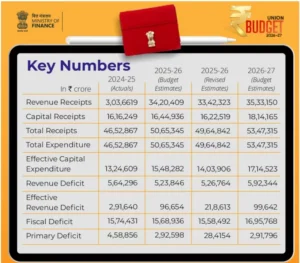
    • In 1947, India’s first budget, presented by RK Shanmukham Chetty, was only about ₹197 crore. The 2026-27 budget has grown to ₹53.5 lakh crore, representing a 27,000-fold increase over 75 years.
  • Continuity in Fiscal Leadership: Notably, Finance Minister Nirmala Sitharaman set a record by presenting her ninth consecutive budget.
  • Administrative Shift to Kartavya Bhavan: This is also the first budget from Kartavya Bhavan, the Finance Ministry’s new building, inaugurated in 2025.
  • Core Philosophy: The budget’s core philosophy is built around three “Kartavyas” (Duties):
    • First Kartavya (Duty 1): Increasing economic growth and productivity.
    • Second Kartavya (Duty 2): Fulfilling the aspirations of citizens (middle-class housing/cars and the basic needs of the poor).
    • Third Kartavya (Duty 3): Inclusive Growth (Sabka Saath Sabka Vikas), ensuring development reaches every family, community, and region.

Key Budgetary Concepts

  • Budget Estimate (BE) vs. Revised Estimate (RE): BE represents the government’s projected financial plan for the upcoming financial year (e.g., April 2026–March 2027), while RE reflects reality-based adjustments made to the previous year’s estimates in light of actual revenue and expenditure trends.
  • India’s Budget JourneyRevenue Receipts: These are government earnings that do not create repayment liabilities, comprising Tax Revenue (such as GST and Income Tax) and Non-Tax Revenue (including PSU dividends, user charges, fees, and fines).
  • Capital Receipts: These include inflows that either create liabilities or reduce assets, such as borrowings, disinvestment proceeds, and recoveries of loans previously extended.
  • Capital Expenditure (Capex): Capex refers to spending that results in the creation of productive assets like roads, railways, and hospitals, and has a strong multiplier effect, where ₹1 of public investment can generate up to ₹3 in economic output
  • Fiscal Deficit: The fiscal deficit is the gap between total government expenditure and non-loan receipts, financed through borrowing. For 2026–27, the fiscal deficit target is 4.3% of GDP.
  • Fiscal Responsibility and Budget Management (FRBM) Act, 2003:
    • 1990s Fiscal Stress: High fiscal deficits and the 1991 balance-of-payments crisis exposed India’s vulnerability and the absence of fiscal discipline.
    • FRBM Act, 2003: Enacted to institutionalise fiscal prudence by targeting a 3% fiscal deficit, a 40% debt-to-GDP ratio and eliminating revenue deficits.
    • Pre-GFC Consolidation (2007–08): A successful fiscal correction reduced the deficit to 2.7%, before it was derailed by the global financial crisis.
    • COVID-19 Shock (2020–21): Extraordinary pandemic spending led to a historic spike in fiscal deficit to 9.2%, temporarily overriding FRBM limits.
  • NK Singh Committee (2016): Fiscal Deficit Target: Recommended reducing the fiscal deficit to 2.5% of GDP by 2023 to ensure medium-term macroeconomic stability.
    • Debt-to-GDP Framework: Proposed a ceiling of 40% for the Centre and 20% for States to anchor debt sustainability within a rules-based system.
    • Escape Clause: Allowed a temporary deviation of up to 0.5% of GDP during exceptional circumstances such as national security threats or severe economic shocks.

Post-COVID Fiscal Recovery Journey

  • The fiscal deficit declined steadily from 9.2% in FY21 (COVID peak) to 6.7% (FY22), 6.4% (FY23) and 5.6% (FY24), with further consolidation projected at 4.8% (FY25 target), 4.4% (FY26 RE) and 4.3% (FY27 BE), aiming to reach 3.5% by FY 2027–28 and eventually the 3% FRBM mandate.

Debt-to-GDP & Government Borrowings

  • Debt-to-GDP Ratio: FY 26–27: 55.6%; FY 25–26: 56.1%; FRBM target: 40%.
  • Market Borrowings: Gross: ₹17.2 lakh crore; Net: ₹11.7 lakh crore (Gross – loan repayments = Net).
  • Why Government Borrowings Matter: Crowding-out effect on private sector credit; upward pressure on interest rates; future burden on subsequent generations.

Yuva Shakti–Driven Budget- Government’s ‘Sankalp’

  • First Kartavya: Accelerate and sustain economic growth by enhancing productivity and competitiveness and building resilience to volatile global dynamics.
  • Second Kartavya: Fulfil aspirations of our people by building capacity and making them strong partners in India’s path to prosperity.
  • Third Kartavya: Vision of Sabka Saath, Sabka Vikas, ensuring access to resources, amenities and opportunities for every family, community, region and sector.
  • Supporting Pillars: A continuous, adaptive, and forward-looking approach; a robust and resilient financial sector; sustaining momentum for structural reforms; mobilising savings and efficient capital allocation; cutting-edge technologies, including AI applications; and force multipliers for better governance.

First Kartavya (Duty 1)- Strategic Focus on 7 Manufacturing Sectors

  • Bio-Pharma Shakti: Unlike traditional chemical-based medicines, bio-pharma medicines are derived from living organisms (e.g., insulin, cancer drugs, gene therapy).
    • Goal: Increase India’s global market share from the current 2-3%.
    • Action: Upgrade 7 existing NIPERs (National Institutes of Pharmaceutical Education and Research) and establish 3 new ones.
    • SHAKTI Impact: Expansion to 1,000+ clinical trial sites attracts global pharma, enables faster drug approvals, provides early patient access, and reduces import dependence.
    • Current Challenges: High R&D costs ($1–2 billion per drug), shortage of skilled workforce, weak clinical trial infrastructure, and complex regulatory processes.
    • COVID-19 Lesson: mRNA vaccines (Pfizer, Moderna) were biopharma products. India initially couldn’t produce them. Covaxin & Covishield used traditional platforms. With biopharma capability, a faster response would have been possible.
    • Policy Relevance: Aligns with Make in India, Atmanirbhar Bharat, PLI Pharma, reducing API dependence on China and the National Biopharma Mission
  • Semiconductor Mission 2.0: Semiconductors are the building blocks of modern technology, currently dominated by Taiwan and South Korea.
    • Mission 1.0 Results: 10 projects approved with ₹1.6 lakh crore investment, including plants in Gujarat by Tata and Micron.
    • Mission 2.0 Focus: Moving to advanced capabilities, such as producing manufacturing equipment/machinery within India and securing design patents.
    • Electronics: ₹400 crore allocated for components like Printed Circuit Boards (PCBs) and resistors.
  • Rare Earth Corridors: Rare earth elements (17 elements, including Scandium) are vital to EVs, wind turbines, and missiles. China currently controls 90% of global processing.
    • The Corridor: Established across Odisha, Kerala, Andhra Pradesh, and Tamil Nadu to manage the entire value chain from mining to manufacturing.
    • Goal: Produce 6,000 metric tons of permanent magnets annually.
  • Chemical Parks via Challenge Route: India is the 6th-largest chemical producer but accounts for only 3–4% of the global market.
    • Innovation: Three dedicated chemical parks will be awarded through the Challenge Route, where states compete for funding by offering the best infrastructure.
    • Plug-and-Play Model: States provide ready-to-use infrastructure (land, power, water and clearances), enabling firms to start production quickly and reducing gestation from five years to one to two years.
    • Challenge Route Model: Promotes competitive federalism by linking funding to proposal quality, as recommended by NITI Aayog.
    • Global Benchmarks: Successful chemical clusters include Germany’s Chemical Triangle, China’s Jiangsu Chemical Park, Singapore’s Jurong Island, and India’s Dahej PCPIR.
  • Capital Goods and Containers: Capital goods are machines that produce other goods; India’s high import dependence poses a strategic risk to manufacturing continuity.
    • Hi-Tech Tool Rooms: Two CPSE-led facilities will manufacture precision components, dies and moulds using CNC and 3D printing, reducing reliance on imports from Germany and Japan.
    • CIE Scheme: Focuses on indigenising construction and infrastructure equipment, such as bulldozers and excavators, of which over 70% are currently imported, in support of PM Gati Shakti.
    • Container Manufacturing: ₹10,000 crore allocated over five years to reduce dependence on China’s 96% global dominance, lower logistics costs and strengthen supply-chain resilience.
    • Overall Benefits: Reduced logistics costs, strategic autonomy, employment generation, increased steel demand, and support to PM Gati Shakti and the National Infrastructure Pipeline (NIP).
  • Textile Sector Expansion: The textile industry is India’s second-largest employer after agriculture, supporting over 100 million livelihoods.
    • National Fibre Scheme: Focuses on promoting man-made fibres, which now account for around 60% of the global textile market.
    • Global Paradox: Despite being the fifth-largest textile exporter, India holds only 4% of the global market, far behind China (35%+) and Bangladesh (7%).
    • Budget 2026 Response: A comprehensive textile push through four initiatives—National Fibre Scheme, Textile Expansion Scheme, Mega Textile Parks and Gram Swaraj Initiative—to enhance competitiveness and employment.
  • Mega Textiles Park In Challenge Mode: Mega Textile Parks (PM MITRA): Expansion through challenge mode with a focused push on technical textiles.
    • Technical Textiles: Performance-based, non-fashion textile products used in infrastructure (Geotech), agriculture (Agrotech), healthcare (Meditech) and defence (Protech).
    • Market Potential: The Indian technical textiles market is targeted to grow from ₹2 lakh crore to ₹3 lakh crore by 2030.
    • Challenge Mode: Park allocation through competitive federalism, encouraging states to offer superior infrastructure and governance.
  • Mahatma Gandhi Gram Swaraj Initiative: Objective: Strengthen Khadi, handloom and handicrafts, supporting crores of weavers and craftsmen across India while protecting India’s cultural heritage.
    • Rationale: Heritage handloom and handicraft products have a strong global appeal but lack adequate modern market access.
    • GI-Tagged Products (Premium Potential): Pashmina (Kashmir), Chanderi (MP), Pochampally (Telangana), Banarasi (UP), Kanchipuram (TN).
    • Strategy: Branding Indian handlooms for international markets and integrating artisans with digital and e-commerce platforms.
    • Initiative Focus: Global market linkages, India Handloom branding, training that blends modern design sensibilities with traditional skills, and direct-to-consumer sales through e-commerce.

India’s Semiconductor Journey

  • Early Effort (1980s): SCL Mohali initiative failed due to outdated technology and a lack of sustained investment.
  • Policy Revival (ISM 1.0, 2021): ₹76,000 crore allocated to fabs, OSAT, and the chip design ecosystem.
  • Ecosystem Expansion (ISM 2.0, 2026): Emphasis on advanced capabilities, full-stack semiconductor ecosystem and ₹40,000 crore components scheme.
  • ISM 1.0 Achievements (by 2026)
    • Tata–PSMC Fab, Dholera (Gujarat): $10 billion investment; trial production scheduled for February 2026.
    • Micron ATMP, Sanand (Gujarat): $2.75 billion investment; commercial production expected by February 2026.
    • CG Power–Renesas (Gujarat): Facility focused on manufacturing power semiconductors.
  • Outcomes by 2026: 10 projects approved with over ₹1.6 lakh crore investment, including major fab and ATMP facilities in Gujarat.

ISM (India Semiconductor Mission) 2.0- Key New Features

  • Equipment & Materials: Focus on domestic manufacturing of fab equipment, including lithography machines, to reduce dependence on imports.
  • Full-Stack Indian IP: Promotion of indigenous chip design and ownership of intellectual property, moving beyond contract manufacturing.
  • Supply Chain Development: Local sourcing of critical chemicals, gases and materials required for semiconductor fabs to ensure resilience.
  • Research & Training: Introduction of semiconductor courses in IITs and NITs with strong industry–academia collaboration to build skilled manpower.
  • Electronics Components Manufacturing Scheme: ₹40,000 crore allocation for PCBs, capacitors and resistors to strengthen the broader electronics ecosystem beyond chips.

About Rare Earth Elements (REE)

  • Rare Earth Elements (REEs): A group of 17 elements comprising Scandium, Yttrium and 15 lanthanides; geologically common but rarely found in economically viable concentrations.
  • Strategic Applications: Essential for permanent magnets (EVs, wind turbines), batteries (hybrid vehicles), screens (electronics) and defence technologies.
  • Contemporary Relevance: Green energy transition and modern technology are critically dependent on rare earth elements.

The China Problem- Dangerous Monopoly

  • China’s Dominance: Controls 60–70% of global REE mining and over 90% of global processing, creating a near-monopoly across the value chain.
  • Geopolitical Leverage: In 2010 (China–Japan dispute), export stoppage disrupted Japan’s electronics industry, and during the 2019 US–China trade war, export threats triggered concerns in the US semiconductor sector.
  • Strategic Risk: Heavy dependence on a single country turns supply chains into tools of geopolitical coercion.
  • India’s Position: India holds 7.23 million tonnes of REO reserves (6th largest globally), concentrated in monazite sands along the coasts of Odisha, Kerala, Andhra Pradesh, and Tamil Nadu.

India’s REE Challenge & Budget Solution

  • Current REE Challenge: India exports raw REE ores, lacks processing capacity, imports 85–90% of rare-earth magnets, and captures minimal domestic value addition.
  • Budget 2026 Intervention: Creation of Rare Earth Corridors across Odisha, Kerala, Andhra Pradesh and Tamil Nadu to establish an end-to-end value chain from mining to manufacturing.
  • Supporting Measures: ₹7,280 crore Permanent Magnet Scheme and an expanded role for IREL (Indian Rare Earths Ltd) through facilities such as OSCOM in Odisha.
  • Strategic Importance: Critical inputs for EVs, wind energy, and defence platforms underline REEs as strategic minerals.

Check Out UPSC CSE Books

Visit PW Store

online store 1

Chemical Parks- Industrial Backbone of the Economy

  • Context: Despite being the 6th largest chemical producer, India’s global market share remains limited at 3–4%.
  • Budget Intervention: Establishment of three dedicated chemical parks through a challenge route to boost competitiveness.
  • Challenge Route Model: Competitive federalism where states compete for funding based on proposal quality, as recommended by NITI Aayog.
  • Plug-and-Play Infrastructure: Pre-approved land and clearances significantly reduce project gestation considerably.
  • Global Benchmarks: Successful chemical clusters in Germany, China, Singapore and India (Dahej PCPIR).

Need help preparing for UPSC or State PSCs?

Connect with our experts to get free counselling & start preparing

Aiming for UPSC?

Download Our App

      
Quick Revise Now !
AVAILABLE FOR DOWNLOAD SOON
UDAAN PRELIMS WALLAH
Comprehensive coverage with a concise format
Integration of PYQ within the booklet
Designed as per recent trends of Prelims questions
हिंदी में भी उपलब्ध
Quick Revise Now !
UDAAN PRELIMS WALLAH
Comprehensive coverage with a concise format
Integration of PYQ within the booklet
Designed as per recent trends of Prelims questions
हिंदी में भी उपलब्ध

<div class="new-fform">


    </div>

    Subscribe our Newsletter
    Sign up now for our exclusive newsletter and be the first to know about our latest Initiatives, Quality Content, and much more.
    *Promise! We won't spam you.
    Yes! I want to Subscribe.