India’s energy security is currently facing significant challenges due to heavy reliance on imports, geopolitical conflicts, and internal policy gaps.
Dependency and Market Vulnerability
- High Import Reliance: India depends on imports for 90% of its oil needs, primarily sourced from West Asia.
- Economic Growth: With an economy growing at 6% to 8%, India’s demand for oil is continuously increasing
- Supply Disruptions: Even a single day of supply disruption can severely impact the national economy.
Geopolitical Challenges to India’s Energy Security
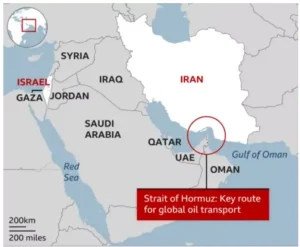
- Conflict in West Asia: The Iran-Israel war has led to the closure of the Strait of Hormuz, that is vital for India’s oil and gas supply
- Pressure from the USA: Following the Russia-Ukraine war, India began purchasing discounted Russian oil, but the US imposed 50% tariffs to pressure India into stopping these purchases.
- Diplomatic constraints in energy decisions: India eventually halted purchases of cheaper Russian oil under U.S. pressure, reflecting the geopolitical complexities shaping its energy diplomacy.
- Uncertainty in future energy arrangements: Although the U.S. now suggests India resume buying Russian oil to stabilise global supply, future discounts from Russia remain uncertain after India’s earlier withdrawal.
About Strait of Hormuz

- Location: A narrow maritime passage connecting the Persian Gulf and the Gulf of Oman.
- Strategic Importance: Nearly 20% of the world’s oil supply passes through the Strait every day.
- Major Chokepoint: It is one of the narrowest and most critical global sea lanes for energy trade.
- Energy Security Risk: Any blockade or disruption can severely affect India’s primary oil import route.
- Bordering Countries: The strait lies between Iran (north) and the UAE–Oman region (south).
|
Domestic Management Challenges in the Energy Sector
- Supply-side gaps in welfare expansion: While Pradhan Mantri Ujjwala Yojana expanded LPG connections for poor households, insufficient attention to securing adequate supply and reserves has raised sustainability concerns.
- Emerging LPG supply constraints: Reports of LPG shortages in several markets indicate weaknesses in fuel supply management and distribution systems.
- Communication lapses: Delayed and unclear government communication regarding fuel availability has fuelled rumours and hoarding, with official clarifications coming relatively late.
- Concerns over pricing fairness: Although the government seeks to shield consumers from global price rises, the benefits of lower international oil prices were not fully passed on to consumers earlier, raising questions about pricing transparency.
Way Forward
- Energy Diversification: India should diversify its energy supply sources across multiple regions to reduce dependence on any single geopolitical zone.
- Strategic Petroleum Reserves: The country needs to strengthen its storage capacity to better handle emergency supply shocks.
- Energy policy framework: Government policies should align the expansion of consumer access (e.g., LPG connections) with adequate supply chains and reserve capacity.
- Alternative energy programmes: Initiatives such as ethanol blending should be expanded, as current efforts remain insufficient to address the broader energy security challenge.
Conclusion
A balanced strategy combining diversified imports, strategic reserves, and stronger domestic energy governance is essential for India’s energy security.