While India is the world’s fastest-growing major economy with projected growth of 7.6% in 2025-26, it is experiencing a K-shaped recovery.
About K-shaped Recovery
- Definition: A K-shaped economy describes a situation in which different sectors, firms, or social groups recover at unequal rates after an economic shock, with some experiencing strong growth while others continue to decline.
Key Economic Terms
- Base Year: A benchmark year used as a reference point to measure changes in economic indicators such as inflation, GDP, and price levels.
- India currently uses 2022–23 as the base year for several statistical calculations.
- Purchasing Power Parity (PPP): A method used to compare living standards across countries by adjusting for differences in price levels and measuring what a unit of currency can actually buy.
- Progressive Taxation: A taxation system in which tax rates increase with rising income levels, meaning higher earners pay a larger percentage of their income in taxes to reduce economic inequality.
- Gini Coefficient and Lorenz Curve: These are standard economic tools for measuring income or wealth inequality.
- The Lorenz Curve graphically shows the distribution of income across the population.
- The Gini Coefficient provides a numerical measure of inequality ranging from 0 (perfect equality) to 1 (perfect inequality).
|
Understanding the Inequality (K-Shaped Growth in India)
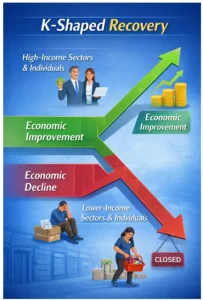
- Growth Paradox: According to the World Inequality Report 2026, India shows strong GDP growth alongside rising economic inequality, indicating that the benefits of growth are unevenly distributed.
- Income Inequality: The top 10% of the population earns about 58% of the national income, whereas the bottom 50% receives only around 15%.
- Wealth Concentration: Wealth ownership is even more unequal, with the top 1% controlling nearly 40% of India’s total wealth, including property, financial investments, and gold.
- Squeezed Middle Class: A large section of the middle class faces high tax burdens and heavy EMI obligations (housing, education, consumer loans), limiting their ability to accumulate wealth despite overall economic growth.
Barriers and Global Comparison
- Higher Inequality Compared to Europe: India’s inequality levels are significantly higher than in Europe, where strong redistributive policies such as progressive taxation and social welfare transfers limit income concentration, resulting in the top 10% earning about 26% of total income.
- Gender Gap in Workforce Participation: A major structural barrier is the low participation of women in the formal workforce (around 15%), largely due to patriarchal norms, lack of safe transport, and inadequate childcare facilities.
- Twin Development Challenge: India faces a dual problem of low average per capita income and very high inequality, which constrain inclusive growth and limit broad-based improvements in living standards.
Enroll now for UPSC Online Course
Four-Point Solution Framework
- Job Creation: Promote employment in manufacturing, logistics, and renewable energy, generating jobs across all skill levels.
- Human Capital: Invest in quality education and healthcare, particularly for economically weaker sections.
- Female Workforce Participation: Improve childcare facilities, safe transport, and flexible work arrangements to increase women’s participation in the workforce.
- Progressive Taxation: Introduce a wealth tax and higher taxes on the ultra-rich to enable redistributive public spending.
Conclusion
India’s K-shaped recovery underscores the need to align high economic growth with inclusive development through job creation, human capital investment, greater female workforce participation, and progressive redistribution policies.


 27 Mar 2026





.png)






 Current Affairs




 GS Foundation
 Optional Course
 Combo Courses
 Degree Program