Recently, the Union Government announced that India is nearing a “Naxal-free” status, citing the significant decline of the Maoist insurgency across the erstwhile Red Corridor due to sustained security operations and developmental interventions.
UPSC Online Preparation
Origins and Definitions of the Naxalite Movement
- The Red Corridor: Refers to the region that once witnessed strong Naxalite influence, stretching from the Nepal border through Bihar, Jharkhand, Chhattisgarh, and Odisha to Andhra Pradesh.
- Organisational Structure:
- Politburo: The highest decision-making body of the Naxal movement. Most of its top leaders have been killed or imprisoned, leaving the structure significantly weakened.
- People’s Liberation Guerrilla Army (PLGA): The armed wing of the Naxals, which was once highly active but is now largely confined to the Abujhmad forests in the Bastar division of Chhattisgarh.
- Historical Rise (1967): The movement originated in the village of Naxalbari as a peasant revolt against the Zamindari System, semi-feudal agrarian relations, and the neglect of Santhal tribal communities.
- Key Quote on Origin: The movement has been described as the “legitimate child of illegitimate neglect”, highlighting how state neglect and social injustice created fertile ground for insurgency.
- Leadership: Charu Majumdar authored the “Eight Documents”, which articulated the revolutionary framework against injustice.
- While the underlying “fire” of grievances already existed, Majumdar effectively “lit the match.”
- Protracted People’s War: A long-drawn armed struggle aimed at gradually weakening the state, which forms the core ideology of Maoist insurgency.
The Peak of the Threat
- National Security Risk: Former Prime Minister Dr Manmohan Singh classified Naxalism as one of the top three threats to India’s internal security
- Major Incidents: The Naxalite–Maoist insurgency in India was characterised by IED blasts, the kidnapping of District Magistrates (DMs), and major ambushes
- Dantewada Attack (2010): One of the deadliest incidents occurred in Dantewada in 2010, where Maoist insurgents ambushed security personnel, resulting in the martyrdom of 76 CRPF soldiers.
Strategy for the Military Defeat of Naxalism
- Iron Fist Approach: The government adopted a “zero tolerance” policy towards Left Wing Extremism (LWE), refusing negotiations that could compromise India’s territorial integrity.
- Specialised Forces:
- Commando Battalion for Resolute Action (CoBRA): A specialised unit of the Central Reserve Police Force (CRPF) trained in jungle warfare and guerrilla counter-insurgency operations.
- District Reserve Guard (DRG): A local force largely comprising surrendered Naxal cadres and tribal youth, providing deep local intelligence and terrain familiarity.
- Operational Synergy: The combination proved highly effective—DRG units supplied local intelligence and guidance, while CoBRA commandos carried out specialised counter-insurgency operations in dense forest regions.
- SAMADHAN Doctrine:
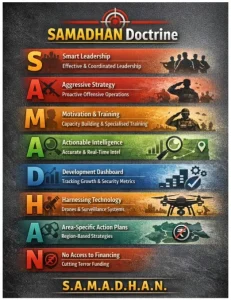 S – Smart Leadership: Effective and coordinated leadership at all levels of counter-insurgency operations.
- A – Aggressive Strategy: Proactive and offensive operations against Left Wing Extremist groups.
- M – Motivation and Training: Continuous capacity building and specialised training of security forces.
- A – Actionable Intelligence: Intelligence-driven operations based on accurate ground information.
- D – Dashboard for Development and Key Performance Indicators: Monitoring development initiatives and security performance through measurable indicators.
- H – Harnessing Technology: Use of modern technology such as drones, communication systems, and surveillance tools.
- A – Action Plan for Each Theatre: Region-specific strategies based on local conditions.
- N – No Access to Financing: Cutting off financial networks and funding sources of extremist groups.
Internal Rot and Decline of the Naxalite Movement
- Internal Decay: The weakening of the Naxalite movement was driven not only by security operations but also by internal corruption and ideological erosion within the organisation.
- Comrade Capitalists: Over time, several Maoist leaders moved away from revolutionary ideology and relied on extortion (“levy”) from coal trucks, contractors, and local businesses, often accumulating personal wealth.
- Anti-Development Tactics: Naxal groups increasingly blew up schools, roads, and public infrastructure to keep remote areas isolated and prevent state penetration, which alienated local communities.
- Citizen Fatigue: Over time, villagers felt trapped between state coercion and insurgent violence, leading to public fatigue, erosion of legitimacy, and declining local support for the Naxalite movement.
Click to Know UPSC Offline Courses
Emerging Urban Dimensions of Conflict
- A New “Red Corridor” in Cities: Growing urban inequality and socio-economic exclusion are creating conditions for potential unrest within metropolitan spaces.
- Extreme Inequality: Stark contrasts between slum dwellers and ultra-rich elites reflect widening wealth disparities and social resentment.
- Educated but Unemployed Youth: Large numbers of educated yet jobless youth raise concerns about whether India’s demographic dividend could turn into a demographic challenge.
- Persisting Structural Grievances: Tribal communities continue to face land displacement due to mining, weak land rights protection, and diversion of welfare funds through corruption, sustaining resentment against the state.
- State–Society Trust Deficit: Administrative actions such as land acquisition are often perceived by tribals as exploitative, resembling colonial-era revenue extraction, deepening alienation.
Four Emerging Forms of Insurgency / Social Conflict
- Linguistic Chauvinism: Language-based identity politics leading to regional hostility and violence.
- Religious Radicalism: Communal mobilisation exploiting social grievances and identity divisions.
- Caste Pride and Violence: Assertion of caste identities resulting in social polarisation and conflicts.
- Urban Rage and Narcotics: Frustration among marginalised youth manifesting in crime, substance abuse, and violent protests.
Conclusion
While security operations have weakened the Naxalite insurgency, addressing underlying socio-economic grievances and strengthening state–society trust remains essential for lasting peace.


 6 Apr 2026





.png)






 Current Affairs




 GS Foundation
 Optional Course
 Combo Courses
 Degree Program