A financial journalist has challenged a Delhi court’s gag order mandating removal and de-indexing of reports on the Sterling Biotech bank fraud case, highlighting the tension between the Right to Be Forgotten (RTBF) and freedom of the press.
UPSC Online Courses
Core Concepts- Digital Permanence vs. RTBF
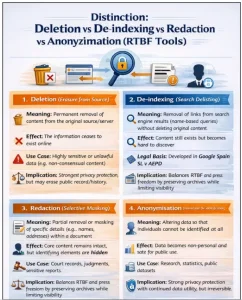
- Digital Permanence: Unlike the pre-digital era where physical files naturally “faded away,” the internet ensures that old, negative, or false information remains accessible indefinitely.
- Definition of RTBF: It involves the deletion, de-indexing, or restriction of personal data from digital platforms when it is outdated, irrelevant, or harmful to an individual’s privacy and reputation.
- Informational Self-Determination: RTBF allows individuals to be “masters of their own data,” ensuring that past “digital scars” do not cause lifelong trauma or hinder Criminal Rehabilitation.
Global Best Practices & Evolution
- European Union (GDPR): Following the Costeja Case (Google Spain), Article 17 of the GDPR codified the “Right to Erasure,” though it excludes data relevant to journalism and public interest.
- Canada (2023-2025): The Federal Court confirmed that search engines are subject to privacy laws (PIPEDA). In 2025, the Privacy Commissioner upheld a limited right to de-indexing in specific harm-based cases.
- United States (California): Evolved from the Online Eraser Law (2015) for minors to the DELETE Act (2023), which allows adults to request data deletion from data brokers.
- UK & Japan: Apply a balancing test to weigh individual privacy against the public’s right to know.
The Indian Legal Framework & Judicial Trend
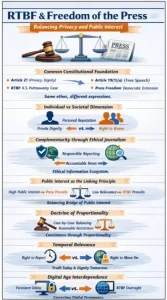
- Constitutional Basis: Flows from the Right to Privacy under Article 21 (K.S. Puttaswamy Case, 2017). It must be balanced against Article 19 (Freedom of Press).
- Statutory Laws: DPDP Act 2023: Provides for the Right to Erasure, though its application to media archives remains ambiguous.
- IT Rules 2021: Mandate intermediaries to remove harmful content within 24 to 36 hours.
- “Swinging” Judicial Trend: Early: Recognized the “Right to be let alone” (R. Rajagopalan, 1994).
- Middle: Prioritized public records and transparency (Dharmaraj Case, 2017).
- Recent Pro-Privacy Shift: Courts have ordered the redaction of names in matrimonial disputes (SC, 2022) and rape cases post-acquittal (HP High Court, 2024) to protect dignity.
Challenges and Risks
- Whitewashing History: Critics fear “digital book-burning” where historical records of financial fraud are erased, preventing future due diligence.
- SLAPP Suits & “John Doe” Traps: Large corporations use Strategic Lawsuits Against Public Participation—often against “unknown persons” (John Doe)—to silence journalists without a fair hearing.
- Settlement vs. Innocence: RTBF is being increasingly used to treat a legal settlement as a “clean chit,” potentially misleading the public record.
- The Streisand Effect: Attempting to hide information often triggers public curiosity, making it more viral than if it had been left alone.
Way Forward
To ensure Digital Constitutionalism, India needs a calibrated approach:
- Independent Adjudication: The Data Protection Board (DPB) should handle RTBF claims to prevent inconsistent “gag orders” from local civil courts.
- De-indexing over Deletion: Preference should be given to making content unsearchable (de-indexing) while keeping the original report alive in journalistic archives.
- Public Interest Exception: Information involving public money, health, or safety must be shielded from erasure requests.
- Natural Justice: Courts must ensure prior notice to media houses before enforcing takedown orders to prevent arbitrary censorship.
Click to Know UPSC Coaching Centres in India
Conclusion
The Right to Be Forgotten (RTBF) is essential to protect individual dignity in the digital age, but it must not undermine transparency. A balanced test—based on the status of the person (public vs private) and the nature of information—is necessary to safeguard privacy without erasing public history.
 20 Apr 2026