Core Demand of the Question
- Potential for Inclusive Development
- Challenges to Inclusion
|
Answer
Public charitable trusts operate under legal frameworks such as the Indian Trusts Act, 1882 and increasingly supplement state capacity in welfare delivery, addressing gaps in health, education, and social protection. Their grassroots reach and flexibility position them as important instruments for advancing more inclusive and participatory development outcomes.
Body
Potential for Inclusive Development
- Service Delivery: Trusts bridge last-mile gaps in health, education, and nutrition where state capacity is weak.
Eg: Tata Trusts support tribal healthcare and malnutrition reduction programmes across Aspirational Districts (NITI Aayog).
- Targeted Support: They focus on vulnerable groups like women, SC/STs, disabled, ensuring equity in benefits.
Eg: Azim Premji Foundation works extensively in improving government school education in rural and marginalized regions.
- Innovation Models: Trusts pilot scalable, low-cost solutions later adopted by government systems.
Eg: Aravind Eye Care model, supported by charitable structures, influenced affordable eye-care delivery nationwide.
- Community Participation: They promote local engagement, strengthening accountability and ownership.
Eg: Watershed projects by trusts under Integrated Watershed Management Programme (IWMP) involve village institutions.
- Resource Mobilisation: They channel private philanthropy into public causes, complementing limited public funds.
Eg: CSR-linked trusts under the Companies Act, 2013 fund sanitation, education, and skilling initiatives.
Challenges to Inclusion
- Weak Oversight: Fragmented regulation (state trust laws, IT Act, FCRA) leads to gaps in monitoring and enforcement.
Eg: Compliance issues flagged under Foreign Contribution (Regulation) Act, 2010 led to cancellation of thousands of NGO/trust registrations (MHA reports).
- Financial Opacity: Inadequate disclosure norms enable diversion or inefficient use of funds.
Eg: Comptroller and Auditor General of India reports have highlighted irregularities in NGO/trust fund utilisation under government-supported schemes.
- Regional Skew: Trust activities are concentrated in developed states, bypassing high-need geographies.
Eg: Data from NITI Aayog NGO Darpan shows higher NGO density in Maharashtra/Tamil Nadu vs. BIMARU states.
- Policy Misalignment: Projects often operate parallel to government priorities, limiting systemic impact.
- Donor-Driven Bias: Focus areas may reflect philanthropic preferences over grassroots needs.
Eg: Economic Survey of India notes concentration of philanthropy in urban education/health over rural livelihoods.

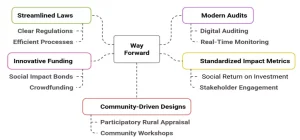
Public charitable trusts can significantly deepen inclusive development if aligned with national priorities, strengthened through transparent regulation, and integrated with government programmes. Enhancing accountability, equity in outreach, and coordination will maximise their transformative developmental potential in India.