Books

Naval Ships of India include aircraft carriers like INS Vikramaditya and INS Vikrant, along with submarines, destroyers, frigates, and patrol vessels. The Indian naval fleet ensures maritime security India, supports defense, and boosts naval power India through modernization.
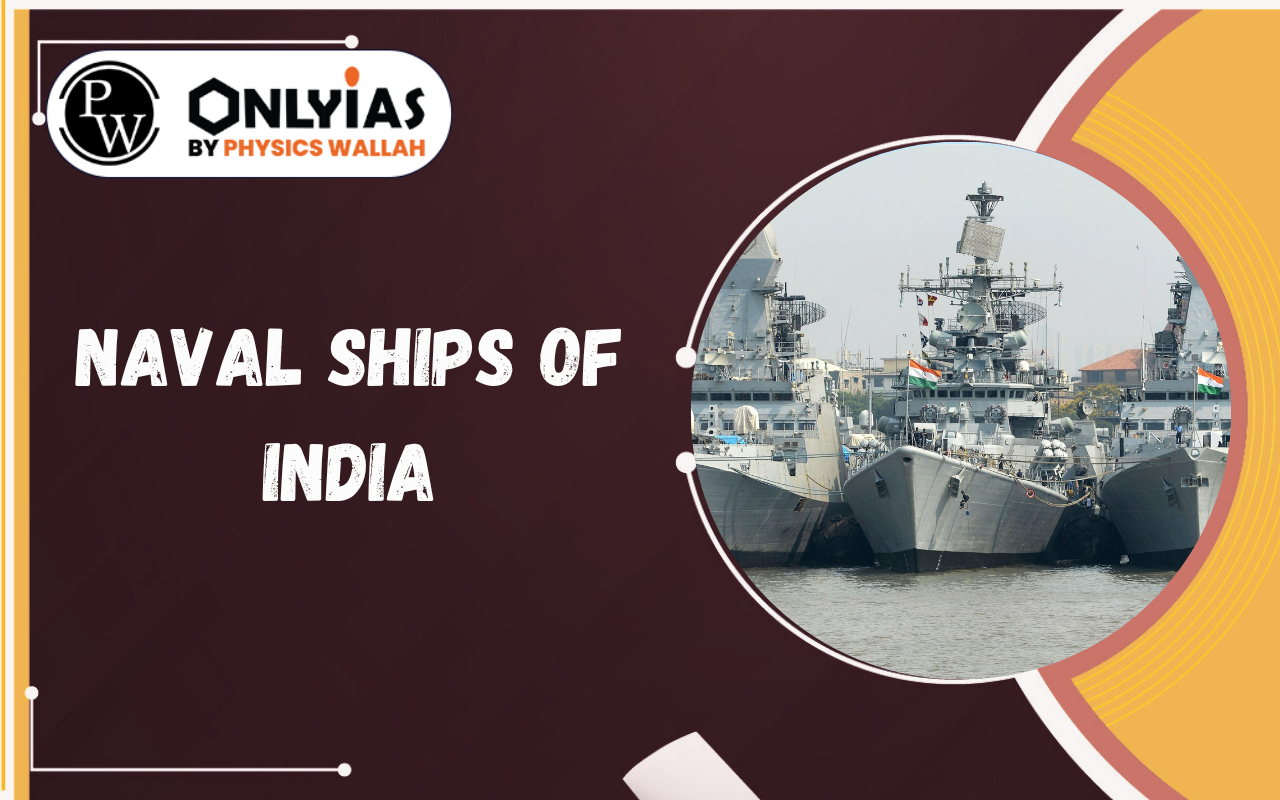
The Naval Ships of India represent the strength and capability of the country’s maritime forces. The Indian Navy plays a major role in protecting the nation’s coastline and ensuring safety in the Indian Ocean. With modern technology and a growing fleet, the Naval Ships of India reflect the country’s focus on strong defense and self-reliance. Read on for the list of Naval Ships of India for the UPSC exam.
The Indian naval fleet includes a wide range of ships designed for different missions. These ships support maritime security India and protect trade routes. The Indian Navy ships list is divided into major categories as shown below:
| Naval Ships of India Overview | ||
| Category | Role / Purpose | Examples |
| Aircraft Carriers | Power projection and air operations at sea | INS Vikramaditya, INS Vikrant |
| Destroyers | Offensive and defensive combat roles | Visakhapatnam-class, Kolkata-class |
| Frigates | Escort missions and multi-role warfare | Shivalik-class, Talwar-class |
| Submarines | Stealth operations and underwater strikes | Arihant-class, Kalvari-class |
| Corvettes | Coastal defense and patrol duties | Kamorta-class, Kora-class |
| Amphibious Ships | Troop transport and disaster relief operations | INS Jalashwa |
| Patrol Vessels | Surveillance and coastal security | Saryu-class, Sukanya-class |
| Auxiliary & Support Ships | Logistics, refueling, and operational support | Deepak-class tankers |
The Naval Ships of India include a wide range of modern warships and support vessels. These ships form the backbone of the Indian Navy vessels and ensure operational readiness at sea.
Aircraft carriers are the core of India’s naval power, projecting air dominance far from land. They serve as mobile airbases.
The Indian Navy currently operates two aircraft carriers:
| Aircraft Carriers | |||
| Name | Class | Displacement (tons) | Commissioned |
| INS Vikramaditya | Modified Kiev | 45,000 | 2013 |
| INS Vikrant | Vikrant-class | 45,000 | 2022 |
Submarines provide critical underwater warfare capabilities, including surveillance, deterrence, and covert operations. The submarines India’s navy relies on are both nuclear and diesel-electric.
The Indian Navy’s submarine fleet includes:
| Submarines | ||||
| Name | Class | Displacement (tons) | Commissioned | Note |
| INS Arihant | Arihant-class | 6,000 | 2016 | Nuclear ballistic missile submarine (SSBN) |
| INS Arighaat | Arihant-class | 7,000 | 2024 | Nuclear ballistic missile submarine (SSBN) |
| INS Kalvari | Kalvari-class | 1,800 | 2017 | Diesel-electric attack submarine |
| INS Khanderi | Kalvari-class | 1,800 | 2019 | Diesel-electric attack submarine |
| INS Sindhuraj | Sindhughosh-class | 3,076 | 1987 | Diesel-electric attack submarine |
| INS Shishumar | Shishumar-class | 1,850 | 1986 | Diesel-electric attack submarine |
Destroyers are large, fast warships armed for anti-air, anti-surface, and anti-submarine warfare. They form a key part of the warships of India.
Notable destroyers of Indian Navy include:
| Destroyes | |||
| Name | Class | Displacement (tons) | Commissioned |
| INS Visakhapatnam | Visakhapatnam-class | 7,400 | 2021 |
| INS Mormugao | Visakhapatnam-class | 7,400 | 2022 |
| INS Kolkata | Kolkata-class | 7,400 | 2014 |
| INS Chennai | Kolkata-class | 7,400 | 2016 |
| INS Delhi | Delhi-class | 6,200 | 1997 |
| INS Ranvijay | Rajput-class | 4,974 | 1987 |
Frigates are versatile escort warships, capable of anti-submarine and anti-air defense, along with surface warfare.
Key frigates of Indian Navy include:
| Frigates | |||
| Name | Class | Displacement (tons) | Commissioned |
| INS Nilgiri | Nilgiri-class | 6,670 | 2025 |
| INS Shivalik | Shivalik-class | 6,200 | 2010 |
| INS Sahyadri | Shivalik-class | 6,200 | 2012 |
| INS Talwar | Talwar-class | 4,035 | 2003 |
| INS Tarkash | Talwar-class | 4,035 | 2012 |
| INS Brahmaputra | Brahmaputra-class | 3,850 | 2000 |
Corvettes are smaller, agile warships suitable for coastal patrols, anti-submarine warfare, and quick response missions.
Active corvettes in the Indian naval fleet are:
| Corvettes | |||
| Name | Class | Displacement (tons) | Commissioned |
| INS Kamorta | Kamorta-class | 3,300 | 2014 |
| INS Kavaratti | Kamorta-class | 3,300 | 2020 |
| INS Kora | Kora-class | 1,400 | 1998 |
| INS Karmuk | Kora-class | 1,400 | 2004 |
| INS Kuthar | Khukri-class | 1,350 | 1990 |
| INS Vibhuti | Veer-class | 455 | 1991 |
These vessels are essential for transporting troops and equipment for beach landings, supporting humanitarian aid, and disaster relief operations.
Major amphibious warfare ships include:
| Amphibious Warfare Ships | |||
|---|---|---|---|
| Name | Class | Displacement (tons) | Commissioned |
| INS Jalashwa | Austin-class | 16,590 | 2007 |
| INS Gharial | Magar-class | 5,665 | 1997 |
| INS Airavat | Shardul-class | 5,650 | 2009 |
| INS LCU 58 | Mk. IV LCU | 830 | 2021 |
Patrol vessels are designed for coastal surveillance, interdiction, search and rescue, and protecting India’s Exclusive Economic Zone.
The Indian Navy operates various patrol vessels:
| Patrol Vessels | |||
| Name | Class | Displacement (tons) | Commissioned |
| INS Saryu | Saryu-class | 2,300 | 2013 |
| INS Sumitra | Saryu-class | 2,300 | 2014 |
| INS Sujata | Sukanya-class | 1,900 | 1993 |
| INS Car Nicobar | Car Nicobar-class | 293 | 2009 |
The auxiliary fleet provides essential support services like replenishment, research, and diving support, ensuring the operational readiness of the Indian Navy vessels. This category includes tankers, survey ships, and training vessels.
Examples include the Deepak-class replenishment oilers, Sandhayak-class survey vessels, and the training ship INS Tir.
The Naval Ships of India play a vital role in strengthening the country’s maritime capabilities. Their importance can be understood through the following points:
Check Out UPSC CSE Books
Visit PW Store
The Naval Ships of India are undergoing rapid modernization, driven by the Indian Naval Indigenisation Plan (INIP) 2015–2030, with a strong focus on self-reliance.
Overall, the Naval Ships of India form the backbone of the country’s maritime strength. With continuous modernization and a growing indigenous fleet, India is steadily enhancing its naval power and securing its position as a leading maritime force in the years ahead.
UPSC Offline Centres List
City
UPSC Offline Centres
Pantna
UPSC Coaching in Patna
Delhi
UPSC Coaching in Delhi
Lucknow
UPSC Coaching in Lucknow
Indore
UPSC Coaching in Indore
Jaipur
UPSC Coaching in Jaipur
Chandigarh
UPSC Coaching in Chandigarh
Bengaluru
UPSC Coaching in Bengaluru
Muzaffarpur
UPSC Coaching in Muzaffarpur
Prayagraj
UPSC Coaching in Prayagraj
Explore UPSC Test Series

Aircraft carriers, destroyers, frigates, submarines, corvettes, and patrol vessels.
India currently operates two aircraft carriers, INS Vikramaditya and INS Vikrant.
They provide stealth, surveillance, and strike capabilities underwater.
They handle advanced combat roles including air, surface, and submarine warfare.
It ensures maritime security, protects trade routes, and strengthens national defense.



Explore SRIJAN Prelims Crash Course


Connect with our experts to get free counselling & start preparing
Books
Udaan (Prelims Wallah)
Prahaar (Mains Wallah)
Q&A Bank (Prelims & Mains)
Budget & Economic Survey
NCERT Wallah
Marks Booster
हिंदी माध्यम विशेष शृंखला
 Current Affairs
Monthly Current Wallah
Subject Wise Current Affairs
Editorial Analysis
Editorial PDFs
News of The Day
Download Our App



Download Our App
<div class="new-fform">
</div>

 GS Foundation
 Optional Course
 Combo Courses
 Degree Program