

Lorem Ipsum is simply dummy text of the printing and typesetting industry. Lorem Ipsum has been the industry's standard dummy text ever since the 1500s

The Making of Modern Germany and Italy: Nationalism and State Formation

July 22, 2024

Post-1848, the widespread surge of nationalism paved the way for the unification of Germany and Italy, marking a significant chapter in their histories as sovereign nation-states. In Europe France, Germany and Italy Became the epicentre for dissipation of Nationalist Ideas. 
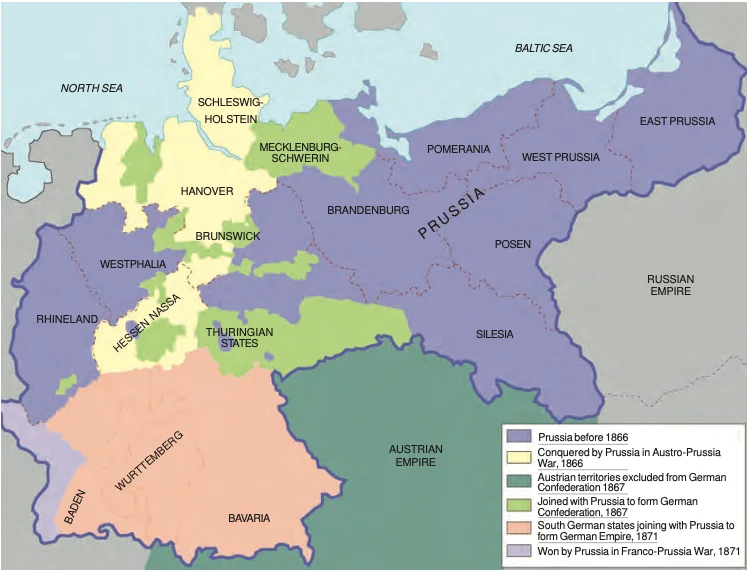
Unification of Germany (1866-71).

German Unification

Suppression of Liberal Nationalism: This liberal initiative to nation-building was, however, repressed by the combined forces of the monarchy and the military, supported by the large landowners called Junkers of Prussia.

  • Prussian Leadership: Prussia took over the leadership of the movement for national unification.
    • Chief minister, Otto von Bismarck, orchestrated this using the Prussian army and bureaucracy.
    • Three wars over seven years – with Austria, Denmark and France – ended in Prussian victory and completed the process of unification. (Refer to Figure 8.9)
  • Proclamation of German Empire: In January 1871, the formal proclamation of William I as the German Emperor took place during a distinguished assembly. (Refer to Figure 8.8)
    • Process of nation-building served as a testament to the undeniable dominance of Prussian state power.
  • Modernization of Germany: The currency, banking, legal and judicial systems in Germany were modernised.


Italy Unified

Divided Italy: In the mid-19th century, Italy was territorially fragmented into seven distinct states. (Refer to Figure)
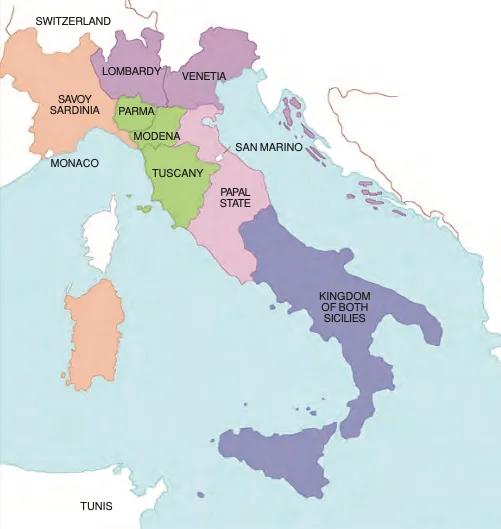
Italian states before unification, 1858
  • Sardinia-Piedmont was ruled by an Italian princely house; all the regions were dominated by different kings.
  • Birth of Italian Nationalism: In the 1830s, Giuseppe Mazzini formally founded a secret society known as Young Italy.
  • Leadership For Unification: Chief Minister Cavour directed the movement.
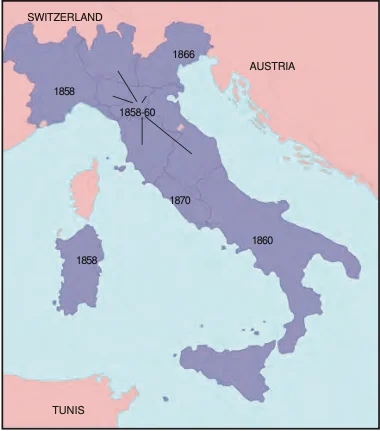
    • In 1859, Sardinia-Piedmont achieved victory over Austrian forces, and in 1860, their successful expansion into South Italy and the Kingdom of the Two Sicilies was marked by endorsement of local peasants.
  • Birth of a Nation with proclamation of Victor Emmanuel II as king of united Italy took place in 1861. (Refer Figure 8.11)
Figure 8.11: Italy after unification.

The Strange Case of Britain

  • Emergence of Great Britain: In the eighteenth century, Great Britain emerged as the prototype for nation, even though there was no distinct British nation before then.
  • Rise of British Power: The nation became powerful as it steadily grew in wealth, importance and power.
  • Birth of United Kingdom: The Act of Union, 1707 resulted in the formation of the United Kingdom of Great Britain, granting England considerable influence over Scotland.
  • Ireland’s Incorporation: In 1801, Ireland was formally and forcibly incorporated into the United Kingdom.
  • Symbols of the nascent Britain – the esteemed British flag (Union Jack), the anthem (God Save Our Noble King) and the English language – were actively endorsed.

Visualising the Nation

National Allegories: In the 18th and 19th centuries, artists skillfully personified countries, portraying them as distinct individuals, while nations were represented with grace and strength through female allegorical figures.

  • Revolution Through Representation: During the French Revolution, female figures were used to represent concepts like Liberty, Justice, and Republic.
  • Symbolizing Justice and Liberty: Liberty is symbolised by a red cap or a broken chain, while Justice is depicted as a blindfolded woman holding weighing scales.

Nationalism and Imperialism

Shrinaking Nationalism: Nationalism began to decline in influence during the last quarter of the 19th century, marking a shift in global ideologies.

  • Tension in Balkan: After 1871, the Balkans,a region of geographical and ethnic variation, including Romania, Bulgaria, Albania, Greece, Macedonia, Croatia, Bosnia-Herzegovina, Slovenia, Serbia, and Montenegro, became a major source of nationalist tension in Europe.
    • The inhabitants of this region were broadly known as the Slavs.
  • Rise of Romanticism: Romantic nationalism’s rise in the Ottoman-controlled Balkans created explosive tensions due to the empire’s disintegration despite modernization attempts.
    • Due to various conflicts, Balkan became an area of intense conflict.
  • Nationalism, Imperialism, and War: During this time, European powers’ fierce competition for trade, colonies, and military supremacy led to regional conflicts and, ultimately, the First World War.
    • In 1914, Europe faced disaster due to Nationalism coupled with imperialism
    • Despite anti-imperial efforts, forming independent nation-states proved challenging. The concept of ‘nation-states’ remained universally accepted.
Must Read
Current Affairs Editorial Analysis
Upsc Notes  Upsc Blogs 
NCERT Notes  Free Main Answer Writing

Conclusion

Nationalism became a strong influence in 19th century Europe, bringing together countries such as Germany and Italy and also escalating conflicts in the Balkans. Although it first promoted a feeling of togetherness and autonomy, its harmful capabilities were revealed during World War I. The concept of the nation-state, while under scrutiny, continued to be a key political goal.


Related Articles 
Indian National Movement: Rise of Nationalism and the Fight for Independence Indian Response to First World War & Home Rule Movement
Impact of French Revolution On India Bureaucracy: Permanent Executive, Feature and Role in Governance

Need help preparing for UPSC or State PSCs?

Connect with our experts to get free counselling & start preparing

Lorem Ipsum is simply dummy text of the printing and typesetting industry. Lorem Ipsum has been the industry's standard dummy text ever since the 1500s
Quick Revise Now !
AVAILABLE FOR DOWNLOAD SOON
UDAAN PRELIMS WALLAH
Comprehensive coverage with a concise format
Integration of PYQ within the booklet
Designed as per recent trends of Prelims questions
हिंदी में भी उपलब्ध
Quick Revise Now !
UDAAN PRELIMS WALLAH
Comprehensive coverage with a concise format
Integration of PYQ within the booklet
Designed as per recent trends of Prelims questions
हिंदी में भी उपलब्ध

<div class="new-fform">


    </div>

    Subscribe our Newsletter
    Sign up now for our exclusive newsletter and be the first to know about our latest Initiatives, Quality Content, and much more.
    *Promise! We won't spam you.
    Yes! I want to Subscribe.