Udaan, Prahaar, Q&A Bank etc.
CA Magazines & Editorials
The 16 Mahajanapadas were major kingdoms and republics of ancient India that emerged during the 6th century BCE. Learn the List of 16 Mahajanapadas, their capitals, political systems, economic features, the Rise of Magadha, links with Buddhism and Jainism, and important UPSC PYQs for exam preparation.

The 16 Mahajanapadas were the major kingdoms and republican states that emerged in India during the 6th century BCE and marked the beginning of large territorial states in ancient India. This period witnessed the Second Urbanisation, the rise of Magadha, the emergence of Buddhism and Jainism, and significant political and economic transformations.
For UPSC aspirants, the topic is important for Prelims, GS Paper I, and History Optional, with questions frequently asked on the Mahajanapadas, republican states, capitals, and the rise of Magadha.
Janapadas were early political units in ancient India, meaning “the foothold of a tribe.” They were tribal settlements that developed into small kingdoms. Over time, some Janapadas grew larger and more powerful. This growth led to their transformation into Mahajanapadas.
Several factors contributed to the rise of the 16 Mahajanapadas.
The List of 16 Mahajanapadas includes both monarchical and republican states. Their capitals were strategic centres of power and economy. While a map would visually show their layout, we can list them with their capitals.
| Mahajanapada | Capital | Region / Notes |
|---|---|---|
| Anga | Champa | East Bihar, known for trade. |
| Magadha | Rajagriha (later Pataliputra) | South Bihar, became the most powerful. |
| Kasi | Varanasi | Present-day Uttar Pradesh is famous for textiles. |
| Kosala | Shravasti | Avadh region is important for Buddhist history. |
| Vajji | Vaishali | A confederacy of eight clans, including the Lichchhavis. |
| Malla | Kushinagar, Pava | A republican state, associated with Buddha’s death. |
| Chedi | Suktimati | Bundelkhand region. |
| Vatsa | Kaushambi | Near Prayagraj, an important trade centre. |
| Kuru | Indraprastha | Modern Delhi-Meerut region is mentioned in the Mahabharata. |
| Panchala | Ahichchhatra, Kampilya | Western Uttar Pradesh is divided into northern and southern parts. |
| Matsya | Viratnagar | Rajasthan, west of the Yamuna river. |
| Surasena | Mathura | Western Uttar Pradesh is associated with Krishna. |
| Assaka (Asmaka) | Potana | South India, only the Mahajanapada south of Vindhyas. |
| Avanti | Ujjain, Mahishmati | Western India, important for trade routes. |
| Gandhara | Taxila | Northwest India/Pakistan, famous education and trade centre. |
| Kamboja | Rajapura, Dwaraka | Northwest India, known for excellent horses. |
Explore UPSC Foundation Courses

Explore UPSC Foundation Courses

The map of the 16 Mahajanapadas provides a geographical overview of the major kingdoms and republics that existed in ancient India during the 6th century BCE.
It helps visualise their locations, territorial spread, and strategic importance in shaping the political and cultural landscape of early Indian civilisation.
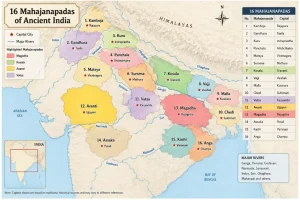
The capitals played a vital role in the administration and defence of each Mahajanapada. For example, Rajagriha was the initial capital of Magadha, strategically located amidst hills for natural defence.
Here is the complete list of 16 Mahajanpadas:
Located in eastern Bihar and parts of West Bengal, Anga was one of the easternmost Mahajanapadas. Its capital was Champa, an important trade centre situated along river routes. Anga prospered through commerce and maintained active trade connections with neighbouring regions. It frequently rivalled Magadha for political influence before being conquered by King Bimbisara, strengthening Magadha’s position in eastern India.
Located in southern Bihar, Magadha had Rajagriha as its early capital. Rich iron deposits, fertile land, and strategic rivers contributed to its growth. Under rulers like Bimbisara and Ajatashatru, it expanded rapidly and annexed neighbouring states. Magadha eventually became the most powerful Mahajanapada.
Kasi was centred around present-day Varanasi in Uttar Pradesh. Its capital was Varanasi, a major trade and cultural centre. The kingdom prospered through agriculture, textiles, and commerce. Frequent conflicts with Kosala weakened its position, and it was eventually absorbed by its neighbour.
Located in the Awadh region of Uttar Pradesh, Kosala had Shravasti as its capital. It was one of the most influential Mahajanapadas and controlled fertile agricultural land. Kosala played an important role in Buddhist history and frequently competed with Magadha before being incorporated into it.
Vajji was located in northern Bihar with Vaishali as its capital. It was a republican confederacy governed by clan representatives rather than a monarch. The Lichchhavis were its most prominent clan. Vajji was an important political and commercial centre before being conquered by Magadha.
Located in eastern Uttar Pradesh, Malla had two major centres, Kushinagar and Pava. It followed a republican form of government. Malla is especially significant in Buddhist history because Gautama Buddha attained Mahaparinirvana at Kushinagar. It remained more important religiously than politically.
Chedi was located in present-day Bundelkhand, covering parts of Uttar Pradesh and Madhya Pradesh. Its capital was Shuktimati. The kingdom is mentioned in several ancient texts, including the Mahabharata. Chedi was known for its strategic location and regional influence.
Located around present-day Prayagraj, Vatsa had Kaushambi as its capital. It was an important centre of trade and commerce due to its location on major trade routes. The kingdom gained prominence under King Udayana and maintained strong economic ties with neighbouring states.
Kuru was situated in present-day Delhi, Haryana, and western Uttar Pradesh. Its capital was Indraprastha. The kingdom is closely associated with Vedic traditions and the Mahabharata. During the Mahajanapada period, Kuru remained an important centre of political and cultural activity.
Located in western Uttar Pradesh, Panchala had Ahichhatra in the north and Kampilya in the south as major centres. It was known for its contributions to Vedic learning and education. Panchala played an important role in the intellectual and cultural development of ancient India.
Matsya was located in present-day Rajasthan with Viratanagara as its capital. The kingdom was known for cattle rearing and agriculture. It occupied a strategic position between northern and western India and is frequently mentioned in ancient Indian literature.
Explore Prarambh Course

Explore Prarambh Course

Situated around the Mathura region of Uttar Pradesh, Surasena had Mathura as its capital. It was an important centre of trade and religious activity. The kingdom benefited from its location on major commercial routes and later became associated with Krishna traditions.
Assaka was the only Mahajanapada located south of the Vindhya mountains. It was situated along the Godavari River, with Potana (Potali) as its capital. The kingdom participated in regional trade networks and served as an important link between northern and southern India.
Located in western Madhya Pradesh, Avanti had Ujjayini as its capital. It was one of the most powerful Mahajanapadas and a major commercial centre. Its position on important trade routes contributed to economic prosperity. Avanti later became part of Magadha’s expanding influence.
Gandhara was situated in present-day north-western Pakistan and eastern Afghanistan. Its capital was Taxila, a renowned centre of learning. The kingdom benefited from international trade routes connecting India with Central Asia. Gandhara became famous for its educational and cultural achievements.
Kamboja was located in the north-western frontier region near present-day Afghanistan. Its capital is not clearly known from historical sources. The kingdom was known for horse breeding, trade, and military strength. Due to its frontier location, Kamboja maintained links with Central Asian regions.
The Mahajanapada period witnessed the emergence of two major forms of political organisation in ancient India—monarchies and republics (Gana-Sanghas). While several states were ruled by hereditary kings, others followed a republican system in which power was shared among clan leaders or assemblies.
Monarchies were states governed by a single ruler, usually a king whose position was hereditary. The king exercised supreme authority over administration, taxation, justice, and military affairs. To manage the kingdom effectively, he was assisted by ministers, officials, and advisors.
Republics, also known as Gana-Sanghas, were governed by assemblies of clan chiefs, elders, or representatives rather than a single hereditary ruler. Decisions regarding administration, warfare, and public affairs were taken collectively through councils and assemblies. Prominent republican states included Vajji, Malla, and some branches of the Kuru and Panchala regions.
| Basis | Monarchy | Republic (Gana-Sangha) |
| Ruler | Governed by a single king | Governed by a group of chiefs or representatives |
| Succession | Usually hereditary | Leadership chosen from among clan members |
| Decision-Making | Decisions taken by the king and advisors | Decisions taken collectively through assemblies |
| Administration | Highly centralized | Relatively decentralized |
| Examples | Magadha, Kosala, Avanti, Vatsa | Vajji, Malla |
| Military Response | Faster and more unified | Slower due to collective consultation |
| Political Stability | Generally, more stable and expansionist | More dependent on cooperation among clans |
The Mahajanapada period witnessed significant economic growth due to the expansion of agriculture, trade, and urban centres. The widespread use of iron tools improved agricultural productivity, creating surplus production and supporting population growth. Trade and commerce flourished through well-established land and river routes connecting different regions.
Agriculture formed the backbone of the economy. The use of iron ploughshares and tools helped clear forests and increase cultivation, leading to higher agricultural output.
Trade expanded through regional and long-distance trade routes. Merchants exchanged agricultural products, textiles, metals, and other goods across different Mahajanapadas.
Punch-marked coins were among the earliest forms of currency in India. They facilitated trade and reduced dependence on barter transactions.
Several towns developed into important urban centres that served as hubs of administration, trade, and craft activities during the Second Urbanisation.
Artisans specialised in pottery, metalworking, weaving, carpentry, and other crafts, which supported both local consumption and trade.
The Mahajanapada period saw important social and cultural changes. Population growth, urbanisation, and expanding trade contributed to a more complex social structure. New occupations emerged, and towns became centres of economic and cultural activity. This period also witnessed the rise of new religious movements that challenged existing social and religious practices.
Society was broadly organised according to the Varna system, consisting of Brahmanas, Kshatriyas, Vaishyas, and Shudras. Over time, social divisions became more structured.
The growth of trade and administration led to the emergence of towns and cities, creating new opportunities for merchants, artisans, and traders.
Economic prosperity increased the influence of non-agricultural groups such as merchants and craftsmen, leading to significant social transformation.
Buddhism and Jainism emerged during this period, questioning ritualistic practices and promoting ethical living, non-violence, and spiritual equality.
Among the 16 Mahajanapadas, Magadha emerged as the most powerful kingdom and eventually laid the foundation for large empires in ancient India. Its success resulted from favourable geographical conditions, economic resources, and capable rulers.
Magadha’s location in the lower Gangetic valley provided natural protection and easy access to important trade and communication routes.
The kingdom was located near the iron-rich regions of present-day Jharkhand, enabling the production of superior tools and weapons.
The fertile alluvial soil of the Gangetic plains supported high agricultural productivity and generated surplus resources.
Rivers such as the Ganga, Son, and their tributaries facilitated transportation, trade, and military movement.
Rulers such as Bimbisara and Ajatashatru strengthened Magadha through efficient administration, diplomacy, and military campaigns.
Magadha adopted aggressive expansionist policies and annexed neighbouring states, eventually becoming the dominant power in northern India.
The rise of Magadha from a regional kingdom to the most powerful Mahajanapada was largely due to a series of capable rulers. Through military expansion, administrative reforms, and strategic alliances, these rulers strengthened Magadha and laid the foundation for future empires.
Bimbisara (c. 544–492 BCE) was the founder of the Haryanka Dynasty and one of the earliest powerful rulers of Magadha. He expanded the kingdom through conquest and diplomacy, notably annexing Anga. Bimbisara also established matrimonial alliances with neighbouring kingdoms, which enhanced Magadha’s political influence.
Ajatashatru succeeded Bimbisara and further expanded Magadha’s territory. He defeated the Vajji Confederacy and strengthened the kingdom’s military capabilities. His reign marked a significant phase in Magadha’s rise to supremacy in northern India.
Udayin, the son of Ajatashatru, is credited with establishing Pataliputra as the capital of Magadha. Located at the confluence of important rivers, Pataliputra became a strategic political and commercial centre.
Shishunaga founded the Shishunaga Dynasty after the decline of the Haryankas. He successfully annexed Avanti, eliminating one of Magadha’s major rivals and further consolidating Magadhan power.
Mahapadma Nanda was the founder of the Nanda Dynasty and is often regarded as the first great empire-builder of northern India. He expanded Magadha extensively and established a powerful centralised administration that prepared the way for the Mauryan Empire.
The Mahajanapada period represents a major turning point in ancient Indian history. It witnessed the emergence of organised states, urban growth, economic expansion, and new religious movements.
The period marked the transition from tribal societies to territorial states with organised governments, armies, and administrative systems.
Agricultural expansion, trade networks, craft specialisation, and the use of coins contributed to economic prosperity and the growth of urban centres.
The Mahajanapada period saw the rise of Buddhism and Jainism, which challenged existing religious practices and introduced new philosophical ideas.
Growing towns and increased interactions among different regions encouraged cultural exchange, learning, and intellectual development.
The emergence of centralised governance, taxation systems, and bureaucratic institutions laid the foundation for later imperial administrations.
The Mahajanapada period coincided with important religious developments in ancient India. Social and economic changes created conditions that encouraged the emergence of new religious and philosophical traditions.
Buddhism emerged in the 6th century BCE under Gautama Buddha. Many important events in Buddha’s life occurred within the Mahajanapadas such as Kosala, Magadha, and Vajji. Several rulers and merchants supported the spread of Buddhist teachings.
Jainism also gained prominence during this period under the teachings of Mahavira. The religion found support among merchants, urban populations, and some ruling elites across various Mahajanapadas.
Urbanisation, trade, and changing social conditions encouraged the growth of Buddhism and Jainism. Many rulers provided patronage to monks, religious institutions, and philosophical discussions, helping these traditions flourish.
Janapadas were the early territorial settlements of tribes, whereas Mahajanapadas were larger and more powerful political units that emerged around the 6th century BCE.
| Basis | Janapadas | Mahajanapadas |
| Meaning | Territory occupied by a tribe | Large and powerful territorial state |
| Time Period | Vedic Period | Around the 6th Century BCE |
| Size | Comparatively smaller | Larger and more extensive |
| Political Structure | Tribal chiefdoms and small kingdoms | Organised kingdoms and republics |
| Administration | Relatively simple | More developed administrative systems |
| Economy | Primarily agricultural | Agriculture, trade, crafts, and urban economy |
| Military Strength | Limited | Strong standing armies |
| Urban Development | Few urban centres | Significant urbanisation and city growth |
| Examples | Early Kuru, Panchala | Magadha, Kosala, Avanti, Vajji |
The transformation of Janapadas into Mahajanapadas reflects the growth of political organisation, economic prosperity, and urban development in ancient India. This process eventually led to the rise of powerful kingdoms such as Magadha and the formation of large empires.
Question 1: With reference to ancient India (600-322 BC), consider the following pairs: (UPSC Prelims 2025);
| Territorial Region | River Flowing in the Region | ||
| I. | Asmaka | : | Godavari |
| II. | Kamboja | : | Vipas |
| III. | Avanti | : | Mahanadi |
| IV. | Kosala | : | Sarayu |
How many of the pairs given above are correctly matched?
a) Only one
b) Only two
c) Only three
d) All the four
Ans: (b)
Question 2: Which one of the following books of ancient India has the love story of the son of the founder of the Sunga dynasty? (UPSC Prelims 2016)
a) Swapnavasavadatta
b) Malavikagnimitra
c) Meghadoota
d) Ratnavali
Answer: (b)
Question 3: Which of the following Kingdoms were associated with the life of the Buddha? (UPSC Prelims 2014)
Select the correct answer using the code given below.
a) 1, 2 and 3
b) 2 and 4
c) 3 and 4 only
d) 1, 3 and 4
Answer: (c)
Check Out UPSC CSE Books
Visit PW Store
Buddhist texts like the Anguttara Nikaya and Jain literature are the primary sources.
The Vajji confederacy, centred at Vaishali, was a prominent republican state.
Magadha benefited from fertile land in the Gangetic plains and close access to iron ore deposits.
It refers to the growth of towns and cities during this period, following the decline of the Harappan civilisation's urban centres.



Explore UPSC Foundation Batches


Connect with our experts to get free counselling & start preparing
Join India’s trusted platform for expert guidance, quality content, proven success.
Learn anytime, anywhere.



India's leading UPSC coaching platform helping aspirants prepare for IAS, IPS, IFS and other Civil Services examinations with the best faculty and proven strategies.
<div class="new-fform">
</div>