Books

Anuj Agnihotri, UPSC CSE 2025 AIR 1 topper and MBBS graduate from AIIMS Jodhpur, participated in a PW OnlyIAS mock interview simulating the UPSC Personality Test. The session covered governance, public health policy, environment, tourism, and current affairs, offering valuable insights into UPSC interview preparation and administrative thinking.
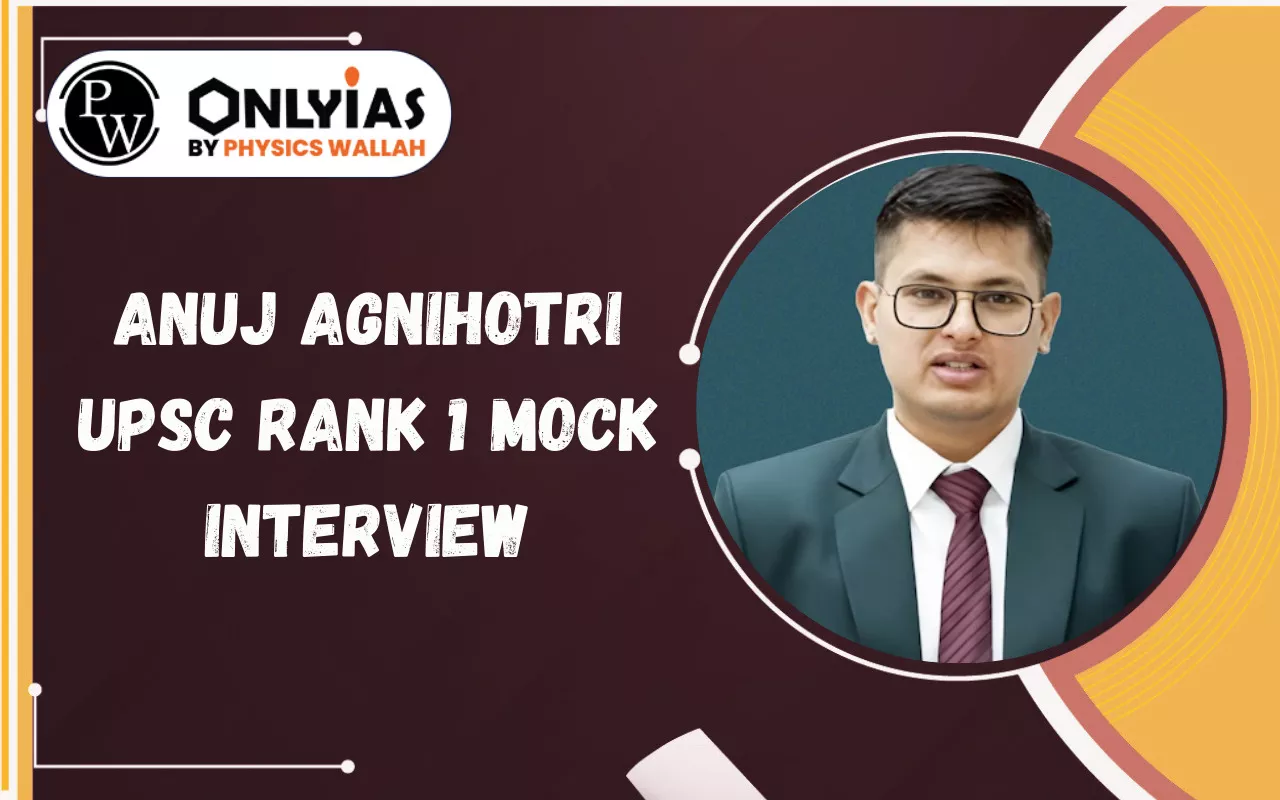
Anuj Agnihotri UPSC Rank 1 Mock Interview: UPSC Personality Test (Interview) is the final stage of the Civil Services Examination and plays a decisive role in determining the final rank of candidates. In a PW OnlyIAS mock interview session, aspirant Anuj Agnihotri participated in a simulated UPSC board interview where panelists evaluated his knowledge, personality, and administrative thinking.
Interestingly, the mock interview session gained even more attention after the UPSC Civil Services Examination 2025 final result, where Anuj Agnihotri secured All India Rank (AIR) 1. His journey from a medical student to UPSC Rank 1 topper has now become an inspiration for civil services aspirants across India.
Anuj Agnihotri achieved AIR 1 in the UPSC CSE 2025 with a total of 1071 marks (867 in Written and 204 in Personality Test), by exploring his insightful mock interview session.
Anuj Agnihotri, the UPSC CSE 2025 AIR 1 topper, participated in a UPSC Interview Guidance Program 2025 (Mock Interview Initiative) where his personality, governance understanding, and analytical thinking were evaluated. The session focused on key areas such as public health policy, environment, administration, and current affairs, simulating the actual UPSC Personality Test.
| Detail | Information |
| Candidate Name | Anuj Agnihotri |
| UPSC Achievement | AIR 1 – UPSC CSE 2025 |
| Background | Doctor (Medical Professional) |
| Career Interest | Civil Services |
| Current Service | DANICS |
| Mock Interview Platform | PW OnlyIAS |
| Focus Areas | Governance, Health Policy, Environment, Current Affairs |
| Interview Type | UPSC Personality Test Simulation |
The mock interview assessed Anuj Agnihotri’s ability to link academic knowledge with governance issues and real-world administration challenges.
The final score of the All India Rank 1 holder is a combination of exceptional performance in both the written examination and the personality test:
During the interview, the panel asked why a doctor would choose civil services instead of continuing in medicine.
Anuj explained that although medical sciences provide opportunities to serve society, civil services allow wider public interaction and larger societal impact. According to him, administration enables officers to solve people’s problems at a broader level and contribute to policymaking.
This response reflected an important UPSC interview quality — clarity of purpose and motivation for joining public service.
One of the important questions in the mock interview focused on India’s changing Total Fertility Rate (TFR).
The panel highlighted that:
Anuj explained that India’s TFR has fallen below replacement level, which may lead to challenges such as:
He emphasized that population policy needs recalibration to maintain a sustainable demographic balance.
The panel asked Anuj what one intervention he would implement if appointed as District Magistrate (DM).
He proposed that all citizens above 40 years of age should undergo mandatory annual health check-ups.
The objective of this intervention was to detect Non-Communicable Diseases (NCDs) such as:
These diseases often show no early symptoms, making preventive screening crucial for early diagnosis.
This response demonstrated his medical background combined with administrative thinking.
The panel also asked questions related to development projects in the Andaman and Nicobar Islands, especially the Great Nicobar infrastructure project.
Anuj explained that the project has both advantages and concerns:
He suggested that development decisions must balance economic growth with environmental protection and tribal rights.
Another question addressed government efforts to promote tourism in Port Blair and surrounding islands.
Anuj mentioned several initiatives:
He also suggested exploring Japanese tourism interest, considering Japan’s historical presence in the islands during World War II.
The panel raised concerns about garbage generation due to increasing tourism.
Anuj proposed a waste-to-energy model, which could:
He also suggested adopting a high-value, low-volume tourism model, similar to Bhutan’s tourism policy, to control environmental damage.
Since Anuj has a medical background, panel members asked questions related to healthcare governance.
Key topics discussed included:
Anuj stated that government health expenditure is approximately 2.5% of GDP, highlighting the need for efficient utilization of resources.
He emphasized promoting:
These measures could reduce the burden of lifestyle diseases in India.
The panel also discussed drug safety issues, especially incidents involving Diethylene Glycol (DEG) contamination in cough syrups.
Anuj explained that regulatory agencies responsible for monitoring drug quality include:
These institutions ensure medicines meet safety and quality standards before reaching the market.
Another interesting question compared Ladakh’s demand for Sixth Schedule status with the situation in Andaman and Nicobar Islands.
Anuj explained that Ladakh demands this status to protect tribal culture, land rights, and local autonomy, while the Andaman Islands have a more cosmopolitan population with smaller tribal populations, which changes the dynamics of the demand.
At the end of the mock interview, panel members provided detailed feedback to help improve performance.
Panel members advised him to revise important topics from his Detailed Application Form (DAF) and recent news.
Check Out UPSC CSE Books
Visit PW Store
The mock interview provided valuable insights for UPSC aspirants:
These strategies help candidates perform better in the UPSC Personality Test.
The Anuj Agnihotri UPSC Rank 1 Mock Interview demonstrates how UPSC interview panels evaluate candidates beyond academic knowledge. The discussion covered diverse topics including public health policy, population trends, tribal rights, tourism development, environmental sustainability, and governance.
Such mock interviews help aspirants refine their answer structure, confidence, and analytical ability, which are crucial for success in the UPSC Civil Services Personality Test.
Ready to boost your UPSC 2026 preparation? Join PW’s UPSC online courses today!
Explore UPSC Test Series

India's TFR falling below the replacement level indicates an impending aging population. This can lead to a shrinking workforce and an increased dependency ratio, posing significant economic and social challenges similar to those faced by countries like China.
DEG is a toxic solvent NOT a normal component of cough syrup. Its presence indicates adulteration or unauthorized substitution for legitimate solvents, often to cut costs. Ingesting DEG has tragically led to child fatalities due to its toxic nature.
Positively, the project holds immense strategic and military value and acts as an economic multiplier. Negatively, it has significant environmental implications, adverse effects on indigenous people like the Shompen tribes, and impacts the region's status as a biodiversity hotspot.
With a limited budget, health administrations should prioritize interventions with a high input-output ratio, primarily focusing on preventive medicine. This includes promoting vaccination programs, healthy lifestyle practices to curb non-communicable diseases, and implementing targeted health check-ups for early disease detection.
The Shanti Bill controversially allows private and foreign organizations to fund nuclear power projects, even with a stake below 49%. This raises significant concerns regarding potential strategic and security risks associated with critical national infrastructure.



Explore SRIJAN Prelims Crash Course


Connect with our experts to get free counselling & start preparing
Books
Udaan (Prelims Wallah)
Prahaar (Mains Wallah)
Q&A Bank (Prelims & Mains)
Budget & Economic Survey
NCERT Wallah
Marks Booster
हिंदी माध्यम विशेष शृंखला
 Current Affairs
Monthly Current Wallah
Subject Wise Current Affairs
Editorial Analysis
Editorial PDFs
News of The Day
Download Our App



Download Our App
<div class="new-fform">
</div>

 GS Foundation
 Optional Course
 Combo Courses
 Degree Program