Udaan, Prahaar, Q&A Bank etc.
CA Magazines & Editorials
Monsoon in India is a seasonal wind system influenced by land–sea heating, ITCZ shift, and global ocean–atmosphere interactions. It includes the Southwest and Northeast monsoons, shows uneven rainfall distribution, and is vital for agriculture, economy, and ecology. UPSC PYQs focus on mechanisms, features, distribution, and climate variability like ENSO.
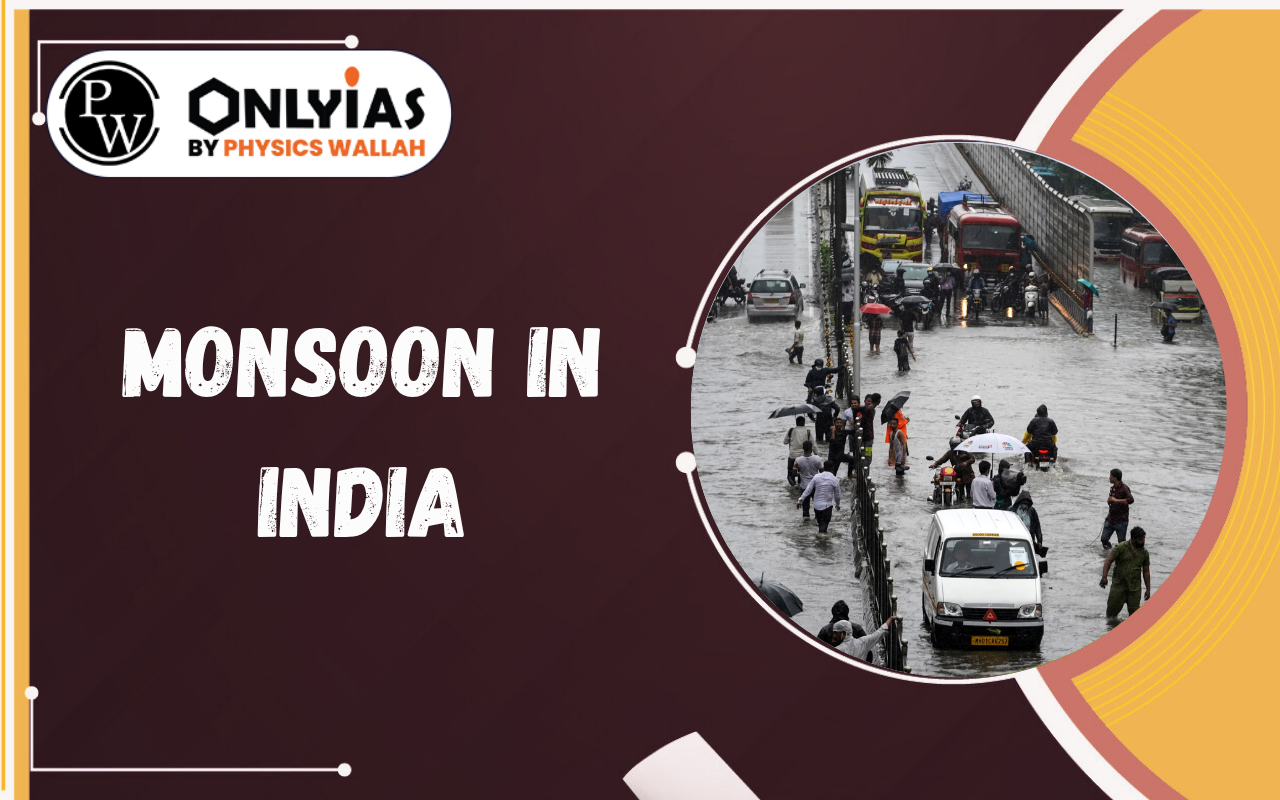
Monsoon in India refers to a large-scale seasonal reversal of winds caused by the differential heating of land and sea. It is one of the most important climatic systems in the world and plays a crucial role in shaping India’s agriculture, economy, water resources, and biodiversity.
India experiences two major monsoon systems — the Southwest Monsoon and the Northeast Monsoon. The behavior of monsoon is highly variable, often leading to floods, droughts, and fluctuations in agricultural output, which makes it critical for disaster management and planning.
This topic of ‘Monsoon in India’ is important from the perspective of the UPSC IAS Examination, falling under General Studies Paper I (Geography), General Studies Paper III (Environment, Agriculture & Disaster Management), and Prelims.
UPSC Previous Year Questions (PYQs) are an important resource for understanding the exam pattern, key themes, and the level of analytical depth required in the Civil Services Examination, helping aspirants focus on frequently asked and high-priority topics.
India’s monsoon system follows a clear seasonal pattern driven by pressure differences between land and sea.
| Type of Monsoon | Duration | Wind Direction | Key Regions Affected | Importance |
| Southwest Monsoon | June – September | Sea to Land (SW) | Entire India | Primary rainfall season; critical for agriculture and water supply. |
| Northeast Monsoon | October – December | Land to Sea (NE) | Tamil Nadu, SE Coast, Andhra Pradesh | Known as the “Retreating Monsoon”; vital for the South’s water needs. |
| Pre-Monsoon | March – May | Local Winds | Interior India, Kerala, Bengal | Features “Mango Showers” and thunderstorms; heralds the coming heat. |
| Winter Monsoon | December – February | Dry Winds | Limited Areas (North/NW India) | Generally a dry season; brings light rain to the North via Western Disturbances. |
Explore UPSC Foundation Courses

Explore UPSC Foundation Courses

The term “monsoon” originates from the Arabic word “Mausim,” meaning “season.” It describes a seasonal reversal of wind patterns that occurs due to unequal heating of land and sea, which creates pressure differences and drives the flow of winds.
During summer the land heats up faster than the surrounding sea. As land heats up, the warm air rises and forms a low-pressure area. This draws in cooler, moisture-rich air from the sea, where pressure is higher. These winds move toward the land as monsoon winds and produce widespread rainfall when they reach the mainland.
The reverse happens in winter, with winds blowing from the cooler land areas towards sea as a retreating monsoon. This explanation only provides a basic overview of monsoon circulation and does not capture its full complexity.
The Indian monsoon is driven by a combination of atmospheric and oceanic factors. During summer, land heats up faster than oceans, creating a low-pressure zone over India. This attracts moisture-laden winds from surrounding oceans.
Key processes include:
Together, these factors create the large-scale monsoon circulation system.
India experiences two distinct monsoons each year. These include the Southwest Monsoon and the Northeast Monsoon.
The southwest monsoon is India’s main rainy season and a lifeline for the country’s economy and ecology. It supports farming, fills rivers and lakes, and recharges groundwater. Nearly 75% of India’s annual rainfall is received during this season, making it crucial for irrigation, drinking water supply, and hydropower-based electricity generation.
As the southwest monsoon withdraws, the northeast monsoon develops around October, marking the period known as the retreating monsoon. It is relatively brief and covers a smaller area, yet remains significant, particularly for the southern parts of India.
By October, the land starts to cool faster than the ocean. This creates a high-pressure area over the Indian subcontinent and a low-pressure area over the surrounding seas. The direction of wind flow reverses. Now, winds blow from land to sea. These are called northeasterlies
Rainfall distribution in India is highly uneven due to geography and relief features.
Western Ghats and Northeast India receive very heavy rainfall due to orographic lift. In contrast, regions like Rajasthan receive very low rainfall due to the distance from the sea and dry air conditions. Rain shadow areas like the Deccan Plateau also receive moderate to low rainfall.
The Indian monsoon is influenced by a wide range of atmospheric and oceanic factors that interact at global and regional scales, determining its onset, intensity, duration, and spatial distribution across the country.
El Niño is a climate phenomenon that occurs due to the abnormal warming of sea surface temperatures in the central and eastern Pacific Ocean. This warming disturbs normal atmospheric circulation and weakens the pressure difference between oceans.
As a result, the southwest monsoon winds over India become weaker, leading to below-normal rainfall, delayed monsoon onset, and dry spells. In severe cases, El Niño is associated with drought conditions in India and reduced agricultural productivity.
Explore Prarambh Course

Explore Prarambh Course

La Niña is the opposite phase of El Niño and is characterized by unusually cooler sea surface temperatures in the central and eastern Pacific Ocean. This strengthens the pressure gradient and enhances moisture transport towards India.
As a result, the Indian monsoon becomes stronger than normal, bringing above-average rainfall. While beneficial for agriculture, it can sometimes lead to floods and waterlogging in several regions.
ENSO is a combined climate system that includes both El Niño and La Niña phases along with neutral conditions. It represents the fluctuation in ocean temperatures and atmospheric pressure across the Pacific Ocean. ENSO has a major influence on global climate, including the Indian monsoon.
The Indian Ocean Dipole refers to the difference in sea surface temperatures between the western and eastern Indian Ocean. It has two phases:
IOD can sometimes counteract or strengthen ENSO effects, making it a very important monsoon modifier.
Jet streams are narrow bands of fast-moving winds in the upper atmosphere. They influence monsoon circulation by controlling pressure systems. The subtropical westerly jet shifts northward in summer, allowing monsoon winds to enter India. Its position and strength directly affect the onset and intensity of the monsoon.
Snow cover in the Himalayas affects land heating. Excessive snow cover leads to slower heating of the Indian landmass, which weakens low-pressure formation. This can delay or reduce monsoon strength. Lower snow cover, on the other hand, supports stronger heating and a more intense monsoon.
Western disturbances are extra-tropical storms originating from the Mediterranean region. They mainly affect northwest India during winter and early spring. Although they are not part of the monsoon system, they influence pre-monsoon atmospheric conditions and soil moisture levels, indirectly affecting monsoon development.
Cyclones are low-pressure systems formed over warm ocean waters, especially the Bay of Bengal and Arabian Sea. They influence monsoon patterns by:
Strong cyclonic activity can therefore modify rainfall distribution during the monsoon season.
The Indian monsoon is the lifeline of the country as it supports nearly every aspect of life, economy, and environment. Its seasonal rainfall ensures ecological balance and sustains both rural and urban systems.
Explore UPSC Optional Courses

Explore UPSC Optional Courses

The Indian monsoon, while essential for the country’s economy and ecology, also brings several challenges due to its irregular, intense, and sometimes unpredictable nature. These challenges can severely impact agriculture, infrastructure, and daily life across different regions of India.
Heavy and continuous monsoon rainfall often causes rivers to overflow, leading to severe floods that damage life, property, and infrastructure in many regions.
Weak or delayed monsoon rainfall results in drought conditions, especially in rain-fed areas, affecting agriculture and water availability.
Monsoon rainfall is highly uneven across India, causing some regions to receive excess rain while others face water shortages.
Irregular or excessive rainfall during the monsoon season can damage crops, reduce yield, and sometimes lead to complete crop failure.
Rapid urbanization and poor drainage systems in cities often lead to waterlogging and urban flooding during heavy monsoon showers.
Intense rainfall in hilly and mountainous regions loosens soil, triggering landslides that disrupt transport and endanger lives.
Climate change is increasing monsoon variability, making rainfall patterns more unpredictable with stronger extremes of both drought and heavy rainfall.
In recent years, the Indian monsoon has become increasingly affected by climate change, leading to noticeable shifts in its traditional behavior. These changes are making the monsoon less predictable and more extreme, impacting agriculture, water resources, and disaster management across the country.
Climate change has led to uneven and inconsistent rainfall distribution, where some regions receive excessive rain while others face below-normal precipitation.
There is a rising frequency of short-duration, high-intensity rainfall events, which often result in flash floods and severe damage to infrastructure and crops.
In several years, the arrival of the monsoon has been delayed, affecting the sowing cycle of major crops and reducing agricultural productivity.
The retreat of the monsoon has also become irregular, sometimes occurring earlier or later than usual, disrupting post-monsoon agricultural activities.
Long dry spells within or after the monsoon season have become more common, increasing the risk of drought conditions in many regions.
The Monsoon in India is the lifeline of the country’s climate system. It not only supports agriculture and economy but also influences daily life, water security, and ecological balance. Understanding its mechanism and behavior is essential for both academic studies and UPSC preparation.
Check Out UPSC CSE Books
Visit PW Store
Explore SRIJAN Courses

The Indian monsoon is driven by differential heating of land and sea, seasonal shift of the ITCZ, development of low-pressure over the Indian subcontinent, and reversal of wind patterns due to Earth’s rotation.
El Niño generally weakens the monsoon by reducing rainfall over India, while La Niña strengthens monsoon winds and usually leads to above-normal rainfall.
India receives most rainfall during monsoon because moisture-laden winds from the Indian Ocean are drawn towards low-pressure areas over land during summer.
The Indian monsoon is characterized by seasonal reversal of winds, uneven spatial distribution of rainfall, variability in intensity, and dependence on ocean-atmosphere interactions.
The monsoon is crucial as it supports agriculture, replenishes water resources, generates hydropower, and drives rural income and overall economic growth.




Explore UPSC Foundation Batches


Connect with our experts to get free counselling & start preparing
Join India’s trusted platform for expert guidance, quality content, proven success.
Learn anytime, anywhere.



India's leading UPSC coaching platform helping aspirants prepare for IAS, IPS, IFS and other Civil Services examinations with the best faculty and proven strategies.
<div class="new-fform">
</div>