Udaan, Prahaar, Q&A Bank etc.
CA Magazines & Editorials
Continental Drift Theory explains that all continents were once joined together as a supercontinent called Pangaea and later drifted apart over millions of years. Proposed by Alfred Wegener in 1912, the theory is supported by evidence such as fossil distribution, matching coastlines, similar rock formations, and glacial deposits. Although Wegener’s explanation of the forces behind continental movement was criticized, the theory became the foundation for modern Plate Tectonic Theory and remains an important topic for UPSC Geography preparation.
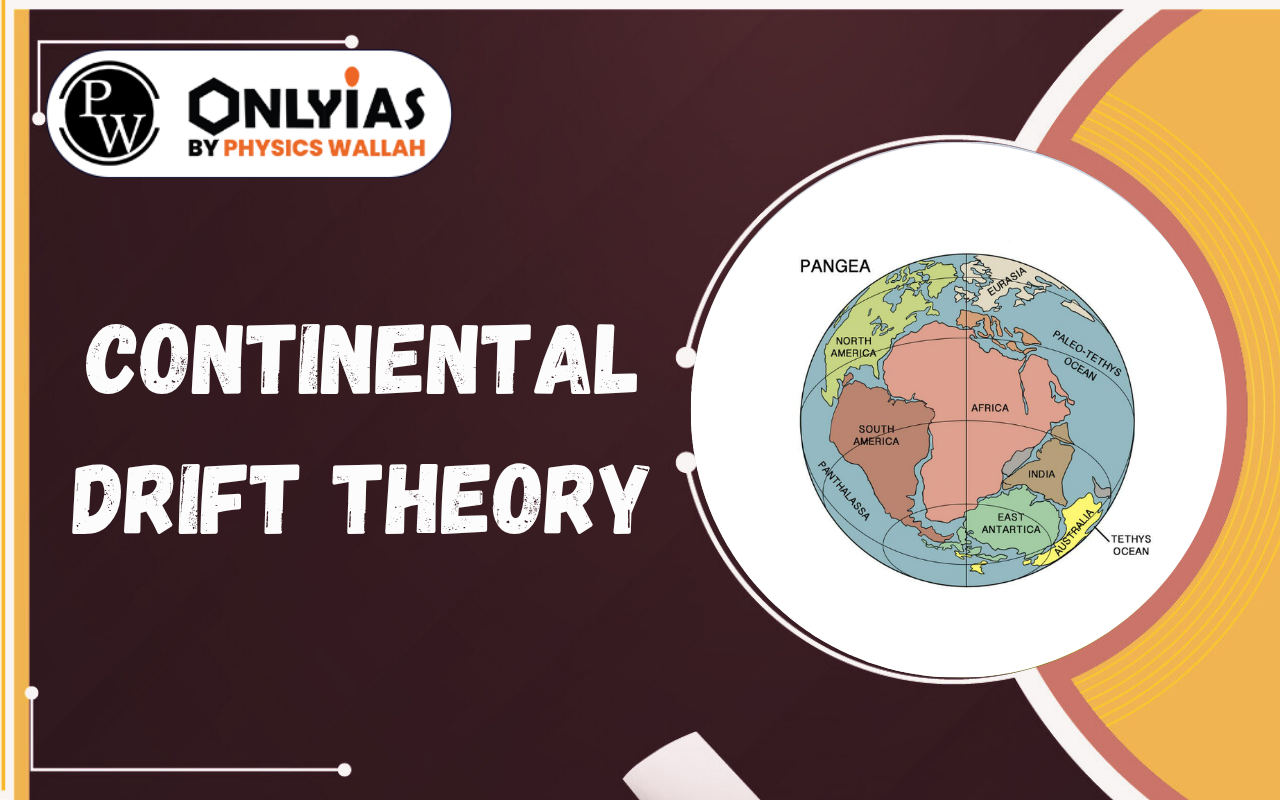
Continental Drift Theory was proposed by Alfred Wegener in 1912 to explain the movement of continents across the Earth’s surface over geological time. According to this theory, all present-day continents were once joined together as a single massive supercontinent called Pangaea, which was surrounded by a vast ocean known as Panthalassa.
Over millions of years, Pangaea gradually split into two major landmasses known as Laurasia in the north and Gondwanaland in the south, which later drifted apart to form the modern continents. Wegener supported his theory using evidence such as matching coastlines, fossil distribution, rock formations, and glacial deposits.
Although the theory initially faced criticism due to the lack of a proper explanation for continental movement, it later became the foundation of the modern Plate Tectonic Theory, which explains the movement of tectonic plates and the formation of mountains, earthquakes, and oceans.
This topic of ‘Continental Drift Theory’ is important from the perspective of the UPSC IAS Examination.
The continental drift explanation begins with the idea that the continents are not fixed. According to Wegener’s continental drift theory, all continents were once part of a single, massive landmass called Pangaea (meaning “all Earth”). This supercontinent was surrounded by a mega-ocean known as Panthalassa (“all water”).
Wegener suggested that approximately 200 million years ago, Pangaea began to split due to internal forces.
The Continental Drift Theory explains that the continents are not fixed but have moved across the Earth’s surface over millions of years. According to Alfred Wegener, the continents are mainly composed of a lighter material known as SIAL, which is rich in silica and aluminium. In contrast, the ocean floors are made up of denser material called SIMA, containing silica and magnesium.
Wegener believed that the lighter continental masses floated over the denser oceanic crust and gradually drifted apart from their original positions. The theory mainly emphasized the horizontal movement of continents across the Earth’s surface. This movement led to the separation of Pangaea into Laurasia and Gondwanaland, eventually forming the present-day continents and oceans.
Explore UPSC Foundation Courses

Explore UPSC Foundation Courses

Wegener proposed two primary forces responsible for the drift of continents:
Critique: While his observation of movement was correct, these specific forces were later found to be too weak to move entire continents. This gap in the Alfred Wegener theory was later filled by the discovery of mantle convection currents.
Alfred Wegener provided several compelling scientific proofs to support the drift of continents. These are vital for any Continental Drift Theory UPSC notes:
Although the Continental Drift Theory was revolutionary, it faced significant criticism from the scientific community during the time of Alfred Wegener. One of the major weaknesses of the theory was the lack of a proper scientific mechanism to explain how continents moved across the Earth’s surface.
Wegener’s explanation of forces such as the pole-fleeing force and tidal force was considered too weak to move massive continents over long geological distances. Scientists also objected to the idea that continents could drift through the rigid and dense oceanic crust without breaking apart. During Wegener’s time, there was insufficient geological and geophysical evidence to fully support continental movement, which led many researchers to reject the theory initially.
Despite these criticisms, later discoveries such as sea-floor spreading and mantle convection provided scientific support for the movement of tectonic plates and validated many of Wegener’s original ideas.
The Continental Drift Theory played a major role in transforming the field of physical geography and geology. It became the foundation for the modern Plate Tectonic Theory, which explains the movement of lithospheric plates on the Earth’s surface.
The theory also helped scientists better understand the occurrence of earthquakes, volcanic activity, and mountain formation. By explaining the past positions and movements of continents, it improved our understanding of Earth’s geological evolution over millions of years.
In geomorphology and geology, the theory remains highly important because it explains the formation of continents, ocean basins, fold mountains, and the distribution of fossils and minerals across the world.
Explore Prarambh Course

Explore Prarambh Course

The Continental Drift Theory and Plate Tectonic Theory both explain the movement of continents and changes in the Earth’s surface over geological time. However, Plate Tectonic Theory is considered a more advanced and scientifically accepted explanation compared to Wegener’s original Continental Drift Theory.
| Continental Drift Theory vs Plate Tectonic Theory | ||
| Basis | Continental Drift Theory | Plate Tectonic Theory |
| Proposed By | Alfred Wegener | Developed by modern geologists in the 1960s |
| Movement | Continents drift across ocean floors | Tectonic plates move over the asthenosphere |
| Driving Force | Pole-fleeing force and tidal force | Mantle convection currents, slab pull, ridge push |
| Scientific Acceptance | Initially criticized and partially accepted | Widely accepted modern geological theory |
| Evidence | Fossils, rock matching, glacial deposits | Sea-floor spreading, magnetic studies, earthquake distribution |
| Oceanic Crust | Continents move through oceanic crust | Plates include both continental and oceanic crust |
| Explanation Strength | Lacked proper mechanism | Scientifically supported mechanism |
The Continental Drift Theory remains highly relevant in modern geology because it laid the foundation for several advanced geological concepts. Modern studies of sea-floor spreading provided strong evidence that continents and ocean floors are continuously moving due to tectonic activity.
The theory is closely connected with the study of plate boundaries, where tectonic plates interact and cause earthquakes, volcanic eruptions, and crustal deformation. It also helps explain the formation of major mountain ranges such as the Himalayas, which were formed due to the collision of tectonic plates.
Today, the concepts derived from Continental Drift Theory are essential for understanding earthquake zones, volcanic belts, ocean trench formation, and the dynamic nature of the Earth’s crust.
The following UPSC Previous Year Question is important for understanding the concept, evidence, and significance of the Continental Drift Theory. Practicing such questions helps candidates improve conceptual clarity and answer-writing skills for UPSC Mains examination.
| Que. What do you understand about the theory of continental drift? Discuss the prominent evidences in its Support.[100 Words, 5 Marks] 2013 |
|---|
Check Out UPSC CSE Books
Visit PW Store
Explore SRIJAN Program

Alfred Wegener, a German meteorologist, is considered the father of the theory, having formally proposed it in 1912.
The key evidence of continental drift includes the Jig-Saw fit of coastlines, fossil correlation (like Mesosaurus), matching rock ages across oceans, and glacial tillite deposits.
The supercontinent was called Pangaea, and the single global ocean surrounding it was called Panthalassa.
Continental Drift Theory UPSC is a fundamental topic in the Geography syllabus. It explains the origin of continents, the formation of the Himalayas, and the distribution of natural resources.




Explore UPSC Foundation Batches


Connect with our experts to get free counselling & start preparing
Join India’s trusted platform for expert guidance, quality content, proven success.
Learn anytime, anywhere.



India's leading UPSC coaching platform helping aspirants prepare for IAS, IPS, IFS and other Civil Services examinations with the best faculty and proven strategies.
<div class="new-fform">
</div>