Recently, the World Trade Organization concluded its 14th Ministerial Conference (MC14) in Yaoundé, Cameroon (a country in Central Africa), where global trade ministers discussed key challenges and the future of the multilateral trading system.
About WTO Ministerial Conference
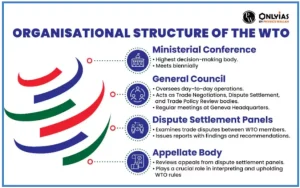
- Highest Decision-Making Body: The Ministerial Conference (MC) is the supreme authority of the World Trade Organization, empowered to take decisions on all matters under WTO agreements.
- First Meeting (Historical Origin): The 1st Ministerial Conference was held in 1996 in Singapore, marking the beginning of regular high-level global trade deliberations under the WTO framework.
- Biennial Global Forum: It is usually held every two years, bringing together trade ministers from all member countries.
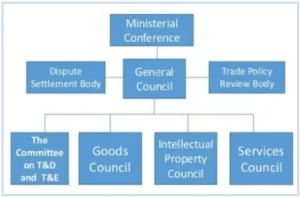 Decision-Making Powers: The MC can adopt agreements, declarations, and amendments, and provide political direction to negotiations.
- Negotiation Platform: It serves as a key forum to advance multilateral trade negotiations, including issues like agriculture, fisheries subsidies, and e-commerce.
- Consensus-Based Functioning: Decisions are taken through consensus, reflecting the member-driven nature of the WTO system.
Key Outcomes of WTO MC14 (Yaoundé, 2026)
- Fisheries Subsidies – Forward Momentum: Members agreed to continue negotiations to develop comprehensive disciplines on fisheries subsidies, keeping alive efforts to align trade with environmental sustainability goals.
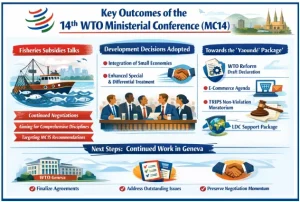 Decisions on Development Concerns: Ministers adopted decisions to enhance integration of small economies and improve the implementation of Special and Differential Treatment (S&DT) provisions, particularly under the Sanitary and Phytosanitary (SPS) Agreement and Technical Barriers to Trade (TBT) Agreement.
- Progress Towards “Yaoundé Package”: Members preserved key negotiating texts and agreed to finalise them in Geneva, indicating a shift towards incremental and process-driven multilateralism.
- Emerging Reform & Governance Agenda: Draft outcomes include:
- Ministerial Declaration on WTO Reform and Work Plan
- Decision on Electronic Commerce
- Decision on Trade-Related Aspects of Intellectual Property Rights (TRIPS) Non-Violation Complaints
- Package for Least Developed Countries (LDCs)
- Continuation of Negotiation Tracks: Key unresolved issues such as electronic commerce rules and intellectual property-related moratoriums were deferred, ensuring continuity of negotiations beyond MC14.
- Limited but Constructive Outcome: While no major binding agreements were concluded, MC14 helped preserve negotiation momentum amid a fragmented global trade environment.
Enroll now for UPSC Online Course
Major Issues and Debates at WTO MC14
- Limited Consensus & Structural Divisions: The World Trade Organization faced deep structural divides, with negotiations shaped by geopolitical tensions and divergent economic interests, reflecting a crisis of multilateralism.
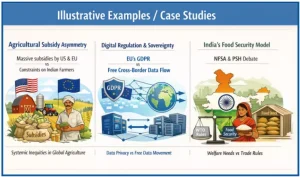
- Agriculture Deadlock & Market Distortions: Persistent disagreements over Public Stockholding (PSH), subsidy limits, and market access continued, alongside concerns over large-scale trade-distorting farm subsidies (~$624 billion annually).
- E-commerce & Digital Sovereignty Debate: Divisions over the moratorium on customs duties on electronic transmissions highlighted tensions between digital trade liberalisation and concerns of revenue loss, policy space, and data control, linked to the Digital Trade Divide and Data Colonialism.
- Plurilateralism vs Multilateralism (Investment Facilitation for Development Agreement – IFDA): The push for plurilateral agreements such as the Investment Facilitation for Development Agreement (IFDA) raised concerns over fragmentation of global trade governance and weakening of consensus-based multilateralism.
- Fisheries & Sustainability Tensions: Negotiations reflected the challenge of balancing marine environmental sustainability with livelihood protection of small-scale fishers, highlighting issues of Global Commons governance.
- Development Concerns & Special and Differential Treatment (S&DT): Ongoing debates exposed the Equity vs Efficiency dilemma, particularly regarding policy flexibility for developing and small economies.
- Dispute Settlement Crisis: The continued paralysis of the Appellate Body under the Dispute Settlement Mechanism (DSM) undermines the credibility and enforceability of WTO rules.
- Intellectual Property (TRIPS) Divergence: Disagreements over TRIPS Non-Violation Complaints reflect tensions between protection of innovation and access to affordable technology and medicines.
- Divergent Visions on WTO Reform: Developed countries emphasised efficiency and flexibility, whereas developing countries stressed inclusivity, consensus, and development-oriented principles, complicating reform efforts.
Key WTO Ministerial Conferences & Their Outcomes
- MC1 – Singapore (1996): Introduced the “Singapore Issues”, signalling expansion of WTO agenda beyond traditional trade.
- MC3 – Seattle (1999): Failed to launch a new trade round due to deep divisions and protests, exposing early crisis of consensus.
- MC4 – Doha (2001): Launched the Doha Development Agenda (DDA), emphasising development-centric trade negotiations.
- MC5 – Cancún (2003): Collapsed over agriculture and Singapore Issues, reinforcing the North-South divide.
- MC7 – Geneva (2009): Focused on post-global financial crisis recovery, but achieved limited outcomes.
- MC9 – Bali (2013): Delivered the Bali Package, including Trade Facilitation Agreement (TFA) and Peace Clause on Public Stockholding (PSH).
- MC10 – Nairobi (2015): Achieved elimination of agricultural export subsidies, addressing long-standing distortions.
- MC11 – Buenos Aires (2017): Ended without major consensus, reflecting growing negotiation deadlock.
- MC12 – Geneva (2022): Delivered Fisheries Subsidies Agreement, TRIPS waiver (COVID-19), and food security measures.
- MC13 – Abu Dhabi (2024): Saw mixed outcomes, with continued deadlock on key issues like agriculture and dispute settlement.
|
India’s Stand & Interests in MC14
- Agriculture & Food Security (Core Priority): India strongly advocated for a permanent solution on Public Stockholding (PSH), arguing that existing WTO rules (based on outdated reference prices) unfairly penalise developing countries.
- Peace Clause (Interim Relief): India currently relies on the “Peace Clause” agreed at the Bali Ministerial Conference 2013, which provides temporary protection against legal challenges on breaching subsidy limits under PSH.
- However, its ad-hoc and non-permanent nature reinforces India’s demand for a durable legal solution.
- It emphasised that programmes like the National Food Security Act (NFSA) are essential for food security, poverty alleviation, and livelihood protection, thereby highlighting the Equity vs Efficiency dilemma in global agricultural trade rules.
- Special & Differential Treatment (S&DT): India firmly supported the continuation and strengthening of S&DT provisions, stressing that developing countries require adequate policy space to pursue industrialisation, food security, and welfare measures.
- This reflects the persistent North-South divide, where developed nations push for uniform obligations while developing nations demand differentiated responsibilities.
- E-commerce Moratorium & Digital Sovereignty: India opposed the permanent extension of the moratorium on customs duties on electronic transmissions, arguing that it leads to significant revenue losses, constrains domestic digital industrialisation, and limits regulatory autonomy.
- India’s stance underscores the broader Digital Trade Divide and the tension between policy space vs liberalisation in emerging digital economies.
- This concern is also framed in terms of “Data Colonialism”, where developing countries risk becoming mere data providers while value creation and monetisation remain concentrated in global tech firms from developed economies.
- Fisheries Subsidies & Livelihood Concerns: India pushed for a balanced and development-sensitive approach in fisheries negotiations, advocating longer transition periods and exemptions for small-scale and artisanal fishers.
- It highlighted that sustainability measures must not disproportionately burden countries with subsistence fishing communities, thereby linking trade rules with Global Commons governance and climate justice.
- Dispute Settlement Reform (Restoring Credibility): India called for the immediate restoration of the Appellate Body, emphasising that a two-tier, binding dispute settlement system is central to ensuring predictability, enforceability, and fairness in global trade.
- The continued paralysis is seen as eroding trust and pushing members towards unilateral or bilateral dispute mechanisms.
- Technology Transfer & Developmental Equity: India proposed facilitating the transfer and diffusion of advanced technologies, including environmental technologies, to developing countries in order to address technological asymmetries and promote a more inclusive and development-oriented WTO framework.
About WTO (World Trade Organization)
- Establishment & Legal Basis: The World Trade Organization was established in 1995 under the Marrakesh Agreement, succeeding the GATT (1947) framework.
- Objective & Core Purpose: It aims to ensure free, fair, and predictable international trade by reducing trade barriers and promoting a rules-based multilateral trading system.
- Membership & Coverage: The WTO has 166 member countries, accounting for over 98% of global trade, making it the central institution of global trade governance.
- Comoros and Timor-Leste as members since August 2024.
- Core Functions:
- Administering trade agreements
- Acting as a forum for negotiations
- Dispute settlement mechanism (DSM)
- Trade policy review
- Capacity building for developing countries
- Principles of WTO: Key principles include Most Favoured Nation (MFN), National Treatment, transparency, and non-discrimination in trade practices.
- Institutional Structure: The WTO operates through bodies like the Ministerial Conference (highest authority), General Council, and Dispute Settlement Body (DSB).
- Contemporary Relevance & Challenges: It plays a crucial role in managing global trade flows, but faces challenges such as protectionism, dispute settlement paralysis, and North-South divides.
|
Check Out UPSC CSE Books From PW Store
Changing Global Trade Landscape
These evolving global trade trends are directly shaping negotiations and consensus-building within the WTO framework.
- Rise of Protectionism & Strategic Trade Policies: The global trading system is witnessing a shift from free trade orthodoxy to strategic protectionism, with countries adopting friend-shoring, near-shoring, and industrial policies to secure critical supply chains, thereby weakening the foundational WTO principle of non-discrimination.
 Geopolitical Rivalries & Trade Fragmentation: The intensification of the US–China Trade War has led to tariff wars, technology restrictions, and competing economic blocs, contributing to the fragmentation of global trade governance and undermining consensus-based multilateralism.
- Proliferation of Regional Trade Agreements (RTAs): Mega trade blocs such as the Regional Comprehensive Economic Partnership (RCEP) and Comprehensive and Progressive Agreement for Trans-Pacific Partnership (CPTPP) are increasingly shaping global trade rules outside the WTO framework, signalling a shift towards regionalism over multilateralism.
 Supply Chain Disruptions & Economic Shocks: Events such as the COVID-19 pandemic and the Russia–Ukraine War exposed vulnerabilities in global supply chains, leading to a rethinking of resilience, diversification, and economic security, often at the cost of trade openness.
- Emergence of New Trade Issues: Issues such as digital trade, climate-linked trade measures, and sustainability standards are reshaping the trade agenda, creating new fault lines between developed and developing countries over standards, compliance costs, and technological readiness.
- Carbon Border Measures & Green Protectionism: Instruments like the EU’s Carbon Border Adjustment Mechanism (CBAM) are increasingly seen by developing countries as “green trade barriers”, raising concerns over climate justice, equity, and disguised protectionism, especially for carbon-intensive exports from countries like India.
- Declining Global Investment Flows: Global FDI flows to developing economies have declined significantly (≈2% of GDP), reflecting uncertainties in global trade regimes and reinforcing the need for a stable multilateral framework.
Challenges Before the WTO Multilateral Trading System
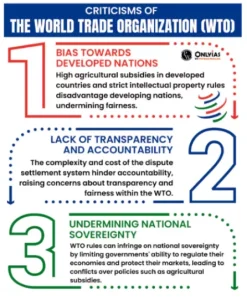
- Appellate Body Paralysis & Erosion of Rule-Based Order: The continued non-functioning of the Appellate Body since 2019 has severely weakened the Dispute Settlement Mechanism (DSM), reducing it to a non-binding, incomplete system, thereby undermining the WTO’s role as a guarantor of rules-based trade governance.
- Crisis of Multilateralism: The inability to achieve consensus on key issues reflects a broader crisis of multilateralism, where divergent national interests and geopolitical rivalries impede collective decision-making.
- Rise of Unilateral & Retaliatory Measures: Countries are increasingly resorting to unilateral tariffs, sanctions, and countermeasures, bypassing WTO mechanisms, which weakens institutional legitimacy and predictability.
 Shift towards Plurilateralism: The growing reliance on plurilateral agreements (e.g., IFDA) indicates a move towards flexible, coalition-based rule-making, but also raises concerns about fragmentation and exclusion within the WTO system.
- Consensus vs Efficiency Dilemma: The consensus-based decision-making model, while ensuring inclusivity, has increasingly led to negotiation paralysis, with growing demands for plurilateral approaches, raising concerns about fragmentation.
- Crisis of Confidence in WTO: Persistent deadlocks and inability to deliver outcomes have led to declining credibility of the WTO, raising concerns about the erosion of its core purpose as a rule-based institution.
- Escalating Trade Conflicts: Rising trade tensions, particularly between major economies like the US and China, are undermining multilateral cooperation and weakening WTO’s dispute settlement role.
- Implementation Gap in S&DT: Despite over 150 Special & Differential Treatment provisions, challenges persist in making them precise, effective, and operational, limiting benefits for developing countries.
Way Forward
- Revive Dispute Settlement Mechanism: Build political consensus to restore the Appellate Body, ensuring a fully functional, two-tier dispute resolution system to rebuild trust in WTO rules.
- Rebalance Development & Liberalisation: Adopt a development-centric approach that reconciles trade liberalisation with policy space, addressing the Equity vs Efficiency dilemma.
- Institutionalise Flexible Multilateralism: Integrate plurilateral agreements within the WTO framework in a manner that remains transparent, inclusive, and non-discriminatory, preventing systemic fragmentation.
- Reform S&DT Framework: Develop dynamic and objective criteria for S&DT to reflect changing economic realities while safeguarding the interests of least developed and vulnerable economies.
- Promote Inclusive Digital Trade Governance: Establish balanced digital trade rules that ensure technology access, data sovereignty, and fair competition, bridging the Digital Trade Divide.
- Strengthen Trust & Cooperation: Enhance transparency, dialogue, and confidence-building measures to address the ongoing fragmentation of global trade governance and revive the spirit of collective action.
- Strengthen Development-Oriented Outcomes: Enhance operationalisation of S&DT provisions, support LDC transition mechanisms, and promote technology transfer for equitable participation.
- Institutionalise Digital Trade Governance: Establish mechanisms like a WTO Committee on Digital Trade to manage emerging issues while balancing development concerns.
Conclusion
MC14 reflects a deeper systemic transition in global trade governance, where the challenge lies not merely in resolving negotiating deadlocks but in reconciling development concerns, equity, and institutional credibility. Revitalising the WTO is essential to ensure a fair, inclusive, and rules-based multilateral trading system in an increasingly fragmented global economy.


 30 Mar 2026




.png)






 Current Affairs




 GS Foundation
 Optional Course
 Combo Courses
 Degree Program