Keytruda, an immunotherapy cancer drug in focus due to reports of counterfeit/leaked vials in India’s supply chain, raising safety concerns.
- It was first approved by the US FDA in 2014.
UPSC Online Coaching
About Immunotherapy
- Immunotherapy is a form of treatment that enhances or modifies the body’s immune system to effectively fight diseases, particularly cancer.
- Nature & Mechanism: Immunotherapy works by strengthening the body’s natural defense system.
- It provides targeted action against diseased cells and, in some cases, helps develop long-term immune memory, enabling sustained protection.
Types of Immunotherapy
- Monoclonal antibodies (mAbs)
- Checkpoint inhibitors
- Vaccines
- Cytokines
- CAR T-cell therapy
|
About Keytruda
- It is an immunotherapy drug — an umbrella term for treatments that train the immune system to tackle disease, primarily cancers.
- It is a part of cancer treatment that also includes radiotherapy, chemotherapy, and if needed, surgery.
- Manufactured by: US-based global pharma major Merck & Co (MSD)
- Commercial Availability: It is commercially available under the brand name of pembrolizumab.
- Mechanism of Action: Keytruda belongs to the category of monoclonal antibodies, which are laboratory-made molecules designed to bind with specific targets, enabling the immune system to identify and destroy cancerous cells.
- Checkpoint inhibitors: It belongs to a class called “checkpoint inhibitors” — drugs that remove the brakes preventing the body’s T cells, which are a crucial weapon in the body’s immune system, from attacking cancerous cells.
- Availability for Indian Patients: It is available through the company’s Patient Access Programme.
- This programme provides patients with 30 free vials on purchasing five initially for a total cost of around Rs 10 lakh.
- Patients may use a third-party health insurance to pay for the initial dose.
- Accessing the drug through the programme has some stipulations — the patient should not have a sum-insured or income of over Rs 25 lakh.
Limitations
- High Cost: Merck & Co. recommends a dose of 200 mg every three weeks. With each 100 mg vial costing over ₹1.5 lakh, treatment can exceed ₹3 lakh per month without insurance.
- However, its patent expiry in 2028 may allow cheaper generic versions, potentially reducing costs by up to 70%.
- Not Universally Effective: It works only in certain cancers and specific patient profiles.
-
- It is effective in some lung cancer patients but may not work in others lacking specific biomarkers (like PD-L1 expression).
- Immune-related Side Effects: It can cause the immune system to attack healthy organs. In some cases patients have been reported to develop inflammation of lungs (pneumonitis) or thyroid disorders.
- Delayed Response: Therapeutic effects may take time compared to chemotherapy.
- Tumor size may initially appear unchanged or even increase before shrinking (pseudo-progression).
UPSC Coaching Preparation
Way Forward
- Enhancing Affordability and Access: There is a need to promote generic and biosimilar versions post-patent expiry of Keytruda (2028) to significantly reduce treatment costs and improve accessibility in countries like India.
- Strengthening Regulatory Oversight: Robust monitoring mechanisms must be established to prevent issues such as counterfeit or leaked drugs in the supply chain, ensuring patient safety.
- Promoting Domestic Research & Manufacturing: Encouraging indigenous R&D and production of immunotherapy drugs can reduce dependence on imports and make treatments more cost-effective.
- Advancing Personalized Medicine: Greater focus on biomarker-based treatment (e.g., PD-L1 testing) is required to identify suitable patients, thereby improving effectiveness and reducing unnecessary costs.
Chemotherapy vis i vis Immunotherapy
| Aspect |
Chemotherapy |
Immunotherapy |
| Definition |
Uses drugs to kill rapidly dividing cells |
Enhances or modifies the immune system to fight disease |
| Target |
Non-specific (affects both cancerous and healthy fast-dividing cells) |
Highly specific (targets cancer cells via immune mechanisms) |
| Mechanism |
Directly destroys cancer cells |
Stimulates immune system (e.g., T-cells) to attack cancer |
| Side Effects |
Severe (hair loss, nausea, fatigue, low immunity) |
Generally fewer, but may cause immune-related reactions |
| Effectiveness |
Works for many cancers but may relapse |
Effective in select cancers; durable response in some cases |
| Duration of Effect |
Usually short-term; requires repeated cycles |
Can provide long-term protection (immune memory) |
| Personalization |
Less personalized |
More scope for personalized treatment |
| Cost |
Relatively cheaper (especially generics) |
Expensive and less accessible |
| Examples |
Cisplatin, Doxorubicin |
Checkpoint inhibitors (e.g., Keytruda) |
Click to Know UPSC OnlyIAS Coaching Centres
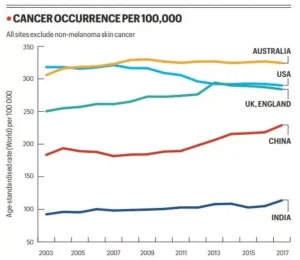
Cancer’s Incidence in India: Overview
- Although India’s cancer incidence rate is currently below the global average, it is climbing steadily.
- Global Burden of Disease Estimates: It indicates that the rate of cancer occurrence rose from 84.8 per 100,000 population in 1990 to 107.2 per 100,000 in 2023.
- WHO’s Global Cancer Observatory: Data from the WHO’s Global Cancer Observatory shows that India recorded 14.13 lakh cancer cases in 2022, a figure projected to surge by 73.8% to 24.56 lakh cases by 2045.
- GLOBOCAN Database: The GLOBOCAN database puts India’s current incidence at 98.5 per 100,000.
|


 13 Apr 2026





.png)






 Current Affairs




 GS Foundation
 Optional Course
 Combo Courses
 Degree Program