India’s civilizational ethos reveres rivers as living mothers, from the Rigveda’s Aapah Sukta to the worship of Ganga, Yamuna, and Narmada. Yet, the pouring of 11,000 litres of milk into the Narmada highlights a growing paradox—traditions rooted in ecological harmony now straining fragile ecosystems under modern scale and pressures.
Best Online Coaching for UPSC
About the Issue- The Narmada Milk Ritual
- Incident Overview: On April 8, 2026, a 21-day religious ceremony in Sehore (Madhya Pradesh) culminated in the ritualistic pouring of 11,000 litres of milk into the Narmada River, symbolising a sacred offering intended to invoke divine blessings for devotees and pilgrims.
- Faith and Cultural Context: Such practices are rooted in India’s river-centric spirituality, where rivers are revered as life-giving mothers and offerings are seen as acts of devotion, purification, and gratitude.
- Moral–Economic Paradox: The incident sparked nationwide concern, exposing a sharp contradiction—11,000 litres of milk (≈ 44,000 glasses) were discarded in a state actively combating child malnutrition through the ₹700-crore Yashoda Milk Supply Scheme. This juxtaposition raises questions about prioritisation of scarce nutritional resources.
- Environmental Dimension: Beyond ethics, such large-scale offerings can adversely impact water quality, increasing biological oxygen demand (BOD) and threatening aquatic ecosystems, thereby contradicting the very ethos of nature reverence.
- Governance and Ethical Concerns: The episode underscores gaps in regulatory oversight, public awareness, and behavioural change, while raising broader issues of ethical responsibility, sustainable religious practices, and scientific temper (Article 51A).
|
Historical & Cultural Evolution of Ritual Practices
- Traditionally Sustainable Practices: Rituals like abhishekam originated in low-density agrarian societies, where offerings were small, biodegradable, and locally sourced, allowing rivers to maintain ecological balance through natural assimilation.
- Scale Expansion due to Urbanisation: With rapid urbanisation, population growth, and mass religious gatherings, the scale of such rituals has expanded significantly.
- River systems like the Ganga basin, supporting nearly 400 million people, now face compounded stress from large-scale ritual offerings alongside other anthropogenic pressures.
- Scientific Evidence of Ecological Impact: Organic offerings such as milk, flowers, and food items increase Biological Oxygen Demand (BOD), reducing dissolved oxygen levels and adversely affecting aquatic life.
- The 11,000-litre milk offering in the Narmada illustrates how excessive organic load can disrupt riverine ecosystems.
- Notably, improvements in water quality during the COVID-19 lockdown highlight the direct link between reduced human activity and ecological recovery.
Biological Oxygen Demand (BOD)
- BOD is the amount of dissolved oxygen (DO) required by microorganisms to decompose organic matter in water over a specific period (usually 5 days at 20°C, i.e., BOD₅).
- High BOD → High organic pollution → Low dissolved oxygen → Harmful for aquatic life
- Low BOD → Cleaner water → Healthy aquatic ecosystem
|
- Empirical Ground-Level Evidence: Across India, instances of ritual-induced pollution are well documented.
- Around 120 tonnes of waste were removed from the Thamirabarani River in Tamil Nadu, while authorities in the Cauvery basin and along the Satluj River have identified ritual waste as a major contributor to water pollution, indicating a systemic and widespread issue.
- Cross-Cultural and Pan-India Dimension: Ecological stress linked to religious practices is visible in festivals such as Durga Puja, Ganesh Utsav, and Chhath Puja, where idol immersion and ritual waste add to water pollution.
- Similar challenges are observed globally, reflecting a broader tension between faith practices and environmental sustainability.
- Positive Cultural Capital and Reform Potential: Historically, religious leaders and institutions have acted as custodians of ecological ethics.
- Emerging initiatives such as restrictions on non-biodegradable offerings and community-led river conservation efforts demonstrate the potential to realign cultural practices with sustainability goals.
UPSC Online Coaching
Ethical Analysis of the Issue
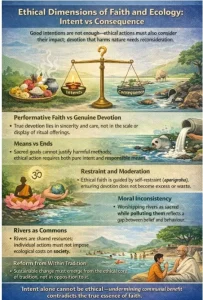
- Conflict of Values- Faith vs Ecological Responsibility: The issue reflects a fundamental tension between freedom of religion (Article 25) and the right to a healthy environment (Article 21).
- While deontological ethics justifies rituals as moral duties, utilitarian ethics demands actions that maximise collective welfare. Ethical reasoning thus requires that individual devotion does not translate into collective ecological harm.
- Moral–Economic Paradox and Resource Ethics: The diversion of 11,000 litres of milk highlights a contradiction between symbolic devotion and resource justice.
- In a context of child malnutrition, such use of nutritional resources raises concerns of ethical prioritisation, where public good must outweigh symbolic excess.
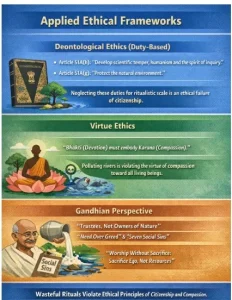 Gandhian Trusteeship & Intergenerational Justice: Mahatma Gandhi’s principle of trusteeship views natural resources as collective assets held for future generations.
 -
- Excessive ritual consumption violates aparigraha (restraint) and undermines intergenerational equity.
- His idea that the Earth meets needs, not greed underscores the ethical imperative of sustainable consumption.
- Spiritual Ecology and Indian Philosophy: Swami Vivekananda’s philosophy of Advaita (oneness) implies that nature and the divine are inseparable.
- If rivers are revered as sacred, degrading them contradicts the very essence of spirituality, shifting devotion from reverence to contradiction.
- Deep Ecology Perspective: Arne Naess’s Deep Ecology asserts that all life forms possess intrinsic value, independent of human use. Rivers must therefore be treated as living ecosystems, not merely as instruments of ritual, aligning with emerging ideas like rights of nature.
- Ethics of Care and Cultural Responsibility: Indian traditions address rivers as “Maiya”, reflecting an ethics of care rooted in empathy and protection.
- Practices that harm river health expose a gap between symbolic reverence and actual conduct, undermining this moral relationship.
- Scientific Temper and Ethical Citizenship: Article 51A(h) mandates the development of scientific temper and critical inquiry.
- Ethical citizenship requires questioning practices that, despite pure intent, produce harmful outcomes, preventing ethical complacency in the name of tradition.
The Imperative for Pollution-Free Rivers
The pursuit of pollution-free rivers is not an environmental luxury but a sovereign necessity, underpinning public health, economic stability, and civilizational continuity. A clean river represents the modern expression of Dharma, bridging ancient ecological reverence with aspirations of a developed India—protecting our health, wealth, and collective soul.
- Public Health and Human Well-being: From a utilitarian perspective, clean rivers are the first line of defense for a nation’s health.
- Reducing Disease Burden: Clean rivers are essential for drinking water, sanitation, and hygiene. Polluted waters increase the burden of water-borne diseases such as cholera and diarrhoea, directly diminishing human productivity.
- Toxic-Free Food Chains: Ensuring rivers are free from heavy metals prevents these toxins from entering the human food chain through irrigation or fisheries, upholding the Right to Health under Article 21.
- Ecological Balance and Biodiversity: Rivers are biological lifelines that require a delicate chemical balance to sustain life.
- Aquatic Respiration: Maintaining low BOD ensures high dissolved oxygen, preventing the suffocation of fish populations and the collapse of aquatic flora.
- Ecosystem Services: Healthy rivers sustain diverse aquatic ecosystems, ensuring groundwater recharge and natural nutrient cycling, which maintains the broader ecological balance.
- Livelihood and Food Security: The health of a river is directly proportional to social equity and rural stability.
- Livelihood Security: Millions depend on rivers for fishing and agriculture. Degraded water quality reduces fish catch and crop yields, raising serious concerns regarding environmental justice for those with the least resources.
- Nutritional Security: Healthy rivers are critical for fisheries and irrigation, which provide essential nutrition and food supply, particularly for vulnerable populations.
- Cultural and Civilizational Significance: In the Indian context, a river’s physical health is inseparable from its spiritual value.
- Preserving Ethos: Rivers hold deep civilizational value. Maintaining their purity is essential to practicing religious traditions in their true, life-giving sense, rather than as rituals that cause destruction.
- Ethical Consistency: It is a moral imperative to align our external worship with internal stewardship, ensuring our “Mother” rivers are treated with genuine reverence, not as disposal channels.
- Economic Sustainability and Climate Resilience: Pollution is a “hidden tax” on the national exchequer and our future climate security.
- Economic Burden: Pollution increases the cost of water treatment, healthcare, and ecological restoration, placing a heavy burden on public finances.
- Climate Action: Healthy river systems enhance climate resilience and ecosystem services, directly contributing to SDG 13 (Climate Action) and SDG 14 (Life Below Water).
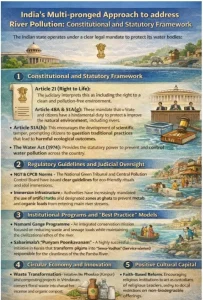
- Legal and Constitutional Mandate: The quest for clean rivers is a legal duty enshrined in the founding documents of the Republic.
- Constitutional Rights: Ensuring clean rivers aligns with the Right to Life (Article 21).
- Statutory Duties: It fulfills the mandate of Article 48A (State’s duty to protect the environment) and Article 51A(g), which requires every citizen to have compassion for living creatures and protect the natural environment.
Stakeholder Responsibilities
- Individuals (Devotees): Devotees are the primary ethical agents, as individual actions aggregate into collective ecological impact.
- The 11,000-litre milk ritual in Narmada ltriggered widespread public criticism, reflecting rising awareness about resource wastage.
- Scientific evidence shows such offerings increase BOD, harming aquatic life. Ethically, this necessitates a shift toward symbolic, minimal offerings, aligning devotion with Ahimsa and sustainability.
- Religious Leaders & Institutions: Religious institutions wield significant moral authority and can influence mass behavioural change.
- Historically custodians of ecological ethics, their role today is to reinterpret rituals in line with environmental realities.
- Emerging examples of eco-friendly temple guidelines and restrictions on non-biodegradable offerings show that faith-based reform is both feasible and socially acceptable.
- State & Governance: The State must reconcile Article 25 (freedom of religion) with Article 21 (right to a healthy environment).
- Evidence from river systems like the Ganga indicates that mass religious activities contribute to pollution loads, especially during large gatherings.
- Ethical governance requires a mix of behavioural nudges, regulatory frameworks (NGT/CPCB norms), and infrastructure support such as waste management at ghats.
- Local Communities: River-dependent communities—fisherfolk, farmers, and downstream users—bear the disproportionate costs of pollution.
- Declining water quality and fish populations affect livelihoods and health, raising concerns of equity and justice, where the ecological burden is externalised onto vulnerable groups.
- Civil Society & Media: The strong public and media reaction to the Narmada incident highlights their role in shaping ethical discourse.
- Civil society initiatives such as river clean-up drives and eco-friendly festival campaigns have been instrumental in promoting “green spirituality” and ensuring accountability through informed debate.
- Scientific & Knowledge Institutions: Scientific studies provide the foundation for informed ethical decision-making.
- Improvements in river water quality during the COVID-19 lockdown demonstrated the direct link between human activity and ecological health, reinforcing the need to align ethical responsibility with scientific temper.
Click to Know UPSC Coaching Centres in India
Global Initiatives and Best Practices:
- Granting Legal Personhood to Rivers (New Zealand):
- The Whanganui River: In a landmark legal move, the New Zealand parliament granted the Whanganui River the status of a legal person, recognizing it as an indivisible and living whole.
- Ethical Shift: This aligns with the Deep Ecology perspective, treating the river as a living ecosystem with its own rights rather than an instrument for human use.
- The EU Water Framework Directive (European Union):
- Holistic Management: This directive requires all member states to ensure that their water bodies achieve “Good Ecological Status”.
- Balanced Regulation: It provides a framework for managing cross-border river systems by balancing industrial and urban needs with strict ecological health indicators, such as maintaining low BOD.
- Faith-Based Conservation (Global Alliance):
- Alliance of Religions and Conservation (ARC): This international body helps major world religions develop environmental programs based on their own core teachings and beliefs.
- Sustainable Rituals: Similar to initiatives in India, this global movement promotes “green spirituality,” where religious leaders reinterpret rituals to align with modern environmental realities.
- The “Green Temple” Concept (East Asia):
- Taiwan and Thailand: Many Buddhist and Taoist temples have shifted toward eco-friendly festivals. This includes banning the burning of large amounts of incense and ghost money to reduce air and water pollution, replacing them with digital offerings or symbolic gestures.
- Waste Diversion: These models mirror Indian initiatives like Phool.co, where ritual waste is diverted into the circular economy as compost or eco-friendly products.
|
Way Forward
To harmonize ancient faith with modern ecological limits, a multi-dimensional strategy is required—one that shifts the focus from material excess to mindful devotion.
- Reinterpreting Dharma- From Ritual to Stewardship:
- Ethical Evolution: Evolve Dharma into a context-sensitive framework where environmental protection is viewed as a core religious duty. Aligning faith with Aparigraha (restraint) ensures that devotion remains responsible in an era of population pressure.
- Scientific Temper: In line with Article 51A(h), bridge the gap between belief and biology. Use evidence-based communication to reduce cognitive dissonance, helping devotees understand that “sacred” organic matter can still physically suffocate a river.
- Leveraging Religious Leadership as Ethical Influencers:
- Moral Persuasion: Priests, gurus, and temple trusts should act as ethical change-makers, advocating for symbolic offerings (e.g., a few drops of milk instead of tankers).
- Faith-Based Reform: Use the moral authority of religious institutions to institutionalize “Green Charters” for temples, turning spiritual centers into hubs for ecological conservation.
- Institutionalizing Circular Economy & Resource Efficiency:
- Waste Transformation: Scale models like Phool.co (Kanpur) and Vrindavan initiatives, which convert floral waste into charcoal-free incense and compost.
- Nutritional Redirection: Instead of river discharge, redirect bulk perishables like milk toward nutrition schemes and Anganwadis, transforming a ritual offering into Manav Seva (Human Service).
- Scaling Replicable “Best Practice” Models:
- Sabarimala (Kerala): The “Punyam Poonkavanam” initiative, which transforms pilgrims into “Sewa-Yodhas” (Service Warriors) responsible for the Pamba River’s cleanliness.
- Kumbh Mela Governance: Replicating large-scale solid waste management, bio-toilets, and regulated immersion zones used in recent Kumbhs across all major festival sites.
- Governance through Nudges and Incentives:
- Behavioral Nudges: Rather than purely punitive measures, deploy signage and real-time pollution monitoring displays at Ghats to nudge devotees toward eco-friendly choices.
- Recognition Mechanisms: Introduce “Green Temple Awards” and tax incentives for religious institutions that achieve zero-waste discharge, fostering a culture of positive competition.
- Strengthening Policy and Community Stewardship:
- Standardized Guidelines: Develop clear, uniform National Ritual Guidelines (based on NGT/CPCB norms) that provide a roadmap for managing daily offerings of oil, flowers, and milk.
- Participatory Governance: Empower local communities, NGOs, and “River Guardians” to manage local Ghats. Community ownership ensures that conservation is not seen as an external imposition but as a local cultural pride.
Click to Know UPSC Offline Courses
Conclusion
The path forward lies not in restricting faith, but in refining it. True devotion must move beyond symbolic offerings to ethical stewardship. If rivers are revered as mothers, the highest form of worship is to ensure their cleanliness, flow, and ecological vitality. Only then can India uphold both its civilizational values and its sustainable future.
 15 Apr 2026