The Mahanadi Water Disputes Tribunal has indicated that it may soon deliver its final judgement on the water-sharing formula between Odisha and Chhattisgarh, as both States have failed to present a concrete mutually agreed settlement proposal.
Best Online Coaching for UPSC
About the Mahanadi Water Dispute
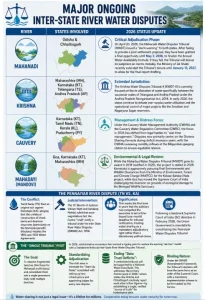
- Nature of the Dispute: The dispute relates to the sharing of waters of the Mahanadi River, particularly during the non-monsoon season, when downstream water availability becomes critically important, and the absence of a formal inter-state water-sharing agreement has intensified the conflict.
- Odisha’s Concerns: Odisha has consistently argued that extensive upstream constructions undertaken by Chhattisgarh, including numerous anicuts and barrages, have resulted in a decline in downstream water flow, thereby threatening irrigation, drinking water supply, fisheries, and ecological sustainability in the State.
- Chhattisgarh’s Position: Chhattisgarh has maintained that it has a legitimate right to utilise river waters, as it accounts for a larger share of the basin’s catchment area, and has asserted that its projects are necessary for regional development and water security. It has also raised concerns about procedural consistency, pointing to instances where adequate consultation was allegedly not followed.
- Historical Evolution: The dispute escalated around 2016, following increased upstream infrastructure development.
- Odisha subsequently approached the Supreme Court of India, which led to the constitution of the Tribunal under the Inter-State River Water Disputes Act, 1956.
- Despite several rounds of negotiations and opportunities for settlement, no consensus has been achieved so far.
Recent Tribunal Developments
- Final Opportunity for Settlement: The Tribunal has granted a final opportunity to both States to arrive at a mutually agreed water-sharing formula within a specified deadline in 2026, failing which it has made it clear that it will proceed to adjudicate the dispute on the basis of available evidence and legal principles.
- Judicial Dissatisfaction: The Tribunal has expressed serious dissatisfaction with repeated adjournments and lack of substantive progress, observing that no concrete proposals or narrowing of contentious issues have been placed on record, despite assurances of settlement efforts.
- Reasons for Deadlock: The continuing deadlock is primarily attributed to the absence of reliable and mutually accepted hydrological data, along with a persistent trust deficit between the two States, which has hindered meaningful negotiations and consensus-building.
-
- Similar to the Cauvery and Krishna river disputes, the Mahanadi conflict highlights persistent challenges of data transparency, delayed adjudication, and balancing upstream utilisation with downstream rights.
About Mahanadi River
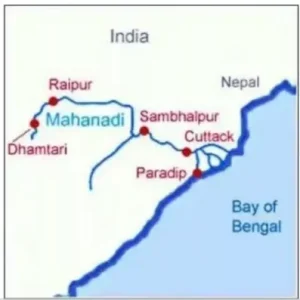
- Origin and Course: The Mahanadi River originates in Chhattisgarh and flows through Odisha before emptying into the Bay of Bengal, covering an approximate length of 851 kilometres.
- Catchment Distribution: The river basin covers about 1.41 lakh square kilometres, of which approximately 53.9 percent lies in Chhattisgarh and 45.7 percent in Odisha, creating a situation of asymmetrical control between upstream and downstream States.
- Tributary System: The river is fed by several tributaries, including Shivnath, Hasdeo, Mand, and Ib on the left bank, and Jonk, Ong, and Tel on the right bank, which together contribute to its overall flow and basin dynamics.
- Economic Significance: The basin supports extensive agricultural activities, provides drinking water and industrial supply, and possesses considerable hydropower potential, making it a vital resource for regional development.
- Major Infrastructure: The river hosts major infrastructure such as the Hirakud Dam, which plays a crucial role in flood control, irrigation, and power generation, and is among the longest earthen dams in the world.
Inter-State River Water Disputes in India
- Constitutional and Legal Framework: Article 262 of the Constitution empowers Parliament to adjudicate disputes relating to inter-state rivers, and allows it to exclude the jurisdiction of courts in such matters.
- The Inter-State River Water Disputes Act, 1956 provides the legal basis for the constitution of tribunals to resolve such disputes.
- Entry 17 (State List): Gives States power over water supplies, irrigation, canals, drainage, and embankments.
- Entry 56 (Union List): Empowers the Union to regulate and develop Inter-State Rivers and river valleys in the public interest.
- Institutional Mechanism: Inter-state river disputes are adjudicated through quasi-judicial tribunals constituted by the Union Government, whose awards are binding on the concerned States, although implementation challenges often persist.
- Key Challenges: Inter-state river disputes in India are often characterised by lack of credible and shared hydrological data, political and federal tensions, delays in adjudication and enforcement, and competing claims between upstream utilisation and downstream rights.
|
Way Forward
- Data Transparency and Sharing: Establish a real-time, transparent hydrological data-sharing mechanism between basin states to reduce disputes arising from data asymmetry.
- Institutional River Basin Governance: Promote river basin organisations for integrated and cooperative water governance beyond adversarial litigation.
- Strengthening Cooperative Federalism: Enhance Centre-mediated dialogue and Inter-State Council mechanisms to facilitate structured negotiations and consensus-building.
- Tribunal Reforms and Enforcement: Ensure time-bound adjudication and effective enforcement of tribunal awards, building on reforms under the Inter-State River Water Disputes (Amendment) Act, 2019.
- Adoption of Guiding Water-Sharing Principles: Operationalise principles of equitable and reasonable utilisation while safeguarding downstream interests through the no-harm principle.
Click to Know UPSC Offline Courses
Conclusion
The Mahanadi dispute highlights the interplay of hydrology, federal politics, and legal governance, and underscores the need for data-driven, cooperative water-sharing mechanisms for a sustainable resolution.
 25 Apr 2026