Despite moral norms, unethical actions are often normalized as necessary by power structures through narrative control, from colonial violence to AI displacement, as explained by Albert Bandura’s moral disengagement.
About Moral Disengagement
- Meaning: Moral Disengagement, a concept developed by Albert Bandura, refers to the socio-cognitive mechanisms through which individuals and institutions justify unethical conduct while maintaining a positive moral self-image.
- Justification without Guilt: It reveals an ethical paradox where individuals do not abandon their morality; rather, they reinterpret ethical standards to align with their actions.
- This allows a decision-maker to bypass self-sanction and avoid the psychological discomfort of guilt or moral conflict.
Theoretical Grounding of Moral Disengagement and Systemic Injustice
- Banality of Evil – Hannah Arendt:
- Core Idea: Evil is not always driven by fanaticism or hatred but often emerges from ordinary individuals performing routine duties without critical reflection.
- Mechanism: Routinized compliance, bureaucratic procedures, and administrative normalization dull moral judgment.
- Implication: Individuals detach from ethical responsibility by seeing themselves as mere functionaries.
- Examples:
- The Holocaust: Bureaucrats and officers facilitated mass atrocities through paperwork, logistics, and transport systems, perceiving their roles as administrative tasks rather than moral crimes.
- Modern corporate environmental violations where executives approve harmful projects citing regulatory compliance, ignoring ecological consequences.
- Obedience and Role Conditioning – Stanley Milgram & Philip Zimbardo:
- Core Idea: Individuals tend to obey authority and conform to institutional roles, even when actions conflict with personal morality.
- Mechanism: Diffusion of responsibility, authority legitimacy, and role internalization suppress ethical resistance.
- Implication: Harmful actions are justified as adherence to “orders” or “system requirements.”
- Examples:
- Milgram Experiment: Participants administered what they believed were painful shocks simply because an authority figure instructed them.
- Stanford Prison Experiment: Participants adopted abusive behaviors when assigned roles of guards, illustrating how situational power shapes conduct.
- Contemporary instances of police brutality or military excesses, where individuals justify actions as “following orders.”
- Power–Knowledge Nexus – Michel Foucault:
- Core Idea: Power operates through control over knowledge, language, and discourse, shaping what is accepted as “truth.”
- Mechanism: Strategic use of terminology, expert narratives, and institutional authority to legitimize actions and marginalize dissent.
- Implication: Ethical violations are reframed as “security measures,” “development,” or “progress.”
- Examples:
- Labeling civilian deaths in conflicts as “collateral damage”, masking the moral gravity of loss.
- Mass surveillance programs justified as national security imperatives, limiting privacy debates.
- AI data extraction and job displacement framed as innovation and efficiency, sidelining ethical concerns about consent and livelihoods.
- Together, these theories reveal that moral disengagement is not merely individual failure but structurally embedded—where bureaucracy (Arendt), authority and roles (Milgram–Zimbardo), and discursive power (Foucault) collectively enable the normalization of unethical conduct while preserving a façade of legitimacy.
Mechanisms of Moral Disengagement
- Moral Justification: Framing harmful actions as serving a higher moral purpose, such as national security or economic progress.
- Example: The justification of civilian harm in global conflicts as a “security necessity” to protect the larger populace from perceived existential threats.
- Euphemistic Labeling: Using sanitized or technical language to strip an action of its emotional and ethical weight.
- Example: Using commercial or technical language to soften the brutality of trafficking or exploitation, or employing phrases like “enhanced interrogation” instead of torture.
- Advantageous Comparison: Constructing a “lesser evil” narrative by comparing an unethical act with a more heinous alternative.
- Example: Trivializing mass surveillance of citizens by arguing it is “preferable to the chaos of terrorism,” making the loss of privacy seem like a benevolent trade-off.
- Displacement of Responsibility: Viewing one’s actions as dictated by external authorities, thereby weakening personal moral agency.
- Example: Bureaucrats implementing discriminatory policies under the defense of “simply following institutional mandates” or legal technicalities.
- Diffusion of Responsibility: Spreading accountability across a collective so thin that the deed becomes anonymous.
- Example: The diffusion of responsibility ensures that systemic failures—from environmental disasters to financial fraud—go unpunished.
- Distortion of Consequences: Minimizing, obscuring, or denying the real harm caused by an action.
- Example: Presenting ecological damage or algorithmic exclusion through abstract metrics and data points that conceal lived human suffering.
- Dehumanization: Portraying targeted groups as threats, burdens, or less than human to reduce the perpetrator’s empathy.
- Example: Portraying vulnerable groups, such as migrants or refugees, as “demographic threats” to justify the suspension of their basic human rights.
- Attribution of Blame: Shifting the moral burden onto the victims, suggesting they are responsible for their own suffering.
- Example: Shifting the narrative in exploitation cases to focus on the victim’s “choices” rather than the perpetrator’s abuse of power.
Factors Driving Moral Disengagement
- Bureaucratic Design: Features such as specialization, hierarchy, file-based decision-making, and a physical distance from consequences make ethical disengagement significantly easier for the individual administrator.
- Frame Analysis (Erving Goffman): Insights from frame analysis help explain how media narratives shape public perception by selecting specific “frames” that normalize or obscure the reality of harmful actions.
- Digital Platforms and Algorithms: Algorithmic bias is frequently presented as “neutral” or “objective mathematics.” Data extraction is normalized as “personalization,” while platform moderation is framed as “community safety,” even when it enables opacity.
- Public Participation and Apathy: Ethical disengagement persists not only because institutions justify harm, but also because publics may gradually become desensitized to the language through which harm is normalized.
- This is often reinforced through uncritical group loyalty and echo chambers.
Enroll now for UPSC Online Course
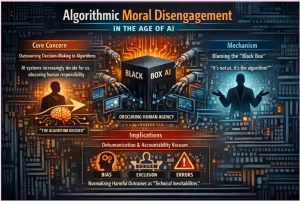
Algorithmic Moral Disengagement in the Age of AI
- With the rise of AI, moral disengagement is increasingly embedded within technological systems, where decision-making is outsourced to opaque algorithms.
- Mechanism: The “black box” nature of AI systems diffuses responsibility, enabling institutions to justify outcomes by claiming that “the algorithm decided”, thereby obscuring human agency.
- Implication: This creates a new layer of dehumanization and accountability vacuum, where biases, exclusions, or errors are normalized as technical inevitabilities rather than ethical failures.
|
Democratic and Legal Dimensions of Moral Disengagement:
- Undermining Constitutional Morality and Rule of Law:
- Core Concern: Moral disengagement weakens constitutional morality, which demands that governance be guided not just by legality but by ethical commitments to justice, dignity, and fairness.
- Mechanism: Authorities selectively interpret laws or exploit legal grey areas to justify ethically questionable actions, creating a gap between procedural legality and substantive justice.
- Implication: The rule of law is reduced to a formal exercise, while its normative core—accountability and equality before law—is gradually eroded.
- Systematic Erosion of Civil Liberties:
- Core Concern: Reframing coercive actions as “security necessities” enables the normalization of exceptional measures.
- Mechanism: Expansion of preventive detention, surveillance regimes, internet shutdowns, and restrictions on dissent under broad and vague grounds such as public order or national interest.
- Implication: Fundamental rights like freedom of speech, privacy, and personal liberty are incrementally curtailed, fostering a climate where rights become conditional rather than guaranteed.
- Examples:
- Prolonged detentions without timely trial justified as preventive action.
- Large-scale digital surveillance is framed as essential for national security, despite concerns around data misuse and lack of oversight.
- Dilution of Accountability and Institutional Checks:
- Core Concern: Moral disengagement enables diffusion of responsibility across bureaucratic and political structures.
- Mechanism: Decisions are justified through technical language, committee-based approvals, or chain-of-command logic, making it difficult to assign direct accountability.
- Implication: Weakening of judicial review, legislative scrutiny, and independent media, leading to a culture of institutional impunity where wrongful acts go unpunished or unnoticed.
- Strain on International Law and Human Rights Norms:
- Core Concern: At the global level, moral disengagement reshapes how states interpret and comply with international humanitarian law and human rights obligations.
- Mechanism: States invoke terms like “strategic necessity,” “counter-terrorism,” or “pre-emptive defence” to legitimize coercive or unilateral actions.
- Implication: This leads to selective adherence and weakens the credibility of global institutions such as the United Nations, fostering a rules-based order that is increasingly fragmented and politicized.
- Examples:
- Civilian deaths during conflicts described as “collateral damage”, diluting accountability under international humanitarian frameworks.
- Unilateral military interventions or sanctions regimes justified without broad consensus, undermining multilateral norms.
- Moral disengagement gradually transforms law from an instrument of justice into a mechanism of justification, eroding civil liberties, institutional accountability, and global legal standards, thereby posing a profound challenge to both democratic legitimacy and the credibility of the rule-based order.
Administrative Language and Ethical Boundaries in Governance
- Distinguishing Precision from Manipulation:
- Core Idea: Institutional language does not inherently signify moral disengagement; rather, in many contexts it reflects administrative precision required to navigate complexity, uncertainty, and sensitivity in governance.
- Rationale: In domains such as diplomacy, public health, and national security, carefully calibrated terminology helps balance transparency with stability, ensuring that communication informs without triggering panic, misinformation, or unintended escalation.
- Implication: Such language, when used responsibly, acts as a tool of clarity and coordination, rather than concealment.
- Examples:
- During the COVID-19 pandemic, phrases like “containment zones” and “graded response strategy” were employed to communicate evolving risks in a structured manner while maintaining public order.
- Governments describe economic downturns as “cyclical slowdowns” or “temporary corrections” to stabilize market expectations and prevent investor panic.
- Functional Necessity in Statecraft:
- Mechanism: Modern governance relies on strategic ambiguity, technical vocabulary, and selective disclosure to ensure operational efficiency and national security.
- Rationale: Complete transparency in all situations may compromise sensitive negotiations, intelligence operations, or military preparedness, thereby necessitating controlled communication.
- Implication: When used judiciously, such language enables policy flexibility, facilitates conflict de-escalation, and preserves institutional credibility in volatile environments.
- Examples:
- In ongoing geopolitical tensions, states often use terms like “calibrated response” or “measured escalation” to signal intent while avoiding direct provocation.
- Diplomatic engagements frequently rely on “constructive ambiguity” to allow multiple stakeholders to interpret agreements in ways that enable consensus without public confrontation.
- Ethical Threshold- From Precision to Obfuscation:
- Core Concern: The ethical boundary is crossed when administrative language shifts from being a means of clarity to a mechanism of concealment, systematically obscuring the real impact of decisions.
- Mechanism: Persistent use of euphemisms and technical jargon to downplay harm, diffuse responsibility, and limit public scrutiny, thereby insulating decision-makers from accountability.
- Implication: This transforms language into an instrument of moral disengagement, eroding public trust, weakening democratic discourse, and normalizing injustice.
- Recent Examples:
- Civilian casualties in armed conflicts being described as “collateral damage”, thereby diluting the moral and legal gravity of human loss.
- Large-scale job losses due to automation and AI framed as “workforce optimization” or “efficiency restructuring”, masking the socio-economic distress of displaced workers.
- Extensive data harvesting by digital platforms is justified as “enhancing user experience”, despite growing concerns around privacy, consent, and surveillance capitalism.
- Normative Boundary- Accountability, Intent, and Oversight:
- Key Principle: The ethical legitimacy of administrative language ultimately depends on intent, proportionality, and the presence of robust accountability mechanisms.
- Rationale: Democratic governance requires that any deviation from full transparency be temporary, justified, and subject to institutional checks such as judicial review, legislative oversight, and a free press.
- Implication: When language is used to serve public interest, it strengthens governance; when used to systematically conceal preventable harm, it undermines the rule of law and democratic ethics.
- Recent Examples:
- Judicial scrutiny in various democracies questioning prolonged internet shutdowns and emphasizing the need for proportionality and transparency.
- Global regulatory debates on AI governance, where demands for algorithmic transparency challenge opaque corporate narratives framed solely around “innovation” and “efficiency.”
- While administrative precision remains an indispensable feature of modern governance, its ethical validity lies in whether it enables informed decision-making or obscures responsibility; thus, transparency, accountability, and proportionality emerge as the critical safeguards against its transformation into a tool of moral disengagement.
Global Governance Frameworks- Institutionalizing Accountability in the Digital Age:
- Human Rights by Design Approach: Promoted by the United Nations Office of the High Commissioner for Human Rights, this approach advocates integrating human rights due diligence, including Human Rights Impact Assessments (HRIAs), into the design and deployment of AI and administrative systems.
- Impact: It encourages institutions to identify and disclose risks such as mass surveillance, discrimination, and algorithmic bias, thereby reducing the tendency to obscure harm through technocratic or neutral-sounding language.
- OECD Guidelines on Responsible Business Conduct: The Organisation for Economic Co-operation and Development has strengthened its Guidelines for Multinational Enterprises (updated 2023) to address issues of corporate accountability and supply chain responsibility.
- These guidelines emphasize risk-based due diligence, responsible sourcing, and grievance redress mechanisms.
- Impact: They limit the scope for firms to evade responsibility by shifting blame onto subsidiaries or contractors, thereby reducing the diffusion of responsibility.
- Several countries are increasingly aligning domestic regulations with these principles, reflecting a broader global shift toward enhanced corporate accountability.
- Multilateral AI and Ethics Governance: Initiatives under the United Nations, UNESCO, and platforms like Global Partnership on Artificial Intelligence emphasize transparency, fairness, and accountability, ensuring that technological progress does not legitimize ethical dilution.
India’s Strategic Response- Strengthening Ethical Infrastructure:
- Digital Personal Data Protection Framework: With the enactment of the Digital Personal Data Protection Act, 2023, India has taken a significant step toward data accountability and citizen-centric governance, including provisions for establishing a Data Protection Board of India to oversee compliance and grievances.
- Key Feature: The Act emphasizes consent-based data processing, purpose limitation, and accountability of data fiduciaries.
- Correction: There is no explicit statutory mandate for “Human-in-the-Loop (HITL)” in Automated Decision-Making (ADM); however, the framework encourages responsible and accountable use of digital systems.
- Impact: Strengthens traceability and institutional accountability, reducing risks of opaque data practices and unchecked algorithmic decision-making.
- Mission Karmayogi – Civil Services Capacity Building: The Mission Karmayogi focuses on transforming governance through competency-driven and value-based training of civil servants.
- Key Feature: It incorporates modules on ethics, integrity, and public service values, promoting a shift from rule-based compliance to outcome-oriented and citizen-centric governance.
- Correction: While “ethical literacy” and reflective thinking are implicit goals, specific references to structured modules on psychological mechanisms like “advantageous comparison” are conceptual extensions, not officially codified content.
- Impact: Enhances moral reasoning, empathy, and accountability among public officials, helping reduce social distance and bureaucratic detachment.
- Administrative Reforms and Ethical Sensitization: Initiatives led by the Department of Administrative Reforms and Public Grievances emphasize capacity building, empathy, and citizen-centric service delivery.
- Recent administrative reform efforts highlight increasing emphasis on empathy, behavioral training, and service orientation among civil servants.
- Whistleblower Protection Framework: India’s Whistle Blowers Protection Act, 2014 aims to protect individuals who expose corruption, misuse of power, and institutional wrongdoing, thereby strengthening transparency and accountability within governance systems.
- Ethical Significance: While not explicitly granting “ethical immunity,” the framework reinforces individual moral responsibility by encouraging officials to report unethical practices rather than comply with them.
- Global Ethical Alignment: This approach resonates with principles such as the Nuremberg Principles, which emphasize that “following orders” is not a valid defense for unethical or illegal actions, thereby promoting moral agency within institutions.
- Responsible AI and Policy Frameworks: Guided by NITI Aayog’s “Responsible AI for All”, India promotes fairness, inclusivity, and transparency in AI deployment, ensuring that innovation aligns with constitutional morality and social justice.
Across both global and Indian contexts, there is a clear transition from diffused and opaque decision-making toward codified accountability frameworks. By embedding human rights, transparency, and individual responsibility into institutions and technology, these initiatives aim to systematically counter moral disengagement and restore ethical integrity in governance. |
Way Forward
- Strengthening Institutional Safeguards: Enhance whistleblower protections, ensure independent judicial oversight, and mandate Human Rights Impact Assessments (HRIAs) for major policy decisions, especially in emerging domains like AI, to enable proactive ethical scrutiny.
- Ensuring Transparent Chains of Responsibility: Clearly define individual accountability within institutional hierarchies and conduct regular ethics audits, so that “following orders” cannot be used as a shield for unethical conduct.
- Promoting Linguistic Accountability: Mandate the use of clear and human-centric language in official communication, ensuring that policy narratives accurately reflect real-world impacts and do not obscure harm through euphemisms.
- Building Moral Courage and Ethical Reasoning: Reform education and training systems to emphasize critical thinking, ethical awareness, and constitutional values, enabling individuals to recognize and resist moral disengagement.
- Strengthening Participatory Oversight: Empower civil society, media, and citizen engagement to enhance transparency and ensure continuous democratic accountability over institutional actions.
Conclusion
Moral Disengagement demonstrates that unethical conduct in power-driven systems persists not through an absence of morality, but through its strategic reinterpretation. Through euphemisms, hierarchies, and narrative control, harmful actions may be normalized and legitimized. To uphold justice and democratic accountability, it is essential to foster a culture of ethical vigilance where the exercise of power remains tethered to the human consequences of institutional action and the basic principles of human dignity.


 20 Mar 2026






.png)






 Current Affairs




 GS Foundation
 Optional Course
 Combo Courses
 Degree Program