Committee to Prepare Yamuna Action Plan
Context: Recently, the Supreme Court constituted a committee under the Union Home Secretary to prepare a comprehensive Yamuna Action Plan within eight weeks.
Key Highlights of the Supreme Court Directions
- Committee Formation: The committee comprises the Union Home Secretary and Chief Secretaries of all States and Union Territories through which the Yamuna flows.
- Objective of the Action Plan: The committee has been directed to prepare an integrated strategy for rejuvenation and pollution control of the Yamuna River.
- Model of Rejuvenation: The Court suggested adopting a long-term integrated approach similar to the Namami Gange Programme for river restoration.
- Components of the Yamuna Action Plan: The plan must include implementation strategy, budgetary allocations, timelines and clearly defined responsibilities of concerned agencies.
- Monitoring and Coordination: The Supreme Court emphasised that coordination and monitoring should be entrusted to a single nodal authority.
- Suggested Measures: Recommendations include geo-tagging sewage treatment plants, monitoring water quality data and identifying polluting industries and settlements.
UPSC Online Courses
About Yamuna River
- The Yamuna is the largest tributary of the Ganga River and one of the most important rivers of northern India.
- Origin: The river originates from the Yamunotri Glacier near Bandarpoonch peak in the Uttarkashi district of Uttarakhand.
- Key Tributaries: Major tributaries of the Yamuna include the Chambal, Betwa, Ken, Sindh and Tons rivers.
- States/UT Traversed : The Yamuna flows through Uttarakhand, Himachal Pradesh, Haryana, Delhi and Uttar Pradesh.
- Pollution Sources Identified: Untreated sewage, toxic industrial effluents, illegal industries and encroachments.
- Mouth: It merges with the Ganga River at Triveni Sangam in Prayagraj.
Khet Bachao Abhiyan
Context: The Union Minister of Agriculture and Farmers Welfare launched the Khet Bachao Abhiyan on 1 June 2026 from Raisen, Madhya Pradesh.
About the Khet Bachao Abhiyan
- It is a nationwide month-long campaign of the Ministry of Agriculture and Farmers Welfare to promote sustainable agriculture and soil conservation.
- Objective: To protect soil health through balanced fertiliser use, scientific farming practices and reduced dependence on excessive chemical inputs.
- Focus Areas: Promotes soil testing, Soil Health Cards, natural farming, water conservation, green manuring and climate-resilient agriculture.
- Farmer Awareness: Educates farmers on the judicious use of fertilisers and identification of counterfeit fertilisers, seeds and pesticides.
- Implementation: Conducted through Krishi Vigyan Kendras (KVKs), Indian Council of Agricultural Research institutions, agricultural universities and state agriculture departments.
India’s 18th Railway Zone
Context: The South Coast Railway (SCoR) zone became fully operational on June 1, 2026, following a formal gazette notification by the Ministry of Railways.
- Headquartered in Visakhapatnam, it marks India’s 18th railway zone.
About India’s 18th Railway Zone
- Administrative Setup: It is temporarily operating from ‘The Deck’ building in Siripuram, while the permanent headquarters is under construction at Mudasarlova (foundation stone laid by the Prime Minister in January 2025).
- Legal Basis: The creation of this zone fulfills a statutory commitment under the Andhra Pradesh Reorganisation Act, 2014, which mandated a dedicated railway zone for the bifurcated state of Andhra Pradesh.
- Divisional Structure: The SCoR zone is organized into four distinct railway divisions:
- Visakhapatnam
- Vijayawada
- Guntakal
- Guntur
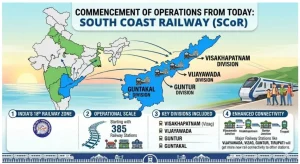
- Geographical Spread: The zone manages a vast rail network running predominantly across Andhra Pradesh, while extending its jurisdiction into parts of neighboring Karnataka and Tamil Nadu.
- Operational Focus: It is designed to manage approximately 17,000 employees.
- Immediate priority is given to capacity augmentation and track development, including the critical third- and fourth-line infrastructure projects around the Visakhapatnam corridor to handle heavy freight and passenger traffic.
About Railway Zones in India
- Administrative Setup: The Indian Railways network is divided into administrative segments known as Zones, which are further sub-divided into Divisions.
- Each zone is headed by a General Manager (GM) who reports directly to the Railway Board.
- Constitutional and Legal Framework: Since Railways falls under the Union List, the authority to constitute, alter or rename railway zones and divisions rests with the Central Government, acting through the Ministry of Railways.
- The creation of new railway zones such as South Coast Railway (SCoR) is aimed at improving administrative efficiency, strengthening regional railway management, and accelerating capacity augmentation.
- Strategic Significance: The creation of localized zones like SCoR is aimed at enhancing administrative efficiency, accelerating regional track electrification and doubling, boosting economic growth via specialized freight corridors, and addressing long-standing regional infrastructural demands.
Lokmata Ahilyabai Holkar (1725 – 1795)
Context: The Prime Minister, Shri Narendra Modi has paid tributes to Lokmata Ahilyabai Holkar on her birth anniversary.
About Ahilyabai Holkar
- Birth and Early Life: Born on 31 May 1725 in Chondi, Maharashtra.
- Personal Losses: Lost her husband, Khanderao Holkar (1754), father-in-law, Malhar Rao Holkar (1766), and son, Male Rao Holkar (1767).
- Accession to the Throne: Ascended the throne of the Holkar dynasty and became ruler of Indore on 11 December 1767.
- Military Administration: Appointed Tukoji Rao Holkar as the commander of her army.
- Capital: Established Maheshwar (present-day Madhya Pradesh) as the capital of the Holkar dynasty.
- Reign and Capital: Ruled the Malwa Kingdom from 1767 to 1795, with her capital at Maheshwar.
- Popular Recognition: Revered as Lokmata and Punyashlok Rajmata for her just, compassionate, and people-centric governance.
- Died: 13 August 1795, aged 70.
UPSC Online Coaching
Contributions of Lokmata Ahilyabai Holkar
- Economic Development: Transformed Malwa into a prosperous center of trade, agriculture, and craftsmanship.
- Administrative Reforms: Promoted efficient administration, public welfare, justice, and social reforms, including support for widows and marginalised communities.
- Infrastructure Development: Encouraged education and developed roads, wells, ghats, and rest houses to improve connectivity and public welfare.
- Arts and Culture: She extended patronage to distinguished poets and scholars such as Marathi poet Moropant, Shahir Ananta Gandhi, and Sanskrit scholar Khushali Ram.
- Temple Restoration and Cultural Preservation: She rebuilt and renovated major temples and pilgrimage sites, including Kashi Vishwanath Temple and Somnath Temple.
- Handloom Promotion: Developed Maheshwar and Indore as major trade centres and promoted the Maheshwari weaving tradition, whose sarees now enjoy GI tag status.
- Enduring Legacy: Remembered as an icon of good governance, cultural preservation, women’s leadership, and public service.
Meteor Explosion Over Northeastern United States
Context: A 3-foot-wide meteor exploded over the Massachusetts–New Hampshire border in the northeastern United States, generating sonic booms and shaking buildings across the region.
NASA’s Assessment of the Event
- High-Altitude Fragmentation: The meteor broke apart at an altitude of about 40 miles (64 km) above Earth.
- Extreme Velocity: It was travelling at approximately 75,000 mph (120,000 km/h) when it entered the atmosphere.
- Explosion: The meteor exploded due to an airburst, which occurs when a meteoroid enters Earth’s atmosphere at extremely high speed and experiences intense air pressure and heating.
- Powerful Energy Release: The breakup released energy equivalent to about 300 tons of TNT, producing the widely reported double boom.
- Natural Origin Confirmed: NASA stated that the object was a natural meteoroid, not a satellite or space debris re-entry.
- The American Meteor Society stated that the meteor likely burned up in the atmosphere and was unlikely to have struck the ground.
- Rare Daytime Fireball: The meteor was an unusually bright and relatively large fireball visible during daylight and was not associated with any known meteor shower.
Bangladesh’s Padma Barrage
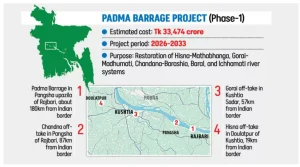
Context: Bangladesh has approved the construction of the Padma Barrage in Rajbari district on the Padma River (downstream stretch of the Ganga River).
About the Project
- Project Features:
- A Bangladesh-led transboundary river infrastructure project aimed at addressing dry-season water scarcity and improving Ganga-Padma water management.
- The 2.1-km-long barrage will include 78 spillway gates, navigation locks, undersluices, and fish passages.
- Designed to store nearly 2.9 billion cubic metres of water and generate 113 MW hydropower.
- Expected Benefits:
- Expected to improve water security across nearly 37% of Bangladesh’s land area.
-
- It will provide irrigation support to around 2.88 million hectares of farmland in the southwest region.
- Key Concerns:
- Environmental groups warn that mega-barrages can disrupt sediment flows and river ecology.
- Major risks include water-logging, decline in downstream fisheries, and inadequate public/transboundary consultations.
- India Linkage:
- Since the Padma is the downstream continuation of the Ganga, the project may influence future India-Bangladesh water-sharing discussions, especially in relation to Farakka Barrage and dry-season river flows.
- Broader Significance:
- The project reflects South Asia’s continued reliance on large river infrastructure for water security, even as concerns remain over sediment flows, river ecology, and transboundary consultations.
- Contrasts with trends in Europe and North America, where obsolete dams and river barriers are increasingly being removed to restore natural river ecosystems.
Click to Know UPSC Coaching Centres in India
Beaufort Castle
Context: The Israeli military captured Beaufort Castle, a strategic mountain-top fortress in southern Lebanon, located near Nabatiyeh and overlooking the Litani River.
About Beaufort Castle
- Beaufort Castle (known in Arabic as Qalaat al-Shaqif) is a highly strategic, 900-year-old medieval fortress located in southern Lebanon.
- Geographical Advantage: Located on high hills near Nabatiyeh, the fortress overlooks the Litani River and offers a strategic military view of southern Lebanon and northern Israel.
- Historical Profile: Built as a Crusader castle in the 12th century over older fortifications, it was later controlled by Saladin’s army, the Mamluks, the Ottomans, the French Mandate authorities, and the Palestine Liberation Organization (PLO).
- Modern Conflict History: The Israeli military captured the castle from the Palestine Liberation Organization (PLO) in 1982 and held it until 2000. After recapturing it on May 31, 2026, Israeli forces raised their flag there for the first time in 26 years.
- International Protection Status: UNESCO has granted Beaufort Castle provisional enhanced protection under the 1999 Second Protocol to the 1954 Hague Convention for the protection of cultural property during armed conflict.
 1 Jun 2026