Sri Vishwesha Tirtha Swamiji
Context: Prime Minister unveiled the logo for the birth centenary celebrations of Sri Vishwesha Tirtha Swamiji.
UPSC Online Courses
About Sri Vishwesha Tirtha Swamiji

- Sri Vishwesha Tirtha Swamiji (1931–2019) was the pontiff of Sri Pejavara Adhokshaja Matha, one of the Ashta Mathas of Udupi, associated with the Dvaita school of philosophy founded by Madhvacharya.
- Early Life: Born as Venkataramana on 27 April 1931 in Ramakunja, Karnataka, he entered monastic life in 1939 and was given the name Vishwesha Tirtha.
- He became the head of the Pejavara Matha and later served as the Paryaya Peetha holder at the Udupi Sri Krishna Temple five times.
- Key Contributions
- Social Equality: He opposed untouchability and caste discrimination, advocating social harmony and enabling greater access to darshan and prasadam for Dalits and backward communities at the Udupi Krishna Mutt.
- Service & Humanitarian Work: During droughts, he established gruel centres, gau ashrams and relief initiatives, while personally promoting frugality and assistance to affected communities.
- Philosophy: His public life combined Dvaita Vedanta, devotion, social service and inclusiveness, with emphasis on religious values alongside social responsibility.
- Legacy: He was awarded the Padma Vibhushan and remained an influential religious and social figure associated with Udupi’s spiritual traditions.
- His initiatives on social harmony, humanitarian service and religious engagement continue to shape his public legacy.
About Udupi Sri Krishna Temple
- Udupi Sri Krishna Temple is a major Vaishnavite pilgrimage centre in Udupi, Karnataka, associated with the Dvaita Vedanta tradition.
- Origin: The temple is traditionally associated with Madhvacharya, who founded the Udupi Krishna tradition in the 13th century.
- Deity: The principal deity is Bala Krishna, depicted as a child Krishna holding a churning rod and rope.
- Temple Style: The temple reflects the traditional coastal Karnataka architectural style, featuring wooden elements, tiled roofs and a simple functional layout.
- Kanakana Kindi: Devotees traditionally view the Krishna idol through Kanakana Kindi, a silver-plated window containing nine openings.
- Ashta Mathas: The temple is administered through the Ashta Mathas (eight monasteries) established by Madhvacharya, with the Paryaya system rotating temple management among them.
- Religious Significance: The temple is an important centre of Dvaita Vedanta, Krishna worship and Vaishnavite religious traditions.
Agasthyamalai Biosphere Reserve Floral Checklist
Context: A new Jawaharlal Nehru Tropical Botanic Garden and Research Institute checklist has documented 3,261 flowering plant species in the Agasthyamalai Biosphere Reserve (ABR), highlighting its exceptional floral diversity and endemism.
Key Findings of ABR Floral Checklist
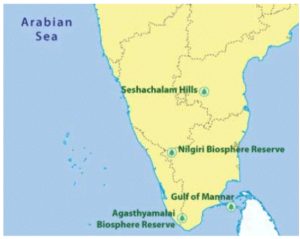
- Comprehensive Checklist: The Jawaharlal Nehru Tropical Botanic Garden and Research Institute (JNTBGRI) documented 3,261 species, 26 subspecies and 28 varieties, belonging to 1,139 genera and 190 families.
- JNTBGRI is an autonomous research center established by the Government of Kerala in 1979, in Palode, Thiruvananthapuram, to conserve tropical plant resources and promote sustainable utilization through scientific research.
- High Endemism: It recorded 1,018 taxa (31.2%) endemic to India, including 245 steno-endemic taxa restricted to specialised habitats.
- Species-Rich Families: Fabaceae is the most species-rich family with 349 taxa, followed by Rubiaceae (194), Poaceae (193) and Orchidaceae (168).
- Biogeographical Significance: The ABR shares 347 taxa with Sri Lanka and shows affinity with 102 taxa of tropical American flora, reflecting complex biogeographical histories.
UPSC Online Classes
About Agasthyamalai Biosphere Reserve (UPSC CSE Pre 2005 , 2019)
- It is a massive biosphere reserve that protects ecologically diverse tropical ecosystems in the southern Western Ghats and is recognised as a major centre of biodiversity and endemism.
- Origin & Recognition: It was established in 2001 and was included in UNESCO’s World Network of Biosphere Reserves in 2016 under the Man and the Biosphere (MAB) Programme.
- Location: The reserve covers about 3,500 sq km across Kerala and Tamil Nadu, including parts of Thiruvananthapuram, Kollam, Pathanamthitta, Tirunelveli and Kanyakumari.
- Geography: The landscape is mountainous, with Agasthyamala Peak (1,868 m) as its highest point, and serves as an important catchment for rivers including Thamirabarani, Neyyar and Karamana.
- Climate: It experiences a tropical monsoon climate and receives rainfall from both the South-West and North-East monsoons.
- Vegetation: Major ecosystems include tropical wet evergreen forests, moist deciduous forests, montane rainforests and Shola-grassland complexes.
- Key Species: Important fauna include the tiger, Asian elephant, Nilgiri tahr, lion-tailed macaque and grizzled giant squirrel, while its flora includes numerous endemic orchids and medicinal plants such as Arogyapacha.
- Protected areas: It includes the Kalakkad Mundanthurai Tiger Reserve, Shendurney Wildlife Sanctuary, Peppara Wildlife Sanctuary, and Neyyar Wildlife Sanctuary.
- Tribal Communities: The Kani community inhabits the region and possesses extensive traditional knowledge of its medicinal plant resources.
V4+India Foreign Ministers’ Meeting
Context: India held the first V4+India Foreign Ministers’ Meeting on the sidelines of the 81st United Nations General Assembly (UNGA) session in New York.
- The meeting was held under the Slovak Presidency of the V4.
About Visegrád Group (V4)

- V4 is a regional cooperation grouping of four Central European countries: Poland, Hungary, Slovakia, and the Czech Republic
- It promotes cooperation in political, economic, cultural, energy, and security affairs.
- Established: 1991.
- Name: Named after Visegrád, a town in Hungary.
- Common Memberships: All four nations are also members of the European Union, the North Atlantic Treaty Organization, and the Three Seas Initiative.
- Institutional Cooperation: The International Visegrad Fund promotes cooperation among the four Visegrad countries through grants, cultural exchanges, and cross-border initiatives.
India Joins G20 Nations In Adopting Four Consensus Outcomes
Context: India, along with other G20 nations, adopted four consensus outcomes at a meeting hosted by the White House National Energy Dominance Council, the U.S. Departments of Energy and the Interior, and the Environmental Protection Agency (EPA).
UPSC Coaching Classes
Four Key Consensus Outcomes
- Household Energy Access:
- Supported scalable solutions such as Liquefied Petroleum Gas (LPG) to replace traditional biomass.
- Aim: Help developing countries transition towards cleaner cooking fuels.
- Faster Infrastructure Approvals:
- Called for faster and more predictable government permitting processes for energy infrastructure projects to reduce delays in developing critical energy infrastructure.
- Water Reuse: Launched a voluntary water-reuse initiative to promote recycling and reuse of water based on its quality.
- Covers agriculture, manufacturing and community sectors.
- Critical-Mineral Supply Chains: Agreed to voluntarily strengthen and diversify critical-mineral supply chains.
- Focus areas include shared data, innovation and joint investments to improve supply-chain security.
TARANG SHAKTI 2026
Context: The second edition of TARANG SHAKTI, the Indian Air Force’s multinational air exercise, will be conducted from 26 September to 12 October 2026 at Jodhpur, Rajasthan.
About TARANG SHAKTI 2026
- Exercise Tarang Shakti is a multinational air exercise organised by the Indian Air Force.
- Participating Countries
- 8 Friendly Foreign Countries will participate with air assets: Australia, Bangladesh, France, Germany, Greece, Sri Lanka, UAE, USA
- 32 countries will participate as observers.
- Objectives
- To enhance interoperability among participating air forces.
- To facilitate joint planning and execution of multinational combat operations.
- To develop tactically viable solutions for contemporary air-warfare challenges.
- To promote operational learning and exchange of best practices.
- Significance: TARANG SHAKTI 2026 will strengthen India’s defence cooperation and operational interoperability with partner countries and provide exposure to complex, contemporary air-warfare scenarios.
Neelakurinji Decline
Context: Large-scale destruction of Neelakurinji blooms in Munnar by tourists has raised concerns over habitat damage and unregulated tourism during its flowering season.
Click to Know UPSC Coaching Centres in India
About Neelakurinji
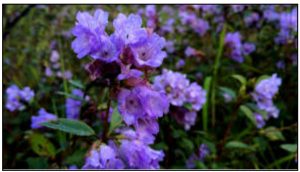
- Neelakurinji (Strobilanthes kunthiana) is a rare, purplish-blue flowering shrub belonging to the Acanthaceae family.
- It is endemic to India and is closely associated with high-altitude Shola forest-grassland ecosystems.
- Distribution: It occurs mainly in the Western Ghats, with a small isolated population in the Eastern Ghats.
- It is found at elevations of approximately 1,340–2,600 metres.
- Of 34 known subpopulations, 33 occur in the Western Ghats and one in the Eastern Ghats.
- Key Features
- 12-Year Blooming Cycle: Neelakurinji exhibits mass synchronous flowering approximately once every 12 years, after which the plant sets seeds and dies.
- The last major bloom occurred in 2018, with the next major cycle expected around 2030.
- Shola Ecosystem: It grows predominantly in high-altitude Shola grassland mosaics, which are important habitats of the Western Ghats.
- Ecological Significance: Mass flowering attracts pollinators such as honeybees and supports biodiversity, including the Nilgiri Tahr.
- Cultural Significance: The Paliyan tribal community has traditionally used its 12-year flowering cycle as a natural measure of age and generations.
- Threats
- Habitat loss and fragmentation due to plantations, infrastructure and urbanisation threaten its restricted habitat.
- Invasive species, climate change and unregulated tourism further damage populations and interfere with regeneration.
- During flowering seasons, tourists may trample or uproot plants in unprotected areas.
- Conservation Status
- IUCN Red List: Neelakurinji is classified as Vulnerable (VU) under Criterion A2c due to an estimated 40% reduction in its population and habitat over the last three generations.
- Wildlife (Protection) Act, 1972: It is included under Schedule III following the 2022 amendment.
- Protected Area: Kurinjimala Sanctuary in Kerala protects approximately 32 sq. km of important Neelakurinji habitat.
 23 Sep 2026