Andhra Pradesh to Emerge as India’s Third Subsea Digital Hub
Context: Andhra Pradesh is set to become India’s third major international subsea cable gateway after Mumbai and Chennai.
UPSC Online Courses
About Subsea Cable Infrastructure
- Submarine cables are fiber-optic cables laid on the seabed that carry the overwhelming majority of intercontinental digital traffic.
- They are critical infrastructure and provide high-bandwidth, low-latency, and cost-effective connectivity between countries and continents.
- At the coast, cables terminate at Cable Landing Stations (CLS), which connect them to terrestrial fiber networks, data centers and cloud infrastructure.
- Major Indian Subsea Landing Hubs in India:
- Mumbai: India’s major international connectivity hub, linking to several global submarine cable systems.
- Chennai: An important gateway to Southeast Asia and East Asia.
- Kochi: Key landing point connecting India with West Asia and Southeast Asia.
- Thoothukudi: Emerging southern landing hub, strengthening India’s international connectivity.
- Visakhapatnam: Important eastern-coast landing point, particularly for connections towards Asia-Pacific networks.
Significance
- Digital Resilience: Adds route diversity beyond Mumbai and Chennai, reducing dependence on a limited set of landing points.
- Economic Growth: Can attract technology, cloud, and digital infrastructure investments to Andhra Pradesh.
Key Concern
- Cable Vulnerability: Damage from anchors, fishing activity, and seabed disturbances can disrupt connectivity.
- Aging Infrastructure: Existing cables face capacity constraints and are reaching end-of-life.
- Fiber Shortage: Rapid expansion of AI infrastructure is creating shortages of optical fiber and related components.
Samarthak
Context: Recently, the Indian Navy inducted Samarthak.
About Samarthak
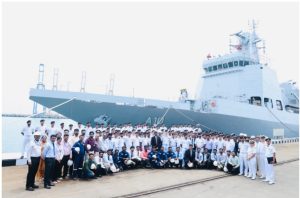
- Samarthak is India’s first indigenous Multi-Purpose Vessel (MPV), built by Larsen & Toubro (L&T) at Kattupalli.
- Meaning: The name Samarthak means “The Proponent”, signifying its role as a dependable enabler of multiple missions.
- Primary Purpose: Designed primarily as a versatile platform for naval trials and evaluation.
- Indigenisation: Built with over 75% indigenous content, supporting Aatmanirbhar Bharat.
Key Features
- Maritime Surveillance: Supports surveillance and reconnaissance missions.
- Offshore Patrolling: Capable of conducting offshore patrol and maritime security operations.
- HADR Capability: Can undertake Humanitarian Assistance and Disaster Relief (HADR) operations.
Trump Renames Lake Ontario as “Lake America”
Context: U.S. President Donald Trump signed an executive order renaming Lake Ontario as “Lake America”.
About Lake Ontario
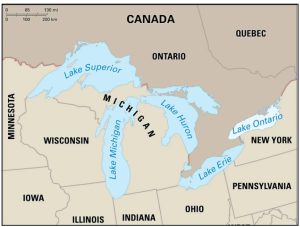
- Lake Ontario is one of North America’s five Great Lakes and the smallest by surface area.
- “Ontario” has Indigenous origins and carries cultural significance for Canada.
- Five Great Lakes: Superior, Michigan, Huron, Erie and Ontario (SMHEO) — a group of interconnected freshwater lakes in North America, shared by the United States and Canada.
- Location: Lies between Ontario, Canada, and New York, USA, along the international border.
- Hydrological Link: Receives water from Lake Erie via the Niagara River and drains into the St. Lawrence River towards the Atlantic Ocean.
Onion Price Rise and Government Price-Stabilisation Measures
Context: The Delhi onion price touched ₹62/kg on August 27, 2026, prompting the Union government to intervene through buffer-stock releases and subsidised retail sales at ₹35/kg.
Reasons for Price Rise
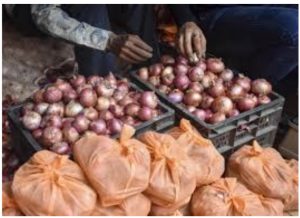
- Hoarding: Artificial restriction of market supply through stock accumulation can raise prices.
- Black Marketing: Unregulated market practices can contribute to abnormal price escalation.
- Middlemen: The government has highlighted profiteering and intermediary margins as contributors to the farmer-consumer price gap.
- Seasonality: Changes in market arrivals, harvest cycles and storage stocks can cause price volatility.
Government Price-Stabilisation Measures
- Subsidised Retail Sale: The government plans to make onions available at ₹35 per kg through designated mobile vans and retail outlets in cities including Delhi.
- Cooperative Distribution: National Agricultural Cooperative Marketing Federation of India Limited (NAFED) and National Cooperative Consumers’ Federation of India Limited (NCCF) will undertake retail distribution through their outlets and Kendriya Bhandars.
- Buffer Stock Release: The government has initiated calibrated and targeted release of onion buffer stocks to increase availability and moderate seasonal price pressures.
- Transportation: Buffer onions are being moved through a hybrid transportation model involving railway rakes and road transport.
- Targeted Supply: Supplies are being directed towards major consumption centres based on prevailing market prices and supply conditions.
UPSC Online Classes
Onion Buffer Stock
- Purpose: Onion buffer stocks are maintained to intervene in the market during periods of price volatility, helping protect both consumers and farmers.
- Price Stabilisation: Stocks can be released during periods of short supply and rising prices to increase market availability.
- Procurement: Government agencies procure onions from farmers during periods of low prices or surplus production, thereby providing some price support to farmers.
- Market Intervention: The stored onions can subsequently be released in deficit periods to moderate retail prices.
Role of NAFED and NCCF
- NAFED: The National Agricultural Cooperative Marketing Federation of India Limited is a major cooperative organisation involved in agricultural marketing and government market interventions.
- NCCF: The National Cooperative Consumers’ Federation of India Limited undertakes consumer-oriented activities, including distribution of essential commodities during price-stabilisation interventions.
- Joint Intervention: NAFED and NCCF are important implementing agencies for procurement, storage and distribution of onions under government price-stabilisation measures.
Jawaharlal Nehru Port (JNP)
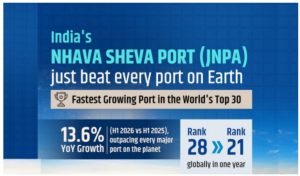
Context: The Jawaharlal Nehru Port (JNP) has been recognised as the world’s fastest-growing container port.
- The port has climbed to the 21st position globally in container port rankings.
- It recorded a 13.6% growth in container throughput during the first half of 2026.
- JNP has outpaced every other port among the world’s top 30 in terms of growth rate during this period.
About Jawaharlal Nehru Port
- Location: Jawaharlal Nehru Port (JNP), also known as Nhava Sheva Port, is located in Navi Mumbai, Maharashtra, and is one of India’s premier container-handling ports.
- Commission: Commissioned in 1989, JNP is a major port under the Ministry of Ports, Shipping and Waterways, Government of India.
- Status: It is India’s largest container port, handling a significant share of the country’s containerised cargo traffic.
- Significance: It plays a central role in India’s EXIM (export-import) trade, particularly for cargo moving through the western coast.
Click to Know UPSC Coaching Centres in India
Javelin Anti-tank Missiles
Context: India has finalised a deal with the United States to procure the Javelin anti-tank guided missile (ATGM) system for the Indian Army.
What is the Javelin Missile?
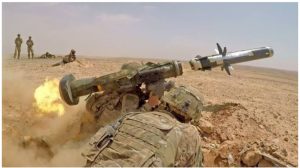
- Javelin (FGM-148) is a man-portable, medium-range anti-tank guided missile (ATGM) that entered US military service in 1996.
- Manufactured by: Manufactured by the Javelin Joint Venture, a partnership between Raytheon (RTX) and Lockheed Martin.
Key Features
- Fire-and-Forget: The missile uses an imaging infrared seeker, allowing the operator to launch it and immediately take cover without continuously guiding the missile.
- Range: It has an effective range of around 2.5 km.
- Man-portable: The system can be carried and operated by soldiers.
- It can be:
- Shoulder-fired by a single soldier, or
- Fired from a remote launcher mounted on an unmanned ground vehicle (UGV)
 28 Aug 2026