In a landmark judgment , the Delhi High Court has granted a woman permission to extract and preserve the sperm of her husband, an Indian Army soldier currently in a vegetative state.
Best Online Coaching for UPSC
About Perimortem Sperm Retrieval
- It is a medical procedure through which sperm is retrieved from a man who is critically ill, comatose, or recently deceased for use in assisted reproductive technologies.
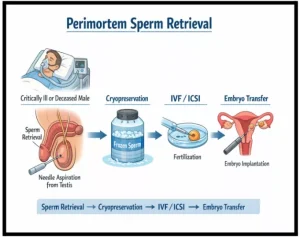 Use in Assisted Reproduction: The retrieved sperm is cryopreserved (frozen) and later used for In-Vitro Fertilisation (IVF) or Intracytoplasmic Sperm Injection (ICSI).
 -
- Cryopreservation involves freezing sperm at extremely low temperatures, usually using liquid nitrogen.
- Frozen sperm can remain viable for up to a decade and can later be used in IVF procedures.
- Methods of Sperm Retrieval:
- Penile Vibratory Stimulation (PVS): Non-invasive stimulation to induce ejaculation when spinal reflexes are intact.
- Electroejaculation: Electrical stimulation of nerves to trigger ejaculation.
- Testicular Sperm Aspiration (TESA): A fine needle is inserted into the testes to extract sperm directly if the ejaculation methods fail.
- Effectiveness of Sperm Retrieval:
- Sperm retrieval success: Nearly 100% in many cases.
- Viable sperm availability: Approximately 80–90% of retrieved samples contain viable sperm capable of fertilisation.
- Precedent: In the United Kingdom (UK), a 2018 High Court ruling permitted doctors to retrieve sperm from an unconscious man on life support after evidence showed that the couple had earlier intended to have children.
Biological Basis of Sperm Retrieval in Coma
- Continuation of Vital Functions: Even in a coma or vegetative state, the body may continue vital physiological functions such as heartbeat, blood circulation, and organ activity.
- Active Testicular Function: Since the testes can remain biologically active, sperm production may still occur, making retrieval medically feasible under certain conditions.
Limitations and Medical Concerns
- Impact of Critical Illness and Medication: Critical illness and medications (such as antibiotics, sedatives, and life-support drugs) may reduce sperm quality or quantity, and the quality may degrade rapidly after retrieval, requiring prompt extraction and preservation.
- Uncertainty in IVF Outcomes: Fertilisation success, embryo development, and implantation in IVF are not guaranteed.
- Potential Genetic and Health Concerns: There may be concerns regarding genetic integrity and possible long-term health outcomes of the child.
Legal and Ethical Issues
- Consent of the Individual: Determining whether the patient had explicit or presumed consent for posthumous reproduction before sperm retrieval.
- Reproductive Autonomy: Balancing the spouse’s reproductive rights with the autonomy and presumed wishes of the incapacitated individual.
- Parenthood and Inheritance: Addressing the legal status, parentage, and inheritance rights of children conceived after the father’s incapacitation or death.
Click to Know UPSC Offline Courses
Conclusion
While medically feasible, perimortem sperm retrieval involves multiple medical, ethical, and legal uncertainties that require careful consideration.
 17 Apr 2026