Books

 23 Mar 2026
March, a transition month from winter to summer, saw unusual weather variability, with early heatwaves in Jammu & Kashmir, Punjab, Gujarat, Maharashtra, and Himachal Pradesh, followed by thunderstorms, hailstorms, and rainfall.
Explore UPSC Foundation Courses

Explore UPSC Foundation Courses
Check Out UPSC CSE Books
Visit PW Store
| Aspect | Western Disturbances | Monsoon (Southwest) |
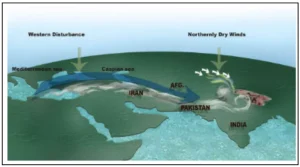
| Introduction | Western Disturbances are extra-tropical weather systems bringing winter rain and snow to northwestern India. | The monsoon is a seasonal tropical wind system bringing widespread rainfall to most parts of India during summer. |
| Origin | They originate near the Mediterranean Sea and move eastward. | They originate due to differential heating of land and sea, primarily influenced by the Indian Ocean. |
| Type of System | They are low-pressure systems formed in the mid-latitudes. | They are tropical systems driven by thermal pressure differences and ocean-atmosphere interactions. |
| Season/Months | Predominantly active during winter (December to February), but increasingly seen in pre-monsoon months. | Active mainly from June to September during the southwest monsoon season.
Retreating Monsoon Season during October and November which causes rain in the eastern part of the Peninsula. |
| Moisture Source | They draw moisture from the Mediterranean, Caspian Sea, and Arabian Sea. | They collect moisture while crossing the warm Indian Ocean and the Bay of Bengal. |
| Main Impact Area | Affect northwest India and the western Himalayas. | Impact almost all of India, especially central, western, and northeastern regions. |
| Associated Phenomena | Cause snowfall, winter rain, fog, and cold waves. | Bring widespread rain, floods, soil erosion, and break periods. |
| Influencing Factors | Influenced by the subtropical westerly jet stream. | Influenced by Inter Tropical Convergence Zone (ITCZ), sea surface temperature, Tibetan heating, and jet streams. |
Explore UPSC Test Series



.png)


Explore SRIJAN Prelims Crash Course



Connect with our experts to get free counselling & start preparing
Books
Udaan (Prelims Wallah)
Prahaar (Mains Wallah)
Q&A Bank (Prelims & Mains)
Budget & Economic Survey
NCERT Wallah
Marks Booster
हिंदी माध्यम विशेष शृंखला
 Current Affairs
Monthly Current Wallah
Subject Wise Current Affairs
Editorial Analysis
Editorial PDFs
News of The Day
Download Our App



Download Our App
<div class="new-fform">
</div>

 GS Foundation
 Optional Course
 Combo Courses
 Degree Program