The foundation of this discussion rests on Mahatma Gandhi’s famous assertion that “the real India lives in villages”.
The source emphasizes that national development is impossible without the comprehensive development of rural areas.
To address this, India is collaborating with the International Fund for Agricultural Development (IFAD)—a specialized UN agency focused on eliminating poverty and hunger in developing nations—to implement a medium-to-long-term roadmap (2026–2033) known as the Country Strategic Opportunity Program.
UPSC Online Classes
What is the Country Strategic Opportunities Programme (COSOP)?
- Medium to long-term strategic roadmap prepared jointly by IFAD and a member country.
- India’s COSOP covers the period 2026–2033.
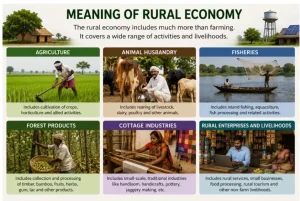
- Focuses on strengthening India’s rural economy and improving livelihoods.
Three Pillars of COSOP 2026–2033
- Socio-Economic and Climate Resilience: Strengthening rural communities against, Poverty, Diseases, Climate change and Economic shocks
- Focus on resilient livelihoods and adaptive capacity.
- Strengthening Grassroots Institutions: Empowering Self Help Groups (SHGs), Panchayats and Farmer Producer Organisations (FPOs)
- Enhancing decentralised governance and collective bargaining power.
- Example: FPOs help farmers buy seeds, fertilizers, and inputs collectively at lower prices.
- South-South Cooperation: India will share successful rural development models with other developing countries. Areas where India can contribute:
- Digital governance
- SHG movement
- Rural financial inclusion
About International Fund for Agricultural Development (IFAD)
- A specialized agency of the United Nations.
- Established to reduce:
- Rural poverty
- Hunger
- Food insecurity in developing countries.
- Works with developing nations through long-term rural development programmes.
- IFAD is not affiliated with the World Bank.

Challenges in India’s Rural Economy
- Structural Constraints: Small and fragmented landholdings reduce agricultural productivity and make the use of advanced machinery difficult.
- Disguised Unemployment: More people are engaged in agriculture than required, resulting in low productivity and hidden unemployment.
- Climate Vulnerability: Indian agriculture is highly vulnerable to droughts, floods, and irregular rainfall caused by climate change.
- Droughts in Vidarbha
- Floods in Bihar
- Uncertain monsoon patterns
- Weak Market Access and Debt Trap: Poor infrastructure and lack of institutional credit force farmers to sell produce at low prices and depend on moneylenders.
- Human Development Deficit: Poor healthcare and education facilities weaken human capital formation in rural areas.
Key Solutions Proposed under COSOP
- Shift Towards Market-Oriented Agriculture: The programme promotes commercial farming and market-based production to increase farmer income.
- Value Addition in Agriculture: Processing agricultural products increases profitability and promotes rural entrepreneurship
- Promotion of Self Help Groups (SHGs): SHGs strengthen women’s empowerment through better credit access and entrepreneurship opportunities.
- Climate-Resilient Agriculture: Climate-resilient farming practices help reduce the impact of climate change on agriculture.
- Financial Inclusion: IFAD aims to improve rural credit access through NABARD and banking institutions.
- Institutional credit
- Reduced dependence on moneylenders
- Rural financial support
- Strengthening Institutions: The programme supports Panchayats, FPOs, and SHGs through legal, financial, and market assistance.
Role of Artificial Intelligence (AI) in Rural Development
AI is identified as a transformative tool for rural development in several ways:
- Precision Farming: Using sensors to provide exact data on soil moisture and fertilizer needs.
- Advanced Forecasting: Providing early warnings for droughts and floods.
- AI Credit Scoring: Utilizing satellite imagery of crops to help banks assess a farmer’s eligibility for loans.
- Market Linkages: Using apps to alert farmers to cities where their specific crops are fetching the highest prices.
- Telemedicine & E-Education: Overcoming the “human development deficit” by providing remote healthcare and quality education via AI-driven platforms.
Key Government Schemes to Leverage
The source lists several critical initiatives for rural upliftment:
- PM Gram Sadak Yojana: For all-weather road connectivity.
- PM Awas Yojana (Gramin): For providing permanent housing.
- PM-KISAN: Direct financial support of ₹6,000 to farmers.
- PM Fasal Bima Yojana: For crop insurance.
- e-NAM: A digital platform to create a unified national market for agricultural products.
Click to Explore UPSC Offline Coaching
Conclusion
True rural development requires moving beyond the “goodwill” of historical ties and focusing on delivery and implementation. By integrating domestic reforms, institutional strengthening, and cutting-edge technology like AI, India can transform its rural economy from a site of “subsistence” into a driver of national growth.