The United States–Israel–Iran conflict intensified after airstrikes killed Iran’s Supreme Leader Ayatollah Ali Khamenei and senior Islamic Revolutionary Guard Corps (IRGC) officials.
The Pretext and Failed Diplomacy
- Contradiction of Anti-War Commitment: Despite campaigning against endless wars, the U.S. military escalation in West Asia indicates deeper strategic entanglement.
- The USA claims to fight for the freedom of Iranians while ignoring the ongoing oppression of the Stateless Palestinians and maintaining ties with various other dictators.
- Questionable Pre-emptive Justification: The absence of publicly available evidence of an imminent Iranian attack weakens the claim of anticipatory self-defence under international law.
- Diplomatic Setback: Ongoing negotiations under Omani mediation between the USA and Iran were reportedly close to a breakthrough, suggesting that military action disrupted a potential diplomatic breakthrough, similar to the collapse of the 2015 nuclear agreement after the U.S. withdrawal in 2018.
Military Dynamics and Regional Escalation
- Lack of Air Defence: Iran lacks advanced air defence systems, such as the S-400, which allowed the USA and Israel to achieve air superiority and domination to wipe out Iran’s top leadership in a first strike.
- Iran’s Retaliation: In response, Iran has begun attacking US military bases located in neighbouring countries, including the UAE, Saudi Arabia, Iraq, Kuwait, Bahrain, and Qatar, as well as launching missiles at Israel.
- Humanitarian Toll: The conflict has already resulted in civilian casualties, including a strike on an Iranian school that killed 150 students
Global and Economic Impact
- Threat to the Strait of Hormuz: There is significant concern that Iran will close the Strait of Hormuz, a critical narrow passage for global oil trade, heightening the possibility of regional spillover and global oil supply disruptions.
- If the Strait is closed, global oil prices will skyrocket.
- Erosion of Rules-Based Order: Unilateral military action without a broad international consensus raises concerns about weakening global norms and multilateral conflict-resolution mechanisms.
- Regional Destabilisation: The conflict risks drawing in Gulf states and major powers, expanding into a wider regional confrontation.
Strategic Implications for India
- Energy Security: Any disruption in the Strait of Hormuz threatens India’s crude oil imports and energy stability.
- Diaspora Concerns: Large Indian communities in Gulf countries may face security and evacuation challenges.
- Strategic Autonomy: India must carefully balance its relationships with the U.S., Israel, and Iran while safeguarding national interests.
- Macroeconomic Impact: Rising oil prices could aggravate inflation, fiscal pressures, and current account deficits.
About Strait of Hormuz
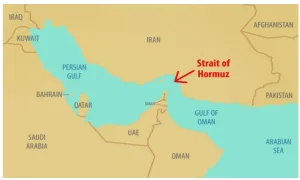
- Geographical Extent: It lies between Oman and the UAE on one side and Iran on the other.
- It links the Persian Gulf in the north to the Gulf of Oman to the south and to the Arabian Sea beyond.
- Buffer Zone: At its narrowest, it is just 33 km wide. The designated shipping lanes within it are only about 3km in each direction, separated by a buffer zone.
- Legal Status and Maritime Regulation: Under international maritime law framed by the United Nations, coastal states exercise sovereignty up to 12 nautical miles (about 22 km) from their shores.
- At its narrowest point, the Strait of Hormuz lies within the territorial waters of Iran and Oman.
|
Scholarly Perspectives
- War of Choice: Realist thinker John Mearsheimer describes this as a “War of Choice” rather than a “War of Necessity,” aimed solely at eliminating a regional adversary to protect American and Israeli interests.
- The Power Dynamic: The situation is likened to Thucydides’ observation that “the strong do what they can and the weak suffer what they must”.
Conclusion
Immediate de-escalation and respect for international law are vital to prevent regional instability and protect the credibility of the rules-based international order and the functional relevance of multilateral institutions such as the United Nations.


 2 Mar 2026






.png)






 Current Affairs




 GS Foundation
 Optional Course
 Combo Courses
 Degree Program