GS III: Awareness in the fields of IT, Space.
Context: India’s space ecosystem achieved a historic milestone with Skyroot Aerospace’s Aagaman mission placing payloads into orbit via the Vikram-1 rocket, making India the third nation globally to possess private orbital launch capacity.
Catalysts of the Policy Ecosystem
- IN-SPACe Single-Window Facilitation: Established to function as an autonomous regulator, separating ISRO’s dual role as operator and regulator to streamline private approvals.
 Technology Transfer via NSIL: NewSpace India Limited executed over 118 tech-transfer agreements, shifting government-developed intellectual property directly to private manufacturers.
- Shared Testing Infrastructure: ISRO opened its engine test beds and Sriharikota launch facilities at subsidized rates, drastically reducing upfront private Capex.
- FDI Policy Liberalization: Eased regulations allowed 100% FDI for satellite components, 74% for satellite manufacturing, and 49% for launch vehicles, attracting significant global venture funding.
Best Online Coaching for UPSC
Capital Dynamics & Market Imbalances
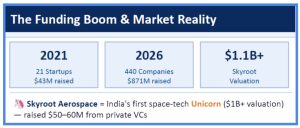
- Capital Concentration Risks: While sector investment grew to $871 million across 440 companies, over 60% of capital remains concentrated in four major startups (Skyroot, Pixxel, AgniKul, and Digantara).
- High Failure Rates in Deep Tech: Due to long R&D cycles and heavy hardware requirements, out of 285 tracked ventures, fewer than 30% successfully secured institutional funding.
Operational Bottlenecks & Systemic Friction
- Infrastructure Capacity Deficit: Both operational launchpads at Sriharikota prioritize national missions, forcing private players into 18-to-24-month wait times for launch slots.
- Launch Frequency & Reliability Gaps: Low annual launch velocity retards flight testing, while recent technical anomalies—such as the PSLV-C62 mission failure—cause temporary disruptions to international commercial partnerships.
- Lag in Reusable Technologies: India’s heavy-lift reusable launch vehicle project (Soorya) targets a first flight around 2032, leaving domestic operators reliant on expendable rockets while international peers scale reusable fleets.
- Institutional Brain Drain: The rapid growth of private ventures has driven high attrition rates among senior scientists at URSC and VSSC, prompting stricter exit rules for critical defense and space projects.
Click to Know UPSC Coaching Centres in India
Way Forward
- Dedicated Private Launch Infrastructure: Fast-track alternative sites like Kulasekarapattinam to provide exclusive launch facilities for commercial small-satellite rockets.
- Patient Sovereign Funding: Create a government-backed deep-tech venture fund to bridge capital gaps for early-stage hardware startups facing long developmental timelines.
- Institutional Role Division: Transition ISRO primarily into deep-space R&D and strategic exploration, delegating routine commercial LEO transportation to private industry.
 24 Aug 2026