The government has announced a five-year transition plan starting June 15 to phase out the Wholesale Price Index (WPI) in favor of the Producer Price Index (PPI), marking a structural overhaul in how India measures producer-level inflation.
About the Producer Price Index (PPI)
- Definition: PPI tracks price changes from the producer’s perspective at the initial stage of economic activity, measuring both what producers receive for their output and what they pay for inputs.
- Dual-Index Mechanism:
- Output PPI: Based on basic prices received by producers, excluding net taxes, trade, and transport margins.
- Input PPI: Based on purchasers’ prices, reflecting the actual costs (including margins and taxes) that producers pay for inputs.
- Global Alignment: Most economies have already transitioned to PPI as it aligns with the internationally accepted System of National Accounts, the standard framework used to calculate GDP.
UPSC Online Courses
Structural Differences- WPI vs. PPI
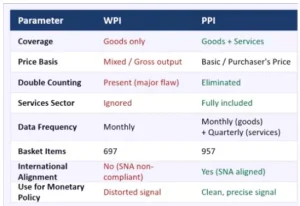
- Coverage Expansion: WPI tracks only goods. PPI includes both goods and services, which is critical since services contribute over 55% of India’s GDP and employ nearly 30% of its workforce.
- Data Granularity: WPI relies on broad-sector gross value estimates. Output PPI utilizes granular, up-to-date national accounts supply tables.
- Elimination of Double Counting: WPI suffered from technical distortions where intermediate goods were counted multiple times across production stages. PPI remedies this by isolating input and output chains.
- Updated Basket: The commodity basket is expanding from 697 to 957 items, incorporating modern sectors like solar, wind, and nuclear energy.
Economic & Policy Significance
- Early Warning System: Input PPI signals cost escalations in sectors like auto, pharma, and construction weeks before they manifest in retail prices (CPI), allowing businesses to hedge risks and adjust margins.
- Predicting Consumer Inflation: Gaps between rising input PPI and stagnant output PPI highlight temporary cost absorption by factories, indicating eventual pass-through pressures on the consumer.
- Monetary Policy Calibrations: By capturing service inflation and eliminating double-counting distortions, the PPI provides the Reserve Bank of India (RBI) with a highly accurate gauge to set interest rates.
- Contractual Smoothness: To prevent disruption to long-term infrastructure and supply contracts that feature WPI-linked escalation clauses, the government will dual-publish a revised WPI alongside PPI for a five-year transition window.
Challenges in Implementation
- Data Asymmetry: The Services PPI component will initially release quarterly rather than monthly, creating a real-time data lag relative to the monthly goods index.
- Collection Bottlenecks: Securing reliable, timely, and high-quality price data from a vast, diverse, and heavily unorganized domestic economic landscape remains an operational hurdle.
Way Forward
- Frequency Harmonization: Policymakers must rapidly transition the quarterly services index into a monthly reporting cycle to ensure real-time utility.
- Data Infrastructure: Strengthen digital reporting mechanisms across manufacturing and service hubs to guarantee the integrity of underlying price data collection.
- Contractual Renegotiation: Corporates and public entities should actively utilize the five-year transition window to rewrite legacy inflation-adjustment clauses from WPI to PPI.
Click to Know UPSC Coaching Centres in India
Conclusion
The shift to PPI fixes a long-standing statistical blind spot by bringing India’s dominant services sector into production-line tracking. Measuring inflation at its origin point ensures that policy formulations match modern economic realities.
 6 Jun 2026