Recently, the Union Government released an analytical review highlighting a structural transformation within India’s middle class over the past 12 years.
- Driven by targeted policy reforms, this segment has transitioned from cautious spenders to central drivers of national consumption, entrepreneurship, and Viksit Bharat 2047 targets.
UPSC Online Preparation
Defining and Mapping the Middle-Class Shift
- Income Benchmarks: According to the World Bank’s FY26 country income classifications, economies are segmented by Gross National Income (GNI) per capita:
- Low income: ≤ $1,135
- Lower-middle income: $1,136 – $4,495
- Upper-middle income: $4,496 – $13,935
- High income: > $13,935
- Demographic Expansion: India’s middle class grew at a steady 6.3% annually (1995–2021) and currently constitutes 31% of the total population. Backed by a 53% surge in GDP per capita between 2011 and 2019, OECD forecasts project India to overtake China in absolute middle-class population between 2030 and 2035.
- The “Consumer City” Phenomenon: Estimates from the World Economic Forum (WEF) reveal that 93% of urban consumer growth is shifting away from traditional Tier-1 mega-cities (Delhi, Mumbai, Kolkata, Bengaluru, Chennai) toward 500 emerging “consumer cities.”
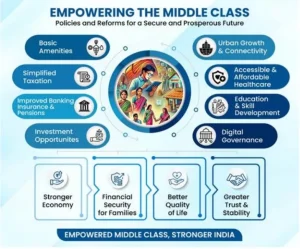 Surge in Spending Capacity: The middle and affluent classes are projected to command 93% of all domestic spending by 2036 (up from 80% in 2026), with over 20% of core demographic cohorts (Gen X, Millennials, Gen Z) spending $45 or more daily by 2035.
Financial Security and Fiscal Reforms
- Direct Tax Overhaul: The comprehensive restructuring of the legacy framework culminated in the enactment of the Income Tax Act, 2025 (effective April 2026). The tax-free threshold has risen significantly from ₹2.5 lakh in 2014 to ₹12 lakh annually (₹12.75 lakh for salaried individuals via standard deductions) under the New Tax Regime, maximizing disposable income.
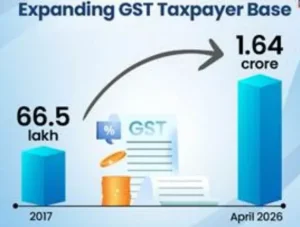 Indirect Tax Unification: Since its 2017 rollout, the Goods and Services Tax (GST) has expanded its taxpayer base from 66.5 lakh to 1.64 crore by April 2026. Rate rationalization on daily essentials has structurally lowered the cost of middle-class household consumption baskets.
- Retirement Cushioning: The launch of the Unified Pension Scheme (UPS) in April 2025 provides central government employees with an assured, inflation-linked pension (minimum ₹10,000/month after 10 years of service) embedded with Dearness Relief and family pension protections.
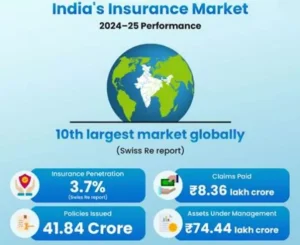 Deepening Insurance and Credit Penetration: Driven by the IRDAI “Insurance for All by 2047” blueprint, institutional savings in insurance and pension funds climbed to 29.6% of household finances in FY25. This is anchored by mass enrollments in PMJJBY (26.88 crore), PMSBY (57.11 crore), and Ayushman Bharat (43.52 crore health cards).
- Monetary Transmission and Softening Interest Rates: Reflecting the RBI’s accommodative trajectory—reducing the repo rate to 5.25% by 2026—commercial borrowing costs eased significantly between 2015 and 2025:
- Home Loans: Dropped from a high of 9.5%–10.5% to 7.35%–8.75%.
- Education Loans: Rationalized from 14.25% down to 9.4%.
- Personal Loans: Eased from 14.25% down to 12.5%.
Urban Infrastructure & Spatial Connectivity
- Affordable Housing Ecosystem: PMAY-Urban 2.0 (launched September 2024) features an allocation of ₹8.76 lakh crore to target 1 crore additional urban homes. Concurrently, the SWAMIH Fund has unlocked ₹49,500 crore of capital to complete over 58,000 stalled residential units, dedicating 44% of its capacity exclusively to Low and Middle-Income Group housing.
- Mass Rapid Transit Scaling: India has advanced to become the world’s third-largest metro network, accelerating track deployment from 0.68 km/month (pre-2014) to nearly 6 km/month in 2026. Metro operations span 26 cities with daily ridership touching 1.15 crore, supported by the domestic production of over 2,100 metro coaches under Make in India.
 Modernizing Railways: Capital allocation surged to ₹2.78 lakh crore in FY26. Safety upgrades are anchored by the Kavach anti-collision system, tracks supporting speeds above 130 kmph expanded to 23,713 km, and standard inter-city travel was upgraded via the Vande Bharat Sleeper and Amrit Bharat fleets.
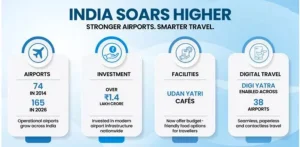
- Civil Aviation Democratization: Under the UDAN scheme, operational airports doubled from 74 (2014) to 165 (2026). The introduction of biometric Digi Yatra has processed 9.3 crore passengers across 38 airports, while budget-friendly UDAN Yatri Cafés lowered travel costs.
- Basic Utilities and Environmental Sanitation:
- Jal Jeevan Mission: Household tap connections increased by over 390%, moving from 3.23 crore (2019) to 15.85 crore (2026).
- Waste Management: Urban solid waste processing expanded from negligible levels in 2014 to 97% in 2026 under SBM-Urban 2.0, paired with AMRUT 2.0 upgrading urban sewage treatment by 6,649 MLD.
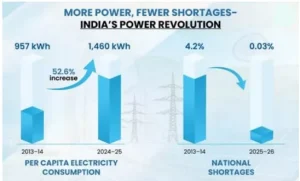
- Power Reliability: Universal electrification drives (Saubhagya) minimized the national energy shortage to a nominal 0.03% in FY26, pushing urban power availability to 23.4 hours/day and lifting per-capita consumption by 52.6% to 1,460 kWh.
Healthcare and Human Capital Upgradation
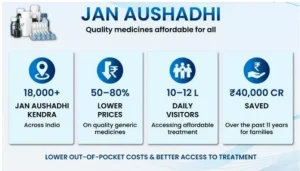
- Out-of-Pocket Expenditure (OOPE) Reduction: The revamp of the Pradhan Mantri Bhartiya Janaushadhi Pariyojana has established 18,000+ generic drug kendras, saving families ₹40,000 crore via price cuts of 50–80% on basic medicines.
- Primary Care Infrastructure: The rollout of 1,85,555 Ayushman Arogya Mandirs (AAMs) has checked over 540 crore cumulative footfalls, triggering a slide in national out-of-pocket health spending from 60.6% down to 39.4%, and lifting the global Universal Health Coverage (UHC) Index to 63.
 Epidemiological Defenses: Institutional frameworks lowered Tuberculosis (TB) incidence by 21% (2015–2024) while escalating treatment coverage to 92%. Intensive “test, treat, track” strategies under the National Strategic Plan for Malaria Elimination dropped cases and moralities by 80%, leading to India’s exit from the WHO High-Burden group.
- Tertiary Cancer Infrastructure: Implemented through the Strengthening of Tertiary Cancer Care Centres Facilities Scheme, the state has operationalized 20 State Cancer Institutes (SCIs), 19 Tertiary Cancer Care Centers (TCCCs), and 439 District Cancer Care Corners (DCCCs).
- Preventive Dietary Regulation: Upstream food safety interventions managed by the FSSAI under the Eat Right India movement (launched 2018) have systematically certified 179 Clean Street Food Hubs and 406 Eat Right Railway Stations.
Click to Know UPSC Offline Courses
Education, Skilling, & Grassroots Entrepreneurship
- Pedagogical Integration: The operationalization of Samagra Shiksha (2018) integrated loose administrative layers across 14.71 lakh schools, creating the baseline infrastructure required to execute the skill-oriented curricula mandatorily framed by the National Education Policy (NEP 2020).
 Premium Academic Scaling: The total number of IITs expanded from 16 to 23, successfully doubling student enrollment capacity to 1.35 lakh. Concurrently, the medical grid expanded to 2,045 medical colleges and 23 operational or approved AIIMS institutes, supported by 157 new nursing colleges.
- Credit Democratization for Higher Education: The Vidya Lakshmi Scheme (2024) provides collateral-free, digital education loans to students entering 860 premier institutions, providing a 3% interest subsidy for households earning under ₹8 lakh.
- Internationalization of Domestic Higher Education: Guided by revised UGC directives, premier global institutions (e.g., Deakin University, University of Wollongong, University of Southampton) have established operational campuses in GIFT City and Tier-1 hubs, mitigating foreign exchange outflows.
- Grassroots Capital Formation: To foster self-employment and de-risk micro-enterprises, the Pradhan Mantri MUDRA Yojana (PMMY) expanded its credit ceiling to ₹20 lakh, disbursing over 57 crore collateral-free loans worth ₹40.07 lakh crore by early 2026.
 6 Jun 2026