GS Paper 3: Inclusive Growth and issues arising from it.
Context: In June 2026, the UN Secretary-General’s Special Advocate for Financial Health visited India to study the country’s progress in financial inclusion and financial resilience.
- The assessment recognized India’s remarkable achievements in expanding access to financial services while emphasizing the need to move beyond financial inclusion towards financial health.
- The central message was that merely owning a bank account is not sufficient; individuals must be able to save, invest, insure themselves, manage financial shocks, and achieve long-term financial security.
What is Financial Health?
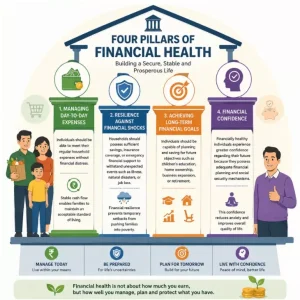
- Financial health refers to an individual’s ability to manage day-to-day finances, withstand unexpected financial shocks, achieve future financial goals, and feel confident about their financial future.
- It is a qualitative measure of financial well-being rather than simply measuring access to financial services.
- Financial health enables individuals to transition from financial survival to financial resilience and prosperity.
Financial Inclusion vs Financial Health
| Financial Inclusion |
Financial Health |
| Financial inclusion focuses on providing access to financial services such as bank accounts, insurance, pensions, and digital payments. |
Financial health focuses on the effective and regular use of these financial services to improve long-term well-being. |
| The primary objective is to ensure access to formal financial institutions. |
The primary objective is to build financial resilience, confidence, and long-term security. |
| Success is measured by the number of accounts opened. |
Success is measured by the quality of financial outcomes experienced by individuals. |
| Example: Opening a Pradhan Mantri Jan Dhan Yojana (PMJDY) account. |
Example: Using the Jan Dhan account to access insurance, pensions, savings, and credit. |
Best Online Coaching for UPSC
Difference through Amartya Sen’s Capability Approach
- Amartya Sen’s Capability Approach emphasizes that possessing resources alone does not improve well-being.
- Individuals must also possess the capability to utilize those resources effectively.
- Similarly, opening a bank account does not automatically improve financial well-being unless individuals actively use financial products to enhance their lives.
- Therefore, financial inclusion creates opportunities, whereas financial health enables people to convert those opportunities into meaningful outcomes.
Importance of Financial Health
- Prevents Poverty: Protects households from falling into poverty after financial shocks.
- Promotes Inclusive Growth: Encourages savings, investment, and responsible borrowing.
- Improves Well-being: Reduces financial stress and enhances quality of life.
- Strengthens the Economy: Supports macroeconomic stability and sustainable growth.
India’s Financial Transformation
- Greater Financial Inclusion: Bank account ownership rose from 56% to nearly 89% (Global Findex).
- JAM Trinity: Expanded access to banking, digital payments, and welfare benefits.
- Digital Finance Leader: Enabled millions to join the formal financial system.
Contribution to Viksit Bharat 2047
- Enables Inclusive Growth: Builds a financially empowered and resilient society.
- From Welfare to Wealth: Promotes financial self-reliance and asset creation.
- Supported Developed India: Financial health is a key pillar of Viksit Bharat 2047.
Case Studies from India
Delhi: Universal Pension for Informal Workers
- The UN delegation observed that informal workers in Delhi were increasingly enrolling in pension schemes.
- Access to retirement savings reduced dependence on family members during old age and promoted financial dignity.
- This supports the broader objective of ensuring a life with dignity under Article 21 of the Constitution.
Mumbai: Workplace Financial Health
- A fintech company collaborated with hospitals to provide responsible credit, affordable loans, and personalized financial guidance to nurses.
- Employees also received financial health assessments, helping them improve money management and reduce financial stress.
- The initiative demonstrated how employers and fintech firms can improve workforce productivity through better financial well-being.
Government Initiatives Supporting Financial Health
Financial Inclusion
- Pradhan Mantri Jan Dhan Yojana (PMJDY): Expands access to formal banking and basic financial services.
- JAM Trinity: Integrates Jan Dhan, Aadhaar, and Mobile to enable seamless digital financial services and welfare delivery.
- Direct Benefit Transfer (DBT): Ensures transparent and efficient transfer of government benefits by reducing leakages.
UPSC Online Coaching
Social Security
- Atal Pension Yojana (APY): Provides guaranteed pension security for workers in the unorganized sector.
- Pradhan Mantri Jeevan Jyoti Bima Yojana (PMJJBY): Offers affordable life insurance coverage to low-income households.
- Pradhan Mantri Suraksha Bima Yojana (PMSBY): Provides low-cost accident insurance to enhance financial protection.
- National Pension System (NPS): Promotes long-term retirement savings through voluntary pension contributions.
Support for Informal Workers
- e-Shram Portal: Creates a national database of unorganized workers to improve access to social security and welfare schemes.
Challenges
- Large Informal Workforce: Nearly 90% of India’s workforce is employed in the informal sector, where access to stable income, pensions, and insurance remains limited.
- Inactive Financial Accounts: Many bank accounts remain inactive despite successful financial inclusion.
- Low Financial Literacy: Limited awareness prevents many households from effectively utilizing insurance, pensions, investments, and digital financial services.
- Income Volatility: Informal workers often face irregular earnings, making regular savings and financial planning difficult.
- Limited Social Security Coverage: Many vulnerable households remain outside the coverage of comprehensive financial protection mechanisms.
Click to Know UPSC Offline Courses
Way Forward
- Develop Jan Dhan 2.0: Transform PMJDY into an integrated financial resilience platform by linking DBT, PM-KISAN, e-Shram, APY, PMJJBY, PMSBY, and MGNREGA payments.
- Strengthen Digital Public Infrastructure (DPI): Expand India’s DPI to provide secure, affordable, and inclusive access to financial services for all citizens.
- Promote Data-Driven Policymaking: Use household financial health surveys and administrative data to design targeted, evidence-based financial policies.
- Encourage Public-Private Partnerships (PPPs): Foster collaboration among government, fintech firms, employers, and financial institutions to improve financial literacy, affordable credit, insurance, and retirement planning.
 11 Jul 2026