Udaan, Prahaar, Q&A Bank etc.
CA Magazines & Editorials
Master UPSC History and Polity through an engaging MCQ battle featuring Previous Year Questions (PYQs) and expert explanations. Learn key concepts like Article 21, Rajya Sabha, Fundamental Duties, Vijayanagara Empire, Indian Councils Act, and more while improving elimination techniques for UPSC Prelims.
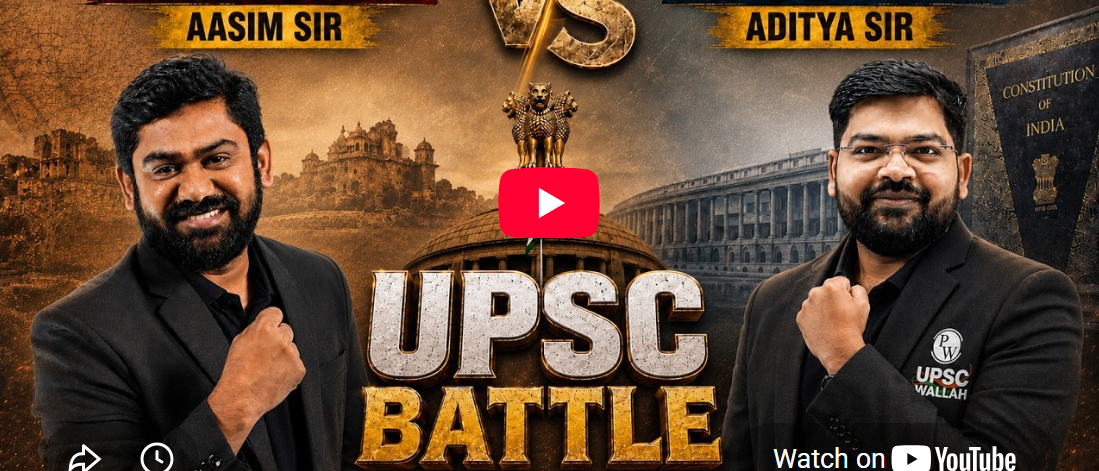
UPSC Civil Services Examination demands a balanced preparation strategy, and two subjects that consistently dominate the Prelims syllabus are History and Polity. While aspirants often debate which subject is more scoring, the real challenge lies in understanding the concepts behind Previous Year Questions (PYQs).
In an engaging History vs Polity Battle, two PW UPSC educators solve real UPSC Prelims MCQs, explain every option, and highlight the logic required to crack the examination. Rather than simply identifying the correct answer, the discussion focuses on why an option is correct, why the others are incorrect, and how UPSC frames tricky questions.
This format helps aspirants develop analytical thinking instead of relying solely on memorization.
History and Polity together contribute a significant number of questions in the UPSC Preliminary Examination every year. Questions are often concept-based and include confusing options that test conceptual clarity rather than factual recall.
The MCQs discussed in this session demonstrate that success in UPSC depends on:
The session follows an interactive quiz format where both educators answer UPSC PYQs without seeing the correct options beforehand. Every question is followed by detailed explanations that simplify difficult concepts and connect them with the UPSC syllabus.
The discussion covers topics from Modern History, Medieval History, Ancient History, Indian Constitution, Governance, Fundamental Rights, Fundamental Duties, Judiciary, Parliament, and Constitutional Developments.
Q1. Who among the following were economic critics of British colonialism in India?
Choose the correct answer:
A. 1 only
B. 1 and 2 only
C. 2 and 3 only
D. 1, 2 and 3
Ans: D. 1, 2 and 3
One of the opening questions asks aspirants to identify the leaders who criticized the economic policies of British rule in India.
The discussion explains how Dadabhai Naoroji, R.C. Dutt, and Subramania Iyer were among the prominent Moderate leaders who exposed the economic exploitation carried out by the British. Dadabhai Naoroji’s famous Drain of Wealth Theory is highlighted as a landmark contribution in understanding colonial economic policies.
The explanation reinforces that all three leaders were associated with economic criticism of British colonialism, making this an excellent conceptual question for UPSC.
Q2. The Constitution uses “procedure established by law” in Article 21, not “due process of law.” After Maneka Gandhi v. Union of India (1978), what changed?
Ans: B. The Supreme Court read “fairness and reasonableness” into “procedure,” effectively importing due process.
Q3. The national motto of India, “Satyameva Jayate” inscribed below the Emblem of India is taken from:
A. Katha Upanishad
B. Chandogya Upanishad
C. Aitareya Upanishad
D. Mundaka Upanishad
Ans: D. Mundaka Upanishad
Q.4. The Rajya Sabha cannot be dissolved, yet it has no power over Money Bills or a No-Confidence Motion. What principle explains this design choice?
Ans: B. Permanence and representative accountability were traded off — the directly elected, dissolvable House controls the purse and the government.
Q5. Who of the following rulers of medieval India gave permission to the Portuguese to build a fort at Bhatkal?
A. Krishnadevaraya
B. Narasimha Saluva
C. Muhammad Shah III
D. Yusuf Adil Shah
Ans: A. Krishnadevaraya
Another Previous Year Question explores Medieval Indian History by asking which ruler permitted the Portuguese to construct a fort at Bhatkal.
The explanation traces the arrival of the Portuguese in India after Vasco da Gama’s voyage and links it with the Vijayanagara Empire. Students learn that Krishnadevaraya granted permission, while also understanding the political circumstances and strategic calculations of the Vijayanagara rulers.
Instead of memorizing one fact, aspirants understand the historical context surrounding Portuguese expansion.
Q6. Why does the Constitution make the Governor a Centre-appointed office that must still act on the State Council of Ministers’ advice, instead of a state-elected ceremonial head?
Ans: A. To keep a channel of central oversight in a quasi-federal structure without disturbing state-level democratic government.
Q7. According to the Portuguese writer Nuniz, the women in the Vijayanagara Empire were experts in which of the following areas?
Select the correct answer using the code given below.
A. 1, 2 and 3 only
B. 1, 3 and 4 only
C. 2 and 4 only
D. 1, 2, 3 and 4
Ans: D. 1, 2, 3 and 4
Ans: B. They serve as a moral/interpretive compass — courts sometimes use them to read reasonable restrictions into rights.
Q9. Consider the following statements in regards to the Indian Councils Act, 1892:
Which of the statements given above is/are correct?
A. 1 only
B. 2 only
C. Both 1 and 2
D. Neither 1 nor 2
Ans: C. Both 1 and 2
Q10. The judicial collegium system replaced the original “President appoints in consultation with CJI” scheme. What separation-of-powers concern drove this shift?
Ans: A. Concern that executive-controlled appointments could compromise judicial independence.
One of the biggest takeaways from the discussion is that UPSC rarely asks direct factual questions.
Instead, the examination tests whether candidates can:
Throughout the session, the educators repeatedly emphasize that many aspirants lose marks not because they lack knowledge, but because they fail to analyze each option carefully.
Check Out UPSC CSE Books
Visit PW Store
History Vs Polity UPSC Battle is an interactive learning session where PW UPSC educators solve Previous Year Questions (PYQs) from History and Polity, explaining every option with conceptual clarity and exam-oriented strategies.
The session covers important topics such as British colonialism, Vijayanagara Empire, Indian Councils Act, Article 21, Rajya Sabha, Governor, Fundamental Duties, Judicial Collegium, and other key History and Polity concepts.
UPSC PYQs help aspirants understand the exam pattern, identify recurring themes, strengthen conceptual understanding, and improve their ability to eliminate incorrect options in MCQs.
The History section includes questions on the economic critics of British colonialism, Portuguese expansion in India, Krishnadevaraya, women in the Vijayanagara Empire, and the Indian Councils Act, 1892.
The Polity discussion covers Article 21 and the Maneka Gandhi judgment, Satyameva Jayate, Rajya Sabha, the Governor's constitutional role, Fundamental Duties, and the Judicial Collegium System.




Connect with our experts to get free counselling & start preparing
Join India’s trusted platform for expert guidance, quality content, proven success.
Learn anytime, anywhere.



India's leading UPSC coaching platform helping aspirants prepare for IAS, IPS, IFS and other Civil Services examinations with the best faculty and proven strategies.
<div class="new-fform">
</div>