Core Demand of the Question
- Essential conditions for exercise of the legislative powers by the Governor
- Legality of re-promulgation of ordinances by the Governor without placing them before the Legislature
|
Answer
Introduction
The ordinance-making power of the Governor under Article 213 of the Constitution of India is an emergency legislative mechanism meant to address situations requiring immediate action. However, constitutional safeguards and judicial interpretation ensure that this power is exercised only under specific conditions and not misused through repeated re-promulgation of ordinances.
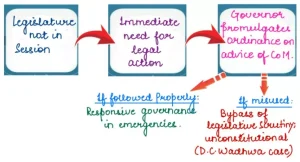
Essential Conditions for Exercise of Legislative Powers by the Governor
- Legislature Not in Session: The Governor may promulgate an ordinance only during legislative recess, making it a temporary substitute for legislation under Article 213.
Eg: In 2021, Maharashtra’s Governor issued an ordinance extending Maratha reservations during the assembly’s recess.
- Immediate Legislative Action Required: The Governor must be satisfied that circumstances require urgent legislative intervention that cannot wait for the Legislature to convene.
- Aid and Advice of Council of Ministers: The Governor exercises ordinance power on the aid and advice of the Council of Ministers, reflecting the parliamentary system.
Eg: Article 163 of the Constitution of India requires the Governor to act on ministerial advice in most functions.
- Subject within State Legislative Competence: An ordinance can be issued only on subjects within the State Legislature’s constitutional legislative competence.
Eg: The Seventh Schedule of the Constitution of India distributes legislative powers through the State List and Concurrent List.
- Mandatory Placement Before Legislature: Every ordinance must be laid before the State Legislature when it reconvenes.
Eg: Article 213(2) of the Constitution of India provides that ordinances lapse if not approved within six weeks of reassembly.
Legality of Re-Promulgation of Ordinances without Placing Them before Legislature
- Constitutional Fraud Doctrine: Repeated re-promulgation without legislative scrutiny is considered a fraud on the Constitution as it bypasses legislative authority.
Eg: The Supreme Court in D.C. Wadhwa v. State of Bihar condemned the practice of continuous ordinance renewal.
- Ordinances Must Be Placed before Legislature: Failure to place ordinances before the Legislature violates the constitutional mandate of legislative oversight.
- Temporary Nature of Ordinances: Ordinances are temporary measures and cannot substitute for regular law-making through the Legislature.
Eg: The Supreme Court in Krishna Kumar Singh v. State of Bihar reaffirmed that ordinances cannot become a parallel legislative mechanism.
- Judicial Review Permitted: Courts can review the validity of repeated ordinance re-promulgation if it reflects mala fide use of power.
- Limited Exceptional Possibility: Re-promulgation may be permissible only if exceptional circumstances justify immediate legislative action again.
Eg: In R.K. Garg v. Union of India, the Supreme Court held that ordinance-making power is an emergency measure and cannot replace regular legislation.
Conclusion
The Governor’s ordinance-making authority is designed as a temporary emergency mechanism within India’s parliamentary framework. Judicial scrutiny and constitutional safeguards ensure that repeated re-promulgation without legislative consideration remains largely impermissible, thereby preserving legislative supremacy and preventing executive circumvention of the democratic law-making process.
 April 23, 2026