Core Demand of the Question
- Economic Complementarities
- Deeper Geopolitical Alignment in the Indo-Pacific
- Limitations / Points of Caution
|
Answer
Introduction
The India–New Zealand FTA may appear modest as New Zealand’s economy is one-sixteenth of India’s and accounts for less than 1% of India’s trade. However, it fits into India’s wider strategy of supply-chain diversification, export expansion and Indo-Pacific alignment.
Body
Economic Complementarities
- Greater Market Access for Indian Exports: New Zealand’s tariff elimination gives Indian exporters wider and more competitive access to its market.
Eg: FTA eliminates duty on 100% of Indian exports, with zero-duty access across 8,284 tariff lines in New Zealand (PIB)
- Protection of Sensitive Domestic Sectors: India has followed a calibrated approach by opening trade while protecting farmers and vulnerable sectors.
Eg: India offered market access in 70.03% tariff lines (PIB)
- Investment Facilitation: The agreement goes beyond tariff reduction by linking trade with long-term investment cooperation.
Eg: USD 20 billion investment commitment over 15 years.
- Support to MSMEs, Jobs and Domestic Growth: Zero-duty access will benefit labour-intensive sectors such as textiles, apparel, leather, footwear, gems and jewellery, engineering goods and processed foods.
Deeper Geopolitical Alignment in the Indo-Pacific
- Supply Chain Diversification: The FTA reflects India’s attempt to build resilient supply chains amid global disruptions.
- Reducing China Dependence: Diversifying trade partners has strategic value as India remains significantly dependent on China for imports.
Eg: DGCI&S data shows that China was India’s top import partner in Q2 FY 2024–25, accounting for 16.59% of India’s total import value basket.
- Export Destination Diversification: The FTA helps India reduce overdependence on a few export markets and expand into Oceania-Pacific markets.
- Strengthening Indo-Pacific Partnerships: The FTA is part of a broader strategic convergence between two democratic maritime partners in the Indo-Pacific.
Limitations / Points of Caution
- Limited Trade Base: The economic scale of India–New Zealand trade remains modest despite the strategic value of the agreement.
Eg: Bilateral merchandise trade stood at only USD 1.3 billion in FY 2024–25, despite registering nearly 49% year-on-year growth (Source: PIB).
- Investment Commitment Is Not Automatic Investment: The investment provision is significant, but actual inflows will depend on implementation and investor confidence.
- Implementation lag: The benefits of the FTA will depend on timely ratification, entry into force, and effective implementation by both countries. Until then, tariff benefits and supply-chain gains remain prospective rather than immediate.
- Domestic Manufacturing Capacity Remains a Challenge: NITI Aayog’s Trade Watch notes that India remains underrepresented in most top importing destinations compared to competitors, with export shares often below 2%.
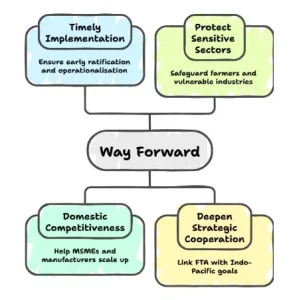
Conclusion
Thus, the India–New Zealand FTA goes beyond trade arithmetic. It combines market access, sectoral protection and investment facilitation with India’s larger geopolitical aim of diversifying supply chains, reducing China dependence and strengthening Indo-Pacific partnerships.
 April 30, 2026