On April 14, 2026, India is celebrating the 135th birth anniversary of Dr. B.R. Ambedkar.
- In an era of shifting social and political landscapes, remembering “Babasaheb” is not just a ritual—it is a necessity. His legacy provides a toolkit for Constitutional Morality, ensuring that justice remains the heartbeat of Indian democracy.
Best Online Coaching for UPSC
About Dr Bhimrao Ambedkar
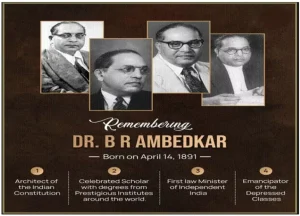
- Early Struggle and Social Context: Born on April 14, 1891, at Mhow (Madhya Pradesh) into a Mahar family, Ambedkar faced systemic caste-based exclusion and humiliation from childhood, which profoundly shaped his lifelong mission to dismantle caste hierarchy and establish dignity for all.
- Family Heritage: He was the 14th and last child of his parents. His father, Subedar Ramji Maloji Sakpal, was a well-read person and a devout follower of Sant Kabir, whose teachings on equality deeply influenced Babasaheb’s early world-view.
- Early Service: He briefly served as the Military Secretary to the Maharaja of Baroda, a post he eventually left due to the severe maltreatment he faced because of untouchability.
- Global Intellectual and Scholar: Educated at Columbia University and London School of Economics, Ambedkar emerged as a scholar of exceptional depth in law, economics, and sociology, making him one of the most intellectually equipped leaders of the freedom movement.
- Statesman and Constitutional Visionary: Chairman of the Drafting Committee of the Constitution of India
- India’s first Law Minister
- Resigned over the Hindu Code Bill, reflecting his commitment to women’s rights and principled politics over power
- His life reflects the transformative potential of education, constitutionalism, and organised resistance.
- Mahaparinirvan Diwas: His death anniversary on December 6 is observed globally as Mahaparinirvan Diwas. The term ‘Mahaparinirvan’ is derived from Buddhist texts, signifying ‘nirvana after death’ and liberation from the cycle of birth and death, highlighting his status as a modern Buddhist guru.

Major Contributions of B. R. Ambedkar
Ambedkar’s vision was of a “social democracy” where political equality is complemented by social and economic justice. His ideas remain central to debates on inequality, governance, and inclusive development in contemporary India.
- Social Contributions- Human Dignity and Equality:
- Institutionalising Social Empowerment: Through the Bahishkrit Hitkarini Sabha (1924), Ambedkar created institutional mechanisms for education, socio-political awareness, and mobilisation, transforming the discourse from charity-based reform to rights-based empowerment rooted in dignity.
- Assertion of Civil Rights: The Mahad Satyagraha (1927) marked a historic assertion of civil and natural rights, where Dalits claimed access to public water resources, symbolising that citizenship rights cannot be denied on the basis of caste.
- Rejection of Scriptural Inequality: The burning of Manusmriti during the Mahad movement was a powerful ideological act rejecting scriptural sanction for caste hierarchy, signalling a shift towards a rational and egalitarian social order.
- Religious and Social Equality Movements: The Kalaram Temple Entry Movement (1930) challenged religious exclusion, asserting that spiritual spaces must embody equality, thereby linking religion with social justice and democratic values.
- Education as a Tool of Liberation: Ambedkar viewed education as the primary instrument of social emancipation, encapsulated in his call- “Educate, Agitate, Organize.” He promoted modern, scientific education to dismantle caste-based oppression.
- Mooknayaka (1920): Before the Bahishkrit Bharat, he launched the newspaper Mooknayaka (Leader of the Silent) to provide a platform for the voices of the marginalized.
- Opposition to Name-Changing Politics (1938): He famously criticized a 1938 bill that sought to change the name of “untouchables,” arguing that changing nomenclature was a superficial distraction from the structural eradication of caste.
- Political Contributions- Democratising the State:
- Constitutional Architecture: As Chairman of the Drafting Committee, Ambedkar designed a transformative Constitution embedding Fundamental Rights, affirmative action, and safeguards for minorities, ensuring substantive democracy.
- Political Representation of Marginalised Groups: Through the Poona Pact (1932), Ambedkar secured reserved seats in legislatures, institutionalising political voice for historically excluded communities.
- Advocacy at Global Platforms: At the Round Table Conferences, Ambedkar internationalised caste issues, compelling recognition of Depressed Classes as a distinct political category with rights.
- Labour and Welfare Reforms: As a member of the Viceroy’s Executive Council (1942), he introduced:
- 8-hour workday
- Provident Fund and social security measures
- Maternity benefits and labour protections
- These reforms laid the foundation for a modern welfare-oriented labour regime.
- Gender Justice and Legal Reform: Through the Hindu Code Bill, Ambedkar advocated women’s property rights, marriage and divorce reforms, marking a progressive step towards gender equality in personal laws.
- Economic Contributions- Architect of Inclusive Development:
- Foundations of Financial Governance: His work “The Problem of the Rupee” and his testimony to the Hilton Young Commission laid the intellectual foundation for the Reserve Bank of India (RBI).
- Fiscal Federalism: His doctoral thesis, “The Evolution of Provincial Finance in British India,” served as the blueprint for the Finance Commission of India, ensuring balanced Centre–State financial relations.
- Infrastructure & Resource Management: He pioneered water and energy governance by establishing the National Power Grid System, the Central Waterways, Irrigation and Navigation Commission, and multipurpose River Valley Projects (Damodar Valley, Hirakud, and Sone River).
- State Socialism: In “States and Minorities”, he advocated for state ownership of key industries to ensure equitable wealth distribution.
- Labour Welfare & Employment: He was instrumental in establishing Employment Exchanges and transitioning India toward a rights-based labour regime.
- Philosophical Contributions- Ethical Foundations of Democracy:
- Constitutional Morality: Ambedkar emphasised that democracy must be sustained through ethical conduct, respect for institutions, and rule of law, warning that a Constitution is only as effective as those who implement it.
- Liberty, Equality, Fraternity: He conceptualised these as interdependent pillars, arguing that without fraternity (social solidarity), liberty and equality cannot sustain a cohesive and just society.
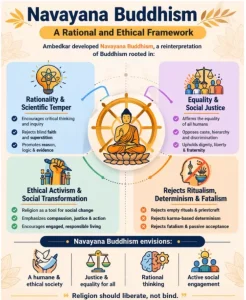
- Buddhism and Moral Reconstruction: Ambedkar’s adoption of Navayana Buddhism (1956) reflected his vision of a rational, ethical, and egalitarian social order, rejecting caste hierarchy and promoting compassion and social justice.
UPSC Online Coaching
Achievements of B. R. Ambedkar
Ambedkar’s achievements lie not just in institution-building, but in redefining the very purpose of the State—from maintaining order to ensuring justice, dignity, and equality for all.
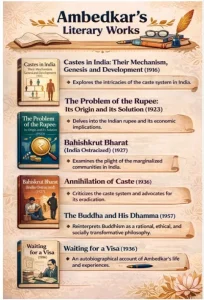
- Transformative Constitutional Leadership: Ambedkar, as the principal architect of the Constitution, crafted a framework that was not merely legal but transformative in intent, aimed at restructuring India into a just, egalitarian, and inclusive society.
- He institutionalised equality before law and social justice through Articles 14–18, including the abolition of untouchability (Article 17)—a radical departure from entrenched social hierarchies.
- His emphasis on constitutional remedies (Article 32) ensured that Fundamental Rights were not symbolic but enforceable, making the Constitution a living instrument of justice.
- He thus embedded the idea of substantive democracy, where political equality is complemented by social and economic empowerment.
- Institutionalisation of Social Justice and Welfare State: Ambedkar translated his vision of equality into policy frameworks, laying the foundation for:
- Affirmative action (reservations) for SCs and STs
- Protective discrimination to address historical injustices
- Institutional safeguards ensuring representation and dignity
- He was instrumental in shaping India into a welfare state, where the State actively works to reduce inequalities and promote inclusive development, rather than remaining a passive entity.
- Pioneering Economic and Financial Architecture: Ambedkar’s economic thought was marked by pragmatism and structural foresight.
- He advocated planned economic development, state intervention in key sectors, and equitable resource distribution—anticipating many features of India’s later mixed economy model.
- Advancement of Gender Justice: Ambedkar was among the earliest champions of gender equality in India’s legal framework.
- Through the Hindu Code Bill, he sought to provide:
- Equal property and inheritance rights for women
- Legal recognition of divorce and individual autonomy
- Although diluted at the time, his efforts laid the foundation for progressive reforms in personal laws and women’s rights.
- Enduring Recognition and Normative Legacy: Ambedkar’s contributions were recognised with the Bharat Ratna (1990), but his true legacy lies in shaping India’s normative and moral foundations.
- He remains a symbol of:
- Social justice and dignity
- Constitutionalism and rule of law
- Resistance against structural inequality
- His ideas continue to guide contemporary debates on inclusion, representation, governance, and democratic deepening.
- Conferred “Bodhisattva” (1954): In a rare honor, Dr. Ambedkar was conferred the title of “Bodhisattva” while he was still alive by Buddhist monks at the Jagatik Buddhism Council in Kathmandu, Nepal.
- Academic Leadership: He served as the Principal of Government Law College, Bombay, from 1935 to 1938, influencing a generation of legal minds.
- Honorary Doctorates: In addition to his earned degrees, he was awarded an honorary LL.D. from Columbia University (1952) and a Doctorate from Osmania University (1953) for his work on the Indian Constitution.
Ambedkar’s Buddhist Conversion- The Navayana Path
Ambedkar’s conversion to Buddhism was not merely a religious act but a revolutionary assertion of self-respect, dignity, and identity, providing a moral foundation for social democracy in India.
- A Historic Mass Movement of Social Transformation: On 14 October 1956 at Deekshabhoomi, Nagpur, Ambedkar embraced Buddhism along with over five lakh followers, marking one of the largest peaceful and voluntary social transformations in modern history.
- The event symbolised a collective assertion of dignity and liberation from caste oppression.
- Rejection of Oppressive Social Structures: The conversion represented a decisive break from caste-based religious hierarchy, particularly rejecting the ideological and scriptural foundations of inequality.
- It was both a spiritual and socio-political act of resistance.
- The 22 Vows- Ethical and Psychological Liberation: The 22 vows taken during conversion acted as a moral and social charter, ensuring:
- Rejection of caste identity and hierarchy
- Commitment to ethical conduct and equality
- Mental emancipation from oppressive belief systems
Ambedkar vs. Gandhi
| Aspect |
B.R. Ambedkar |
M.K. Gandhi |
| Approach to Caste |
Advocated annihilation of caste as inherently oppressive. Called Hinduism a “religion of rules” upholding hierarchy. |
Sought reform within Hinduism (e.g., calling Dalits Harijans). Believed caste could be purified, not abolished. |
| Untouchability |
Demanded legal abolition (Article 17 of Constitution). Led Mahad Satyagraha (1927) for water rights. |
Condemned untouchability but framed it as a moral issue, not structural (Harijan upliftment campaigns). |
| Political Representation |
Poona Pact (1932): Compromised on separate electorates for reserved seats after Gandhi’s fast. Initially wanted separate electorates for Dalits. |
Opposed separate electorates, fearing division. Supported joint electorates with reservations. |
| Economic Justice |
State-led socialism: Land reforms, labor rights, industrialization. Drafted labor laws (8-hour workday). |
Village-centric economy: Focused on self-reliance (Swadeshi), hand-spinning (charkha). Opposed industrialization. |
| Religion & Social Reform |
Converted to Buddhism (1956) to escape caste. Criticized Hinduism’s scriptures (Manusmriti burning, 1927). |
Orthodox Hindu: Defended varnashrama (caste duties) but rejected untouchability. |
| Education |
Modern education as liberation: Founded colleges (Siddharth College) for Dalits. |
Basic education (Nai Talim): Focused on vocational training for rural masses. |
| Women’s Rights |
Hindu Code Bill (1951) for divorce, inheritance rights. Called women’s oppression caste-linked. |
Upliftment within the existing social structure. |
| Vision for India |
Constitutional democracy with state-enforced equality (reservations, labor laws). |
Moral democracy (Ram Rajya) based on village self-governance. |
Click to Know UPSC Coaching Centres in India
Relevance of B. R. Ambedkar in Present Times
Ambedkar’s ideas remain profoundly relevant as India navigates challenges of inequality, institutional integrity, and social cohesion, reinforcing the need to build a just, inclusive, and constitutionally grounded democracy.
- Safeguarding Democratic Institutions: Ambedkar’s emphasis on constitutional morality, institutional autonomy, and separation of powers remains highly relevant in the context of concerns over executive dominance and weakening of checks and balances.
- His warning against the “tyranny of the majority” underscores the need to protect judicial independence, parliamentary accountability, and federal balance, ensuring that democracy does not degenerate into majoritarianism.
- Bridging Socio-Economic Inequalities: Ambedkar’s vision of inclusive and equitable development is crucial in addressing contemporary challenges such as jobless growth, widening income inequality, and the digital divide.
- His focus on state intervention and distributive justice remains vital to ensure that the benefits of economic growth reach the most marginalised sections, aligning with the principle of “leaving no one behind.”
- Advancing Social Justice: Despite constitutional safeguards, caste-based discrimination and social exclusion persist, highlighting the continued relevance of Ambedkar’s idea of substantive equality—which goes beyond formal legal equality to ensure real social and economic empowerment.
- His framework supports ongoing policies on affirmative action, social justice, and dignity of individuals.
- Women’s Empowerment and Gender Justice: Ambedkar’s progressive vision, reflected in his advocacy for the Hindu Code Bill, continues to inform debates on gender equality, legal reforms, and representation of women.
- His assertion that the progress of a society is measured by the progress of its women remains a guiding principle for inclusive and rights-based policymaking.
- Promoting Social Cohesion and Fraternity: Ambedkar’s emphasis on fraternity as the foundation of democracy is critical in addressing growing social polarisation and identity-based divisions.
- He envisioned a society where liberty and equality are sustained by a sense of collective belonging, making fraternity essential for transforming India from a mere political democracy into a socially integrated nation.
| PWOnlyIAS Extra Edge:
Ambedkar in the Age of Artificial Intelligence:
In the age of AI, Ambedkar reminds us that technological progress must be guided by justice, dignity, and equality, lest it create new forms of structural exclusion.
- Combating Algorithmic Bias- Preventing Structural Inequality: Ambedkar’s critique of graded inequality is directly relevant to the challenge of algorithmic bias. AI systems trained on historical data risk reproducing caste, gender, and class prejudices in areas such as hiring, credit, and policing.
- An Ambedkarite approach calls for:
- Ethical AI design and algorithmic audits
- Representative and diverse datasets
- Embedding constitutional anti-discrimination principles
- Democratising Technology- Bridging the Digital Divide: Ambedkar’s call to “Educate, Agitate, Organize” remains vital in ensuring inclusive technological access.
- Promoting AI literacy and digital skilling
- Ensuring equitable access to data and infrastructure
- Encouraging Indic language and inclusive digital ecosystems
- This transforms technology into a tool of social mobility and empowerment.
- Data Privacy and Human Dignity: Ambedkar’s emphasis on fundamental rights and individual dignity provides a strong basis for debates on data governance.
- Protecting against surveillance and profiling
- Ensuring informed consent and data sovereignty
- Safeguarding citizens from misuse of personal data
- Thus, privacy becomes an extension of human dignity, not merely a regulatory concern.
- Constitutional Morality and AI Governance: Ambedkar’s concept of constitutional morality offers a guiding framework for responsible AI governance.
- Ensures accountability, transparency, and fairness
- Applies to both State and private actors
- Aligns technological power with rule of law and democratic values
- AI, Labour, and Social Justice: Ambedkar’s legacy in labour welfare is highly relevant in the context of automation.
- Addressing job displacement and skill obsolescence
- Strengthening social security and labour protections
- Promoting reskilling and lifelong learning
- This supports the transition towards a just and humane digital economy.
|
Click to Explore UPSC Offline Coaching
Conclusion
Dr. B.R. Ambedkar’s legacy is the bedrock of modern India. He proved that political democracy is unsustainable without social equality. To reclaim his vision is to uphold Constitutional Morality, ensuring that “one man, one value” becomes a lived reality for all.


 14 Apr 2026





.png)






 Current Affairs




 GS Foundation
 Optional Course
 Combo Courses
 Degree Program