Recently, a financial journalist has challenged a sweeping gag order by a Delhi court mandating the removal and de-indexing of reports on the Sterling Biotech Bank Fraud Case, involving the Sandesara Group, highlighting the constitutional tension between the Right to Be Forgotten (RTBF) and freedom of the press in matters of public interest.
Best Online Coaching for UPSC
Key Highlights of Sandesara Gag Order
- Background and Context: The gag order arises from proceedings linked to the Sterling Biotech Bank Fraud Case, where allegations include large-scale bank fraud and financial irregularities.
- Scope of the Gag Order: The Delhi court directed blanket removal and de-indexing of online content, requiring:
- Media outlets to take down published reports
- Search engines to remove links from results
- This extended even to archival journalistic content, giving the order a wide and retrospective reach.
- Legal Basis and Claims: The plea invoked the Right to Be Forgotten (RTBF) and right to reputation under Article 21, arguing that continued availability of such reports causes ongoing reputational harm, particularly in unresolved or ongoing cases.
- Challenge and Wider Implications: A financial journalist has challenged the order, arguing it undermines investigative journalism and the public’s right to know.
- The case highlights the urgent need for a clear legal framework to balance RTBF, privacy, and media freedom in India.
|
About Right to Be Forgotten (RTBF)
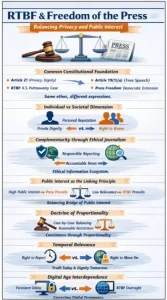
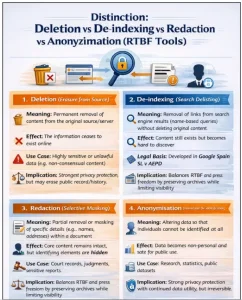
- Concept and Definition: The Right to Be Forgotten (RTBF) enables individuals to seek deletion, de-indexing, or restriction of access to their personal data from digital platforms when such information becomes outdated, irrelevant, disproportionate, or harmful to privacy and reputation.
- It reflects the principle of informational self-determination, allowing individuals greater control over their digital footprint.
- Global Evolution:
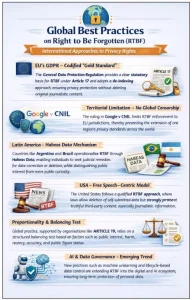
- European Union Framework: The modern articulation of RTBF emerged from the 2014 judgment of the Court of Justice of the European Union in the Google Spain case, which held that search engines are obligated to remove links to personal data that is “inadequate, irrelevant, or no longer relevant” over time.
- This principle is now codified under Article 17 of the General Data Protection Regulation, which grants a formal “right to erasure”.
- However, it is subject to exceptions such as freedom of expression, public interest, archival purposes, and legal obligations.
 Developments in Other Jurisdictions:
- Canada (2023): The Federal Court of Appeal confirmed that search engines like Google are subject to federal privacy law (PIPEDA), paving the way for de-listing of search results.
- In 2025, the Privacy Commissioner applied this in a landmark ruling, upholding a limited right to de-indexing in specific harm-based cases.
- United States (California): The Online Eraser Law (2015) initially allowed minors to remove their posted data, while the DELETE Act (2023) extends similar rights to adults, enabling deletion of personal data held by data brokers.
- Countries like the United Kingdom, Argentina, and Japan have also evolved RTBF-like protections, though with varying scope and enforcement models.
Interpretation and Status of Right to Be Forgotten (RTBF) in India
- Constitutional Basis: RTBF in India flows from the Right to Privacy under Article 21, as recognised in K.S. Puttaswamy v. Union of India.
- The Supreme Court acknowledged RTBF as a derivative right, but clarified that it is not absolute and must be balanced against:
- Freedom of speech and expression (Article 19(1)(a))
- Public interest and transparency
- Legal and archival requirements
- Statutory and Regulatory Position: The Digital Personal Data Protection Act, 2023 recognises the right to erasure, allowing individuals to request deletion of personal data when it is no longer necessary.
- However, ambiguity persists regarding its application to:
- Court records
- Media archives
- Publicly available information
- The Information Technology (Intermediary Guidelines and Digital Media Ethics Code) Rules, 2021 mandate intermediaries to remove or disable access to unlawful or privacy-violating content within prescribed timelines, strengthening procedural remedies.
- Judicial Approach in India:
- Early Foundations: R. Rajagopal v. State of Tamil Nadu recognised the “right to be let alone”, but upheld that public records (e.g., court judgments) remain open to publication.
 Post-Puttaswamy Jurisprudence:
- Dharamraj Bhanushankar Dave v. State of Gujarat (2017): Denied removal of acquittal records, emphasising transparency of judicial records.
- Orissa High Court (2020): Highlighted the need for a structured legal framework, especially in cases like revenge porn, acknowledging the complexity of RTBF.
- Delhi High Court (2021): Allowed de-indexing of case details to protect an individual’s reputation and livelihood, signalling a pro-privacy approach.
- Supreme Court (2022): Directed mechanisms to remove personal details from search engines in sensitive matrimonial disputes, expanding RTBF’s scope.
- Kerala High Court (2023): Refused RTBF in ongoing judicial proceedings, citing open justice and public interest.
- Himachal Pradesh High Court (2024): Ordered redaction of names in a rape case, recognising that continued disclosure post-acquittal may cause lasting stigma and injustice.
UPSC Coaching Classes
Need for Right to Be Forgotten (RTBF)
- Addressing Digital Permanence vs Privacy: In the digital ecosystem, information has near-permanent visibility, unlike the pre-digital era where records faded into inaccessible archives.
- This creates a structural tension between digital permanence and the Right to Privacy, necessitating RTBF to ensure that individuals are not indefinitely exposed to past data that has lost relevance.
- Protection of Personal Reputation and Dignity: RTBF is crucial to prevent perpetual reputational harm caused by the continued availability of outdated or misleading information.
- Even after acquittal or settlement, past allegations remain searchable, undermining an individual’s right to dignity and fair identity reconstruction.
- Constitutional Backing- Right to Privacy under Article 21: The Supreme Court in K.S. Puttaswamy v. Union of India recognised privacy as a fundamental right, which includes the ability to control dissemination of personal data.
- RTBF flows from this principle by enabling individuals to be “left alone” once the purpose of data disclosure is exhausted.
- Preventing Long-Term Social and Economic Harm: Persistent online data creates “digital scars” with tangible consequences:
- Employment Barriers: Employers frequently conduct online background checks, affecting hiring decisions
- Social Stigma: Outdated information can damage family and social relationships
- Rehabilitation Challenges: For acquitted persons or former offenders, RTBF aids reintegration into society by limiting disproportionate exposure to past events
- Checking ‘Trial by Media’ and Ensuring Fairness: In many high-profile cases, including controversies like the Sterling Biotech Bank Fraud Case, individuals argue that while judicial proceedings may conclude, media narratives continue indefinitely online.
- RTBF helps mitigate continuous reputational harm arising from unverified or pre-trial reporting, thereby supporting fairness and due process.
- Preventing Misuse and Over-Collection of Personal Data: With the rise of digital platforms, data brokers, and surveillance-driven economies, personal data is often collected, stored, and circulated excessively.
- RTBF provides a mechanism to restrict unnecessary retention and misuse, ensuring data is used only for legitimate and proportionate purposes.
- Promoting Data Sovereignty and Informational Self-Determination: The Digital Personal Data Protection Act, 2023 introduces the concept of Data Principal rights, reinforcing that individuals should have control over their personal data lifecycle.
- RTBF strengthens data sovereignty by enabling individuals to erase or delink data that is no longer necessary, aligning privacy with human dignity.
Key Challenges in Operationalising Right to be Forgotten (RTBF)
- The Clash of Fundamental Rights & Constitutional Concerns: The biggest roadblock is the conflict between Article 19(1)(a) (freedom of the press) and Article 21 (right to privacy and dignity).
- The Sandesara gag order deepens this conflict by potentially enabling prior restraint and indirect censorship of media reporting.
- It undermines public interest, especially in large financial fraud cases involving public money, where transparency and accountability are essential.
- It also challenges the open justice principle, which mandates public access to judicial proceedings and factual records.
- Procedural Loopholes & Legal Tactics: The way these orders are obtained in court creates several practical problems:
- The “John Doe” Trap: By filing cases against “unknown persons,” plaintiffs get gag orders without the news publishers even knowing. This violates the core legal principle of Natural Justice, where both sides must be heard.
- SLAPP Suits (Intimidation Litigation): Powerful entities often use Strategic Lawsuits Against Public Participation (SLAPP). These aren’t meant to win a trial, but to drown journalists in legal costs and fear, forcing them to delete accurate reports.
- Ignoring High-Court Guidelines: Lower courts often issue urgent temporary orders (ex-parte injunctions) without checking if the news is “palpably false.” This ignores recent Supreme Court warnings (like the Bloomberg ruling) to be careful with pre-trial censorship.
- Preservation of History vs. Digital Cleanup:
- Rewriting the Past: Journalistic archives are a “first draft of history.” If courts order the deletion of reports, they are essentially censoring the national record.
- This makes it impossible for future researchers to understand how major scams or legal cases unfolded.
- Settlement vs. Innocence: A major challenge is that a settlement is a deal to stop a trial; it is not a declaration of innocence. However, the RTBF is being used as if it were a full exoneration (a “clean chit”), which confuses the public record.
- Technical and Global Reality:
- The “Streisand Effect”: Trying to hide information often makes it more famous. While a court can order Google to “de-index” a link in India, the information stays on the server and can be accessed via VPNs.
- Global Sovereignty: Indian laws stop at the border. Challenging content on global platforms like YouTube or Meta involves complex international data rules that Indian district courts aren’t always equipped to handle.
- Lack of Standardized Rules:
- No Specific Law: While the DPDP Act (2023) mentions “erasure,” it doesn’t explain how it should apply to criminal records or news.
- Inconsistent Court Rulings: One High Court might grant the RTBF to an acquitted person, while another might deny it for a different crime. This judicial inconsistency makes it hard for media houses to know what they can and cannot publish.
Way Forward
- Enact a Clear and Comprehensive Legal Framework: India must transition from judicial interpretation to explicit statutory recognition of the RTBF. While the Digital Personal Data Protection (DPDP) Act, 2023 provides a foundation, it remains vague regarding news archives.
- Define Scope and Applicability: The law must clearly distinguish between private personal data (which should be easily erasable) and public records (which serve a broader social purpose).
- Specific Grounds for Removal: Clear criteria must be established—such as the information being irrelevant, disproportionate, or causing demonstrable harm—to prevent the law from being used to hide inconvenient truths.
- Formalize Exceptions: Legitimate journalism, historical research, and legal records must be legally shielded from “deletion” requests to maintain the integrity of the public record.
- Create an Independent Adjudicatory Mechanism: To prevent local civil courts from issuing broad “gag orders,” an empowered Data Protection Board (DPB) should be the primary body for RTBF claims.
- Specialized Expertise: A board equipped with technical and legal experts can provide time-bound, reasoned decisions, ensuring that takedowns aren’t arbitrary.
- Reducing Judicial Burden: This would streamline the process, allowing courts to focus on constitutional appeals rather than every individual request to “cleanse” search results.
- Protect Journalistic Freedom and Archival Integrity: The RTBF must include strong safeguards to ensure it does not become a tool for digital book-burning.
- No Blanket Removal: Safeguards must prevent the total erasure of journalistic archives. Instead of deletion, courts should prefer de-indexing (making content unsearchable) while keeping the original report alive in the archive.
- Develop Clear Guidelines for Intermediaries: Digital platforms like Google and Meta need a standardized set of rules to handle these requests fairly.
- Notice-and-Takedown Standards: There should be a transparent process where the platform explains why content was removed or retained.
- Prevention of Over-Compliance: Without clear rules, platforms may engage in arbitrary censorship simply to avoid legal liability or fines from the government.
 Ensure Procedural Safeguards and Due Process: The Sandesara case highlighted a lack of Natural Justice. The way forward must guarantee:
- Prior Notice: Media houses and journalists must be notified and given an opportunity for a hearing before a takedown order is enforced.
- End Misuse of “John Doe” Orders: Courts should restrict the use of “unknown person” lawsuits when the publishers are easily identifiable, ensuring that plaintiffs cannot bypass their legal opponents.
- Promote Data Minimization and Accountability: Data-collecting entities (both private and government) should follow the principles of Purpose and Storage Limitation.
- Periodic Reviews: Organizations should have policies to review and delete data that is no longer necessary for the purpose it was collected.
- Accountability: Entities must be held responsible for retaining sensitive data longer than justified, which reduces the need for “Right to be Forgotten” requests in the first place.
- Defamation, Correction, and Contextual Updating as Alternatives: Where reporting is false or misleading, remedies like defamation law, corrections, right of reply, and contextual updates are preferable to erasure.
- This addresses inaccuracies while preventing misuse of RTBF to rewrite public history or suppress legitimate journalism.
- Prefer Less Restrictive Alternatives Over Blanket Takedown: Courts should adopt the least restrictive remedy, favouring updates, anonymisation, redaction, contextual disclaimers, or limited de-indexing over deletion.
- Such calibrated measures balance privacy and dignity with press freedom and preservation of public records.
- Learn from Global Best Practices: India should adapt successful elements from the European Union’s GDPR, specifically:
- “Right to Erasure” Standards: Utilizing well-defined standards that have already been tested in international courts.
- Grievance Redressal: Creating institutional mechanisms that allow citizens to dispute their “digital footprint” without needing expensive litigation.
- Institutionalise a Uniform Balancing Test: To avoid inconsistent and arbitrary outcomes, courts or the proposed Data Protection Board should adopt a structured balancing test based on:
- Nature of the Information – whether purely private or linked to public affairs
- Status of the Person – private citizen or public figure/economic offender
- Stage and outcome of Proceedings – allegation, trial, acquittal, settlement, conviction
- Continuing Public Interest – whether society still has a legitimate interest in access
- Extent of Harm Caused – reputational, professional, psychological, or privacy-related
- Least restrictive Remedy Available – whether correction, redaction, or de-indexing can suffice instead of takedown.
Click to Know UPSC Offline Courses
Conclusion
The RTBF debate goes beyond privacy versus press freedom, as digital platforms shape access to information and public memory. It calls for digital constitutionalism, ensuring that dignity, transparency, free expression, and due process guide both the State and private intermediaries.


 18 Apr 2026





.png)






 Current Affairs




 GS Foundation
 Optional Course
 Combo Courses
 Degree Program