Subject: GS 3: Science & Technology
Context: China temporarily banned helium exports amid global supply disruptions, raising concerns over helium availability.
- Following the escalation of the Iran conflict, nearly one-third of global helium production (primarily from Qatar) became vulnerable due to its dependence on the Strait of Hormuz.
- China’s export restriction may help preserve helium supplies for its domestic semiconductor manufacturing and medical sector.
UPSC Online Preparation
About Helium
- Helium (He) is the second-lightest and second-most abundant element in the universe after hydrogen.
- Key Features
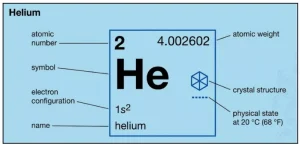 It is a noble gas and is chemically inert, rarely forming compounds with other elements.
- It is naturally a colorless and odorless gas.
- When an electric current passes through it (such as in a gas discharge tube), it glows with a distinct pinkish-orange or bright orange-red light.
- It has the lowest boiling point of any element (-269°C) and remains liquid only at extremely low temperatures.
- It has very low density, making it an ideal lifting gas for balloons and airships.
- Its small atomic size enables it to escape through microscopic leaks, making it useful for leak detection.
- Helium is non-flammable, unlike hydrogen, making it safer for industrial and aerospace applications.
- Helium for commercial use is usually at least 99.997% pure.
Helium Production
- Natural Formation: Helium is produced naturally through the radioactive decay of uranium and thorium within the Earth’s crust.
- The emitted alpha particles capture electrons to form helium atoms, which gradually accumulate in natural gas fields.
- Extraction and Purification: Helium is extracted during natural gas processing when its concentration exceeds about 0.3% by volume.
- It is separated using cryogenic distillation, exploiting its extremely low boiling point.
- Commercial helium generally has a purity of 99.997% or higher.
- Storage and Transportation: Helium is stored as compressed gas or cryogenic liquid.
- Transportation requires specialised vacuum-insulated stainless-steel containers because liquid helium rapidly evaporates at ultra-low temperatures.
Applications
- Healthcare: Helium cools the superconducting magnets used in MRI scanners and other advanced medical equipment.
- Electronics & Emerging Technologies: It is used in semiconductor fabrication, silicon wafer manufacturing, optical fibre production, and quantum computing.
- Space & Defence: Space agencies such as ISRO, NASA and SpaceX use helium to pressurise rocket fuel tanks and support launch operations.
- Industrial & Scientific Uses: Helium is widely used for leak detection, controlled industrial atmospheres, laboratory research, balloons and airships.
- It slips through microscopic cracks and pores that larger gas molecules cannot penetrate.
- Usage in Different Sector: According to the U.S. Geological Survey, laboratory use-cases account for 22% of the demand for helium, followed by controlled atmospheres and semiconductors (17%), lifting gas (17%), MRI scanners (15%), aerospace (9%), and detecting leaks (5%).
Global Production and Trade
- Major Producers: The United States is the largest helium producer, contributing about 43% of global supply (around 81 million cubic metres annually).
- Qatar is the second-largest producer, supplying about 33% (around 63 million cubic metres).
- Major Consumers: The United States and China are the world’s largest helium consumers.
- Despite producing only about 1.6% of global helium, China imports over 80% of its helium requirements, mainly for semiconductor and healthcare industries.
- India’s Position: India is 100% dependent on helium imports, with an annual demand of about 3.4 million cubic metres.
- More than half of India’s helium imports originate from Qatar, exposing the country to geopolitical supply disruptions.
- Small helium traces exist in natural gas fields in West Bengal and Jharkhand, but extraction is presently commercially unviable.
Why is the Helium Supply Chain Expensive?
- Capital-Intensive Purification & Liquefaction: Mid- to large-scale facilities cost over US$100 million, while even smaller plants require around US$10 million.
- Specialised Infrastructure: Processing requires corrosion-resistant alloys capable of operating at ultra-low temperatures.
- Expensive Storage: Developing underground salt caverns, which minimise helium leakage, can cost over US$200 million.
- Compressed gas storage can cost up to US$10 million, while bulk cryogenic liquid storage requires US$0.5–20 million, depending on capacity.
- Specialised Transportation: Helium must be transported in vacuum-jacketed stainless steel vessels, manufactured by only a few companies worldwide.
- Shipments must reach their destination before the vessel’s holding time expires, otherwise helium begins to boil off into the atmosphere.
Click to Explore UPSC Offline Coaching
Conclusion
Helium is a strategic and non-renewable resource whose secure supply is increasingly vital for healthcare, space technology, semiconductors and India’s technological self-reliance.
 13 Jul 2026