UPSC PYQs

Prelims, Mains & Optional PYQs

UPSC Notes

Comprehensive & Short Notes

Election Commission of India: Evolution, Powers and Reforms

12 Oct 2026

Election Commission of India: Evolution, Powers and Reforms

Subject: GS 02: Polity & Governance

Context: Protests and legal challenges over the Special Intensive Revision (SIR) of electoral rolls have renewed debate over the Election Commission of India’s independence, accountability and appointment process, highlighting the significance of its evolution into a three-member body in 1993. 
Best Online Coaching for UPSC

About Election Commission of India

  • Constitutional Framework:
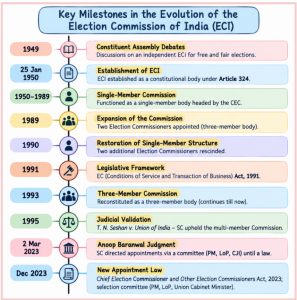
    • Establishment: The Election Commission of India (ECI) was established on 25 January 1950 as a permanent constitutional body. The date is observed as National Voters’ Day.
    • Constitutional Basis: Article 324 vests the ECI with the superintendence, direction and control of elections to Parliament, State Legislatures, and the offices of the President and Vice-President.
    • Composition: Article 324(2) provides for a Chief Election Commissioner (CEC) and such number of other Election Commissioners (ECs) as the President may determine. The ECI initially functioned as a single-member body.
  • Election Commission of IndiaEvolution into a Three-Member Commission:
    • Expansion in 1989: Amid reported differences between the government led by Rajiv Gandhi and then CEC R. V. S. Peri Sastri, a Presidential notification dated 7 October 1989 created two additional posts. S. S. Dhanoa and V. S. Seigell were appointed Election Commissioners.
    • Return to One Member (1990): The government led by V. P. Singh rescinded the notification, restoring the single-member structure. Subsequently, T. N. Seshan became CEC on 12 December 1990.
    • Re-expansion in 1993: Amid reported tensions between Seshan and the government led by P. V. Narasimha Rao, the ECI was reconstituted on 1 October 1993, with M. S. Gill and G. V. G. Krishnamurthy was appointed as Election Commissioners.
    • Legal Framework: An Ordinance amended the Chief Election Commissioner and Election Commissioners (Conditions of Service) Act, 1991 to regulate the Commission’s transaction of business, provide equal decision-making powers to all Commissioners and establish a majority-based decision-making mechanism.
    • Judicial Validation: In T. N. Seshan v. Union of India (1995), a five-judge Bench of the Supreme Court dismissed Seshan’s challenge, upholding the multi-member framework. The ECI has functioned as a three-member body since 1993.
    • 2023: Parliament enacted the Chief Election Commissioner and Other Election Commissioners Act, 2023, providing a statutory framework for appointments and service conditions.
      • Under the 2023 Act, a Search Committee headed by the Union Law Minister prepares a panel of five eligible candidates, followed by a Selection Committee comprising the Prime Minister, Leader of Opposition in the Lok Sabha and a Union Cabinet Minister nominated by the Prime Minister.
    • 23 September 2026: A two-judge Supreme Court Bench delivered a split verdict on challenges to the 2023 Act, leaving the matter for further judicial consideration.

About the Chief Election Commissioner and Election Commissioners (Conditions of Service) Act, 1991:

  • Purpose: Regulates the salary, allowances, tenure and conditions of service of the Chief Election Commissioner (CEC) and Election Commissioners (ECs) under Article 324(5).
  • Key Provisions: Provided for their salary, leave, pension and other service benefits, and protection against disadvantageous changes in service conditions after appointment.
  • Equal Status: The 1994 amendment aligned the CEC’s service conditions with those of a Supreme Court judge and those of other ECs with a High Court judge.
  • Current Status: Repealed and replaced by the Chief Election Commissioner and Other Election Commissioners (Appointment, Conditions of Service and Term of Office) Act, 2023, effective from 2024.

  • Appointment, Tenure and Removal:
    • Appointment: The President appoints the CEC and ECs under Article 324(2) and the Chief Election Commissioner and Other Election Commissioners Act, 2023. 
      • The selection committee comprises the Prime Minister, Leader of Opposition in the Lok Sabha and a Union Cabinet Minister nominated by the Prime Minister.
    • Tenure: Commissioners serve for six years or until attaining 65 years of age, whichever is earlier.
    • Removal: The CEC can be removed in the same manner and on the same grounds as a Supreme Court judge. Other ECs can be removed only on the CEC’s recommendation.
    • Decision-Making: The CEC and other ECs have equal decision-making powers; the majority view prevails in case of disagreement.

Functions and Responsibilities of the ECI

  • Conduct of Elections: The ECI conducts elections to the Lok Sabha, Rajya Sabha, State Legislative Assemblies and Legislative Councils, and the offices of the President and Vice-President.
  • Electoral Rolls: It supervises the preparation and revision of electoral rolls to ensure that eligible citizens can exercise their voting rights.
  • Political Parties and Symbols: It registers political parties under the Representation of the People Act, 1951, and regulates party recognition and election symbols under the applicable legal framework.
  • Model Code of Conduct: It monitors compliance with the Model Code of Conduct and issues directions to prevent the misuse of official machinery and public resources during elections.
  • Disqualification of Legislators: Under Articles 103 and 192, the President or Governor, as applicable, obtains the ECI’s opinion on specified questions concerning the disqualification of Members of Parliament or State Legislatures.
  • Electoral Integrity: It undertakes voter awareness, deploys election observers, monitors expenditure by candidates and political parties, and facilitates grievance redressal during the electoral process.

UPSC Course Fees Online

Contemporary Issues and Challenges

  • Appointment Process: The composition of the selection committee under the 2023 Act has prompted debate over whether the appointment process provides sufficient independence from the executive. A more consultative process could strengthen public confidence.
  • Electoral Roll Revisions: The ongoing debate over SIR has raised questions about the deletion of eligible voters, procedural safeguards, notice requirements and accessible grievance redressal. These are contested issues: the ECI has maintained that its decisions follow the law and established procedures.
  • Transparency and Dissent: Reports of differences within the Commission highlight the importance of recording reasoned decisions, maintaining clear institutional procedures and ensuring that disagreements are resolved transparently.
  • Financial Autonomy: Dependence on budgetary allocations can constrain institutional independence if funding is inadequate or delayed.
  • Enforcement Consistency: Perceived differences in the treatment of political parties and candidates can weaken trust in electoral administration, making consistent and transparent enforcement essential.
  • Technology and Accountability: Digital electoral rolls and software-assisted processes can improve efficiency, but they also require auditability, data security, human oversight and accessible correction mechanisms.

Global Best Practices in Electoral Management

  • Canada: Parliamentary Appointment and Financial Independence. The Chief Electoral Officer of Canada is appointed by a resolution of the House of Commons, serves a 10-year non-renewable term and reports directly to Parliament. 
    • Its funding framework combines annual appropriations with statutory spending authority. India could strengthen cross-party participation in appointments and parliamentary scrutiny of electoral expenditure.
  • South Africa: Constitutionally Protected Independence. Section 181 of the South African Constitution expressly requires independent institutions, including the Electoral Commission, to act impartially and prohibits interference in their functioning. 
    • India could reinforce safeguards against institutional interference and strengthen public confidence in electoral administration.
  • Australia: Specialised Electoral Administration. The Australian Electoral Commission combines national leadership with state, territory and divisional offices, supporting localised election administration. 
    • India can further strengthen coordination, training and operational consistency across its extensive electoral machinery.

Way Forward

  • Transparent Appointments: Build wider consultation and transparent selection criteria into the appointment process to enhance institutional credibility.
  • Financial Autonomy: Consider stronger safeguards for timely and adequate funding, alongside transparent reporting and legislative scrutiny of expenditure.
  • Electoral Roll Safeguards: Ensure that voter deletions follow due process, with adequate notice, accessible appeals and effective restoration mechanisms for eligible voters.
  • Institutional Accountability: Establish clear procedures for recording Commissioners’ views, resolving disagreements and publishing reasoned decisions wherever legally appropriate.
  • Technology Governance: Introduce regular independent audits of electoral software, transparent documentation of changes and human review of consequential decisions.
  • International Cooperation: Use platforms such as the Association of World Election Bodies (A-WEB) to exchange best practices on electoral integrity, voter education, technology and institutional independence.

Click to Know UPSC Coaching Centres in India

Conclusion

The ECI’s transition to a three-member body in 1993 institutionalised collective decision-making, while its credibility depends on transparent appointments, financial autonomy, procedural fairness and impartial enforcement, supported by global best practices and constitutional safeguards.

News Source: Indian Express

Check Out UPSC CSE Books

Visit PW Store

online store 1

Election Commission of India: Evolution, Powers and Reforms

Need help preparing for UPSC or State PSCs?

Connect with our experts to get free counselling & start preparing

Free Counselling for UPSC Aspirants

Connect with our experts and take the right next step.

Expert Guidance
Personalized Strategy
100% Free

Book Your Free Session

NEED ASSISTANCE?

Request a Callback

Our counsellor will connect with you and help you choose the right course and centre.

  • Expert Guidance
  • Course & Fee Information
  • Quick Callback Support

Request a Callback

Books
UPSC PYQs
UPSC Notes
Current Affairs
Quick Revise Now !
AVAILABLE FOR DOWNLOAD SOON
UDAAN PRELIMS WALLAH
Comprehensive coverage with a concise format
Integration of PYQ within the booklet
Designed as per recent trends of Prelims questions
हिंदी में भी उपलब्ध
Quick Revise Now !
UDAAN PRELIMS WALLAH
Comprehensive coverage with a concise format
Integration of PYQ within the booklet
Designed as per recent trends of Prelims questions
हिंदी में भी उपलब्ध

<div class="new-fform">


    </div>

    Subscribe our Newsletter
    Sign up now for our exclusive newsletter and be the first to know about our latest Initiatives, Quality Content, and much more.
    *Promise! We won't spam you.
    Yes! I want to Subscribe.